Department of Neurology, Laboratory for Gait Analysis & Neurodynamics, Movement Disorders Unit, Tel Aviv Sourasky Medical Center, 6 Weizmann Street, Tel Aviv 64239, Israel.
BMC Neurol. 2013 Feb 6;13:15. doi: 10.1186/1471-2377-13-15.
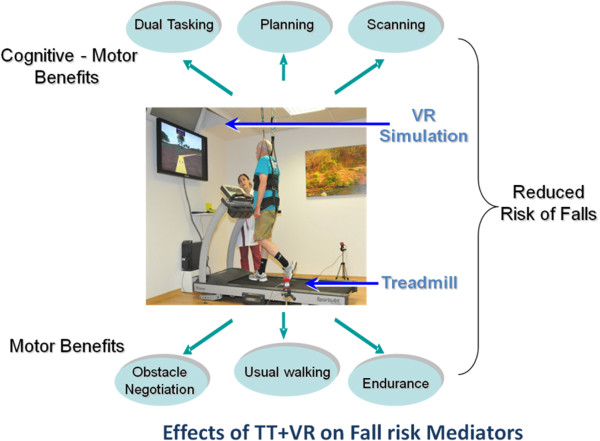
Recent work has demonstrated that fall risk can be attributed to cognitive as well as motor deficits. Indeed, everyday walking in complex environments utilizes executive function, dual tasking, planning and scanning, all while walking forward. Pilot studies suggest that a multi-modal intervention that combines treadmill training to target motor function and a virtual reality obstacle course to address the cognitive components of fall risk may be used to successfully address the motor-cognitive interactions that are fundamental for fall risk reduction. The proposed randomized controlled trial will evaluate the effects of treadmill training augmented with virtual reality on fall risk.
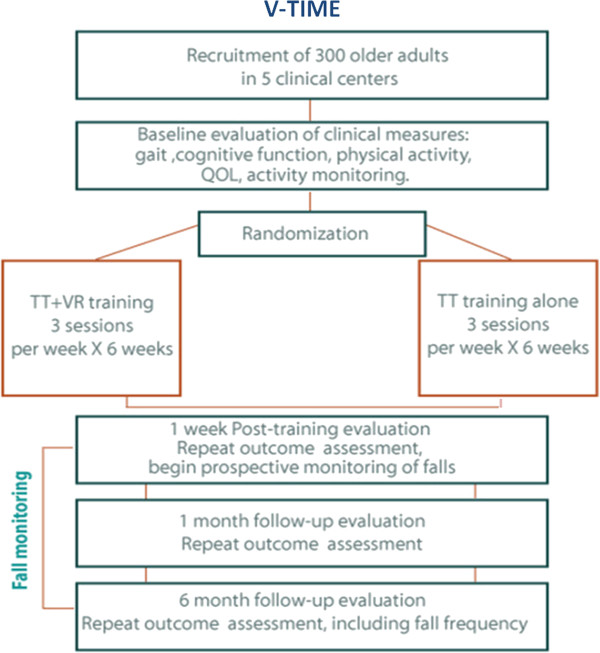
METHODS/DESIGN: Three hundred older adults with a history of falls will be recruited to participate in this study. This will include older adults (n=100), patients with mild cognitive impairment (n=100), and patients with Parkinson's disease (n=100). These three sub-groups will be recruited in order to evaluate the effects of the intervention in people with a range of motor and cognitive deficits. Subjects will be randomly assigned to the intervention group (treadmill training with virtual reality) or to the active-control group (treadmill training without virtual reality). Each person will participate in a training program set in an outpatient setting 3 times per week for 6 weeks. Assessments will take place before, after, and 1 month and 6 months after the completion of the training. A falls calendar will be kept by each participant for 6 months after completing the training to assess fall incidence (i.e., the number of falls, multiple falls and falls rate). In addition, we will measure gait under usual and dual task conditions, balance, community mobility, health related quality of life, user satisfaction and cognitive function.
This randomized controlled trial will demonstrate the extent to which an intervention that combines treadmill training augmented by virtual reality reduces fall risk, improves mobility and enhances cognitive function in a diverse group of older adults. In addition, the comparison to an active control group that undergoes treadmill training without virtual reality will provide evidence as to the added value of addressing motor cognitive interactions as an integrated unit.
(NIH)-NCT01732653.
最近的研究表明,跌倒风险可归因于认知和运动缺陷。事实上,在复杂环境中日常行走需要运用执行功能、双重任务处理、计划和扫描,同时还要向前行走。初步研究表明,一种多模式干预措施,将跑步机训练与针对运动功能的虚拟实境障碍课程相结合,以解决跌倒风险的认知成分,可能用于成功解决降低跌倒风险的运动认知相互作用。拟议的随机对照试验将评估跑步机训练与虚拟现实相结合对跌倒风险的影响。
方法/设计:将招募 300 名有跌倒史的老年人参加这项研究。这将包括老年人(n=100)、轻度认知障碍患者(n=100)和帕金森病患者(n=100)。这三个亚组将被招募,以评估该干预措施在具有不同运动和认知缺陷的人群中的效果。受试者将被随机分配到干预组(跑步机训练与虚拟现实)或活动对照组(跑步机训练无虚拟现实)。每个人都将在门诊环境中每周 3 次参加 6 周的训练计划。评估将在训练前、训练后 1 个月和 6 个月进行。每位参与者在完成训练后 6 个月内将保留一份跌倒日历,以评估跌倒发生率(即跌倒次数、多次跌倒和跌倒率)。此外,我们将测量通常和双重任务条件下的步态、平衡、社区流动性、健康相关生活质量、用户满意度和认知功能。
这项随机对照试验将证明,跑步机训练与虚拟现实相结合的干预措施在不同的老年人中降低跌倒风险、提高移动能力和增强认知功能的程度。此外,与接受无虚拟现实跑步机训练的活动对照组相比,该研究将提供证据,证明将运动认知相互作用作为一个综合单元来处理具有附加价值。
(NIH)-NCT01732653。