Yong Loo Lin School of Medicine, National University of Singapore, Singapore, Singapore.
Department of Neurology, Singapore General Hospital Campus, National Neuroscience Institute, Singapore, Singapore.
Ann Clin Transl Neurol. 2024 Oct;11(10):2548-2562. doi: 10.1002/acn3.52160. Epub 2024 Sep 5.
Novel technology-based interventions have the potential to improve motor symptoms and gait in Parkinson's disease (PD). Promising treatments include virtual-reality (VR) training, robotic assistance, and biofeedback. Their effectiveness remains unclear, and thus, we conducted a Bayesian network meta-analysis.
We searched the Medline, Embase, Cochrane CENTRAL, and Clinicaltrials.gov databases until 2 April 2024 and only included randomized controlled trials. Outcomes included changes in UPDRS-III/MDS-UPDRS-III score, stride length, 10-meter walk test (10MWT), timed up-and-go (TUG) test, balance scale scores and quality-of-life (QoL) scores. Results were reported as mean differences (MD) or standardized mean differences (SMD), with 95% credible intervals (95% CrI).
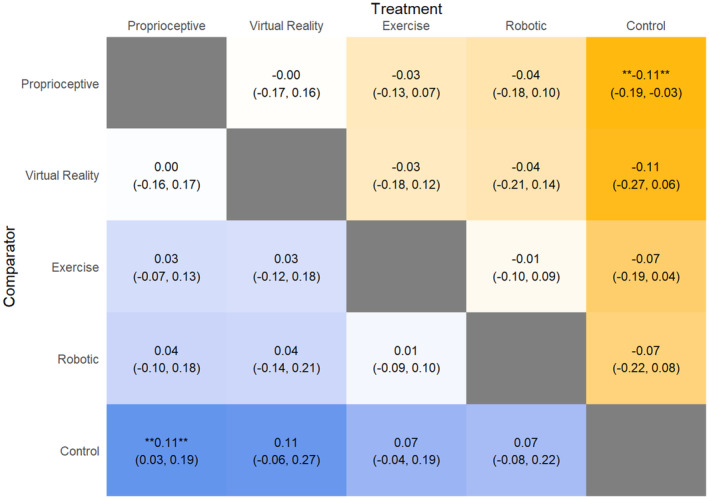
Fifty-one randomized controlled trials with 2095 patients were included. For UPDRS (motor outcome), all interventions had similar efficacies. VR intervention was the most effective in improving TUG compared with control (MD: -4.36, 95% CrI: -8.57, -0.35), outperforming robotic, exercise, and proprioceptive interventions. Proprioceptive intervention significantly improved stride length compared to control intervention (MD: 0.11 m, 95% CrI: 0.03, 0.19), outperforming VR, robotic and exercise interventions. Virtual reality improved balance scale scores significantly compared to exercise intervention (SMD: 0.75, 95% CrI: 0.12, 1.39) and control intervention (SMD: 1.42, 95% CrI: 0.06, 2.77). Virtual reality intervention significantly improved QoL scores compared to control intervention (SMD: -0.95, 95% CrI: -1.43, -0.52), outperforming Internet-based interventions.
VR-based and proprioceptive interventions were the most promising interventions, consistently ranking as the top treatment choices for most outcomes. Their use in clinical practice could be helpful in managing motor symptoms and QoL in PD.
基于新技术的干预措施有可能改善帕金森病(PD)的运动症状和步态。有前途的治疗方法包括虚拟现实(VR)训练、机器人辅助和生物反馈。它们的效果尚不清楚,因此,我们进行了贝叶斯网络荟萃分析。
我们检索了 Medline、Embase、Cochrane 中心、Clinicaltrials.gov 数据库,检索时间截至 2024 年 4 月 2 日,仅纳入随机对照试验。结果包括 UPDRS-III/MDS-UPDRS-III 评分、步长、10 米步行测试(10MWT)、计时起立和行走测试(TUG)、平衡量表评分和生活质量(QoL)评分的变化。结果以均值差(MD)或标准化均值差(SMD)表示,置信区间为 95%(95%CrI)。
纳入了 51 项随机对照试验,共 2095 名患者。对于 UPDRS(运动结果),所有干预措施的疗效相似。与对照组相比,VR 干预在 TUG 中最有效(MD:-4.36,95%CrI:-8.57,-0.35),优于机器人、运动和本体感觉干预。本体感觉干预与对照组相比显著改善步长(MD:0.11m,95%CrI:0.03,0.19),优于 VR、机器人和运动干预。与运动干预相比,VR 显著改善平衡量表评分(SMD:0.75,95%CrI:0.12,1.39)和对照组(SMD:1.42,95%CrI:0.06,2.77)。与对照组相比,VR 干预显著改善 QoL 评分(SMD:-0.95,95%CrI:-1.43,-0.52),优于基于互联网的干预。
基于 VR 和本体感觉的干预措施是最有前途的干预措施,在大多数结果中始终被评为最佳治疗选择。它们在临床实践中的应用有助于管理 PD 患者的运动症状和 QoL。