Department of Biomedical Informatics, The Ohio State University, Columbus, OH, USA.
BMC Med Inform Decis Mak. 2013 Feb 6;13:20. doi: 10.1186/1472-6947-13-20.
In recent years, there have been numerous initiatives undertaken to describe critical information needs related to the collection, management, analysis, and dissemination of data in support of biomedical research (J Investig Med 54:327-333, 2006); (J Am Med Inform Assoc 16:316-327, 2009); (Physiol Genomics 39:131-140, 2009); (J Am Med Inform Assoc 18:354-357, 2011). A common theme spanning such reports has been the importance of understanding and optimizing people, organizational, and leadership factors in order to achieve the promise of efficient and timely research (J Am Med Inform Assoc 15:283-289, 2008). With the emergence of clinical and translational science (CTS) as a national priority in the United States, and the corresponding growth in the scale and scope of CTS research programs, the acuity of such information needs continues to increase (JAMA 289:1278-1287, 2003); (N Engl J Med 353:1621-1623, 2005); (Sci Transl Med 3:90, 2011). At the same time, systematic evaluations of optimal people, organizational, and leadership factors that influence the provision of data, information, and knowledge management technologies and methods are notably lacking.
In response to the preceding gap in knowledge, we have conducted both: 1) a structured survey of domain experts at Academic Health Centers (AHCs); and 2) a subsequent thematic analysis of public-domain documentation provided by those same organizations. The results of these approaches were then used to identify critical factors that may influence access to informatics expertise and resources relevant to the CTS domain.
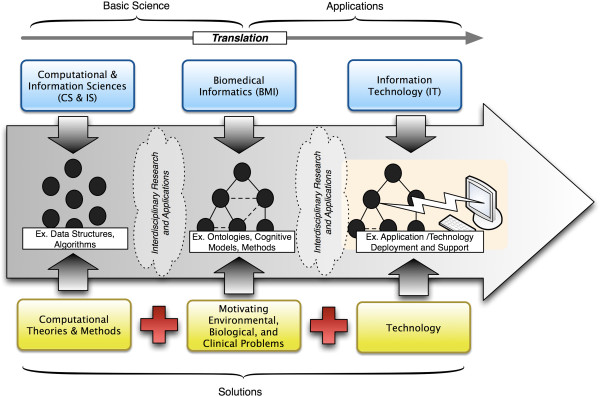
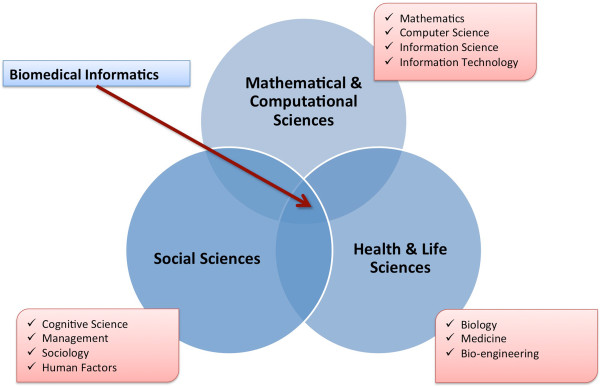
A total of 31 domain experts, spanning the Biomedical Informatics (BMI), Computer Science (CS), Information Science (IS), and Information Technology (IT) disciplines participated in a structured surveyprocess. At a high level, respondents identified notable differences in theaccess to BMI, CS, and IT expertise and services depending on the establishment of a formal BMI academic unit and the perceived relationship between BMI, CS, IS, and IT leaders. Subsequent thematic analysis of the aforementioned public domain documents demonstrated a discordance between perceived and reported integration across and between BMI, CS, IS, and IT programs and leaders with relevance to the CTS domain.
Differences in people, organization, and leadership factors do influence the effectiveness of CTS programs, particularly with regard to the ability to access and leverage BMI, CS, IS, and IT expertise and resources. Based on this finding, we believe that the development of a better understanding of how optimal BMI, CS, IS, and IT organizational structures and leadership models are designed and implemented is critical to both the advancement of CTS and ultimately, to improvements in the quality, safety, and effectiveness of healthcare.
近年来,已经有许多举措来描述与生物医学研究相关的数据收集、管理、分析和传播的关键信息需求(J Investig Med 54:327-333, 2006); (J Am Med Inform Assoc 16:316-327, 2009); (Physiol Genomics 39:131-140, 2009); (J Am Med Inform Assoc 18:354-357, 2011)。这些报告的一个共同主题是理解和优化人员、组织和领导因素的重要性,以实现高效和及时研究的承诺(J Am Med Inform Assoc 15:283-289, 2008)。随着临床和转化科学(CTS)作为美国的国家优先事项的出现,以及 CTS 研究计划规模和范围的相应增长,这种信息需求的紧迫性继续增加(JAMA 289:1278-1287, 2003); (N Engl J Med 353:1621-1623, 2005); (Sci Transl Med 3:90, 2011)。与此同时,对影响数据、信息和知识管理技术和方法提供的最佳人员、组织和领导因素的系统评估明显缺乏。
为了应对知识方面的这一差距,我们进行了以下两项工作:1)对学术健康中心(AHC)的领域专家进行了结构化调查;2)对这些组织提供的公共领域文件进行了后续主题分析。然后,这些方法的结果被用来确定可能影响 CTS 领域获取相关信息学专业知识和资源的关键因素。
共有 31 名领域专家参与了一项结构化调查,涵盖了生物医学信息学(BMI)、计算机科学(CS)、信息科学(IS)和信息技术(IT)领域。在较高的层面上,受访者根据是否建立了正式的 BMI 学术单位以及 BMI、CS、IS 和 IT 领导者之间的感知关系,确定了对 BMI、CS 和 IT 专业知识和服务的不同获取方式。对上述公共领域文件的后续主题分析表明,BMI、CS、IS 和 IT 计划和领导者之间以及与之相关的感知和报告的整合存在差异。
人员、组织和领导因素的差异确实会影响 CTS 计划的有效性,特别是在获取和利用 BMI、CS、IS 和 IT 专业知识和资源方面。基于这一发现,我们认为,更好地了解如何设计和实施最佳的 BMI、CS、IS 和 IT 组织结构和领导模式,对于 CTS 的发展以及最终提高医疗保健的质量、安全性和有效性至关重要。