Soybean Genomics and Improvement Laboratory, United States Department of Agriculture, Agricultural Research Service, 10300 Baltimore Ave, Bldg 006, Beltsville, MD 20705, USA.
Planta. 2013 May;237(5):1337-57. doi: 10.1007/s00425-013-1840-1. Epub 2013 Feb 7.
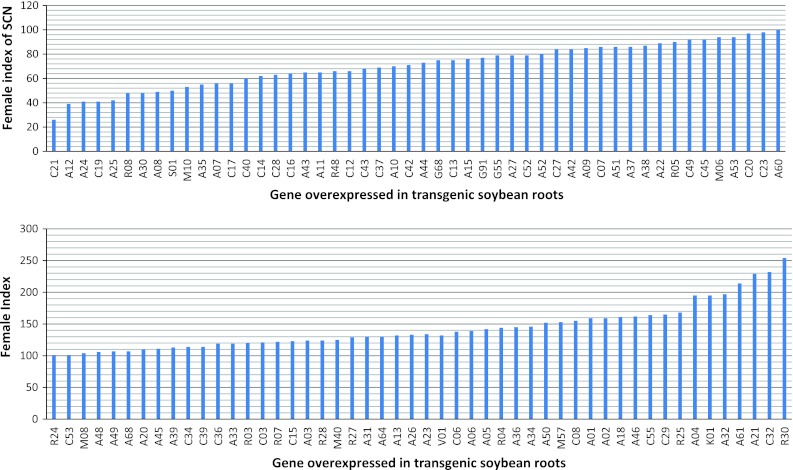
During pathogen attack, the host plant induces genes to ward off the pathogen while the pathogen often produces effector proteins to increase susceptibility of the host. Gene expression studies of syncytia formed in soybean root by soybean cyst nematode (Heterodera glycines) identified many genes altered in expression in resistant and susceptible roots. However, it is difficult to assess the role and impact of these genes on resistance using gene expression patterns alone. We selected 100 soybean genes from published microarray studies and individually overexpressed them in soybean roots to determine their impact on cyst nematode development. Nine genes reduced the number of mature females by more than 50 % when overexpressed, including genes encoding ascorbate peroxidase, β-1,4-endoglucanase, short chain dehydrogenase, lipase, DREPP membrane protein, calmodulin, and three proteins of unknown function. One gene encoding a serine hydroxymethyltransferase decreased the number of mature cyst nematode females by 45 % and is located at the Rhg4 locus. Four genes increased the number of mature cyst nematode females by more than 200 %, while thirteen others increased the number of mature cyst nematode females by more than 150 %. Our data support a role for auxin and ethylene in susceptibility of soybean to cyst nematodes. These studies highlight the contrasting gene sets induced by host and nematode during infection and provide new insights into the interactions between host and pathogen at the molecular level. Overexpression of some of these genes result in a greater decrease in the number of cysts formed than recognized soybean cyst nematode resistance loci.
在病原体攻击时,宿主植物会诱导基因来抵御病原体,而病原体则常常会产生效应蛋白来增加宿主的易感性。通过对大豆胞囊线虫(Heterodera glycines)在大豆根部形成的合胞体进行基因表达研究,鉴定出了许多在抗性和敏感根中表达发生改变的基因。然而,仅通过基因表达模式来评估这些基因对抗性的作用和影响是很困难的。我们从已发表的微阵列研究中选择了 100 个大豆基因,并在大豆根部单独过表达它们,以确定它们对胞囊线虫发育的影响。当过表达时,有 9 个基因使成熟雌性的数量减少了 50%以上,包括编码抗坏血酸过氧化物酶、β-1,4-内切葡聚糖酶、短链脱氢酶、脂肪酶、DREPP 膜蛋白、钙调蛋白和 3 个未知功能蛋白的基因。一个编码丝氨酸羟甲基转移酶的基因使成熟胞囊线虫雌性数量减少了 45%,该基因位于 Rhg4 基因座上。有 4 个基因使成熟胞囊线虫雌性数量增加了 200%以上,而另外 13 个基因使成熟胞囊线虫雌性数量增加了 150%以上。我们的数据支持生长素和乙烯在大豆对胞囊线虫易感性中的作用。这些研究突出了宿主和线虫在感染过程中诱导的截然不同的基因集,并为宿主和病原体在分子水平上的相互作用提供了新的见解。这些基因中的一些过表达会导致形成的胞囊数量比公认的大豆胞囊线虫抗性基因座减少得更多。