Perbal-Hatif Séverine
Cognitive Neuroscience and Cerebral Imaging Unit, Hôpital de la Salpêtrière, Paris, France.
Dialogues Clin Neurosci. 2012 Dec;14(4):425-32. doi: 10.31887/DCNS.2012.14.4/sphatif.
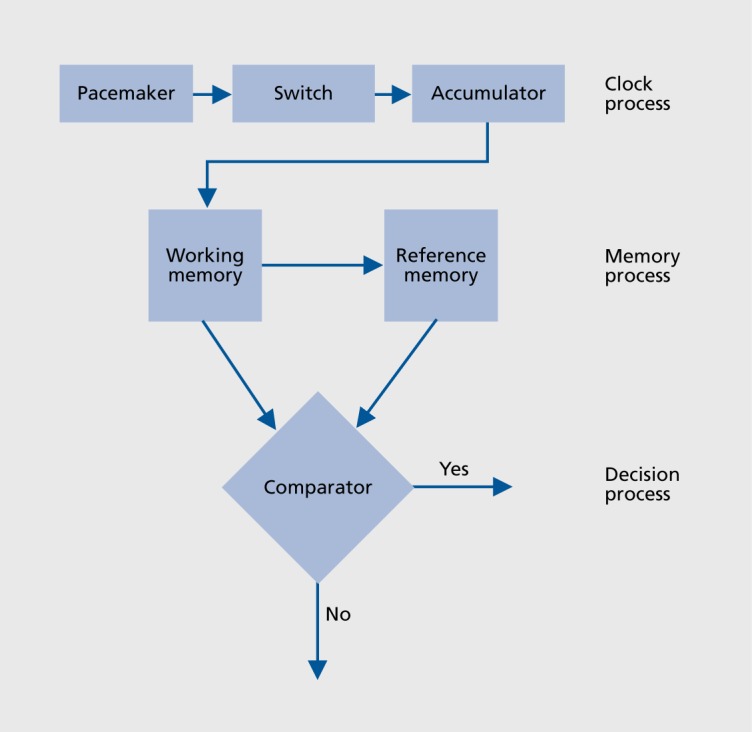
Time estimation, within a range of seconds, involves cognitive functions which depend on multiple brain regions. Here we report on studies investigating the reproduction and production of three durations (5, 14, and 38 seconds) in four groups of patients. The amnesic patient underproduced the length of the long durations because of episodic memory deficit following bilateral medial temporal lesions. Epileptic patients (n = 9) with right medial temporal lobe resections underproduced the three durations because of a distorted representation of time in long-term memory. Traumatic brain injury patients (n = 15) made more variable duration productions and reproductions because of working memory deficits following frontal-lobe dysfunction. Patients with Parkinson's disease (n = 18) overproduced the short duration and underproduced the long duration because of a possible increase in internal clock speed following levodopa treatment, as well as working memory deficits associated with frontal-lobe damage. Further research, in neurological and psychiatric patients, is required to better understand the underlying mechanisms of time estimation.
在数秒范围内的时间估计涉及依赖多个脑区的认知功能。在此,我们报告了针对四组患者对三种时长(5秒、14秒和38秒)进行复制和生成的研究。遗忘症患者由于双侧内侧颞叶损伤后的情景记忆缺陷,对长时程的时长复制不足。右侧内侧颞叶切除术的癫痫患者(n = 9)由于长期记忆中时间表征的扭曲,对这三种时长的复制均不足。创伤性脑损伤患者(n = 15)由于额叶功能障碍后的工作记忆缺陷,在时长生成和复制方面表现出更大的变异性。帕金森病患者(n = 18)由于左旋多巴治疗后内部时钟速度可能增加,以及与额叶损伤相关的工作记忆缺陷,对短时长复制过度而对长时长复制不足。需要对神经科和精神科患者进行进一步研究,以更好地理解时间估计的潜在机制。