Department of Medicine, Graduate School, University of Ulsan College of Medicine, Seoul 138-736, Korea.
Immune Netw. 2012 Dec;12(6):240-6. doi: 10.4110/in.2012.12.6.240. Epub 2012 Dec 31.
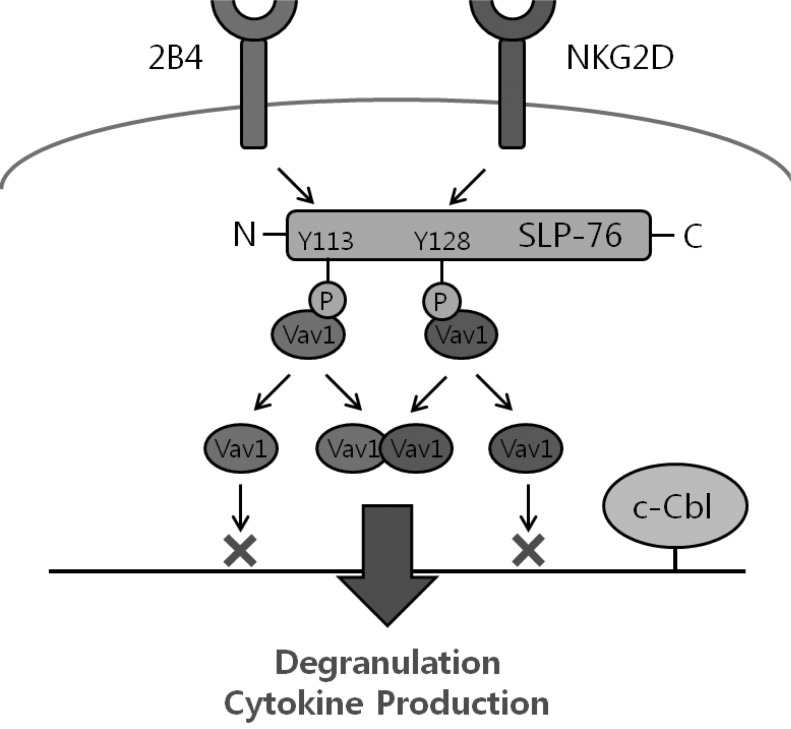
Natural killer (NK) cells play a pivotal role in early surveillance against virus infection and cellular transformation, and are also implicated in the control of inflammatory response through their effector functions of direct lysis of target cells and cytokine secretion. NK cell activation toward target cell is determined by the net balance of signals transmitted from diverse activating and inhibitory receptors. A distinct feature of NK cell activation is that stimulation of resting NK cells with single activating receptor on its own cannot mount natural cytotoxicity. Instead, specific pairs of co-activation receptors are required to unleash NK cell activation via synergy-dependent mechanism. Because each co-activation receptor uses distinct signaling modules, NK cell synergy relies on the integration of such disparate signals. This explains why the study of the mechanism underlying NK cell synergy is important and necessary. Recent studies revealed that NK cell synergy depends on the integration of complementary signals converged at a critical checkpoint element but not on simple amplification of the individual signaling to overcome intrinsic activation threshold. This review focuses on the signaling events during NK cells activation and recent advances in the study of NK cell synergy.
自然杀伤 (NK) 细胞在早期针对病毒感染和细胞转化的监测中发挥着关键作用,它们通过直接溶解靶细胞和细胞因子分泌的效应功能,也参与了对炎症反应的控制。NK 细胞对靶细胞的激活取决于来自不同激活和抑制受体的信号传递的净平衡。NK 细胞激活的一个显著特征是,仅用单个激活受体刺激静止的 NK 细胞本身并不能引发自然细胞毒性。相反,需要特定的共激活受体对通过协同依赖机制来释放 NK 细胞的激活。由于每个共激活受体使用不同的信号模块,因此 NK 细胞协同依赖于这种不同信号的整合。这解释了为什么研究 NK 细胞协同的机制是重要和必要的。最近的研究表明,NK 细胞协同依赖于在关键检查点元件处汇聚的互补信号的整合,而不是通过简单放大单个信号来克服内在激活阈值。本综述重点介绍了 NK 细胞激活过程中的信号事件,以及 NK 细胞协同研究的最新进展。