Department of Anesthesiology and Intensive Care, CHU Toulouse, Université Toulouse III Paul Sabatier, Faculté de Médecine Toulouse-Rangueil, EA 4564-MATN, Institut Louis Bugnard (IFR 150), c, F-31000, France.
Ann Intensive Care. 2013 Feb 12;3(1):3. doi: 10.1186/2110-5820-3-3.
This study was design to investigate the prognostic value for death at day-28 of lactate course and lactate clearance during the first 24 hours in Intensive Care Unit (ICU), after initial resuscitation.
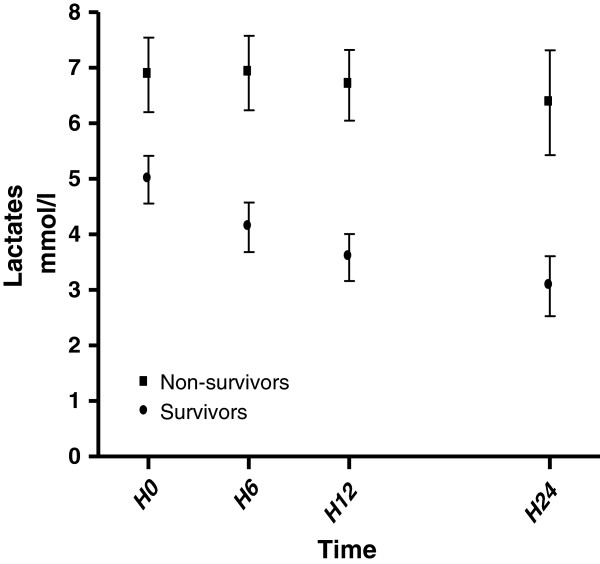
Prospective, observational study in one surgical ICU in a university hospital. Ninety-four patients hospitalized in the ICU for severe sepsis or septic shock were included. In this septic cohort, we measured blood lactate concentration at ICU admission (H0) and at H6, H12, and H24. Lactate clearance was calculated as followed: [(lactateinitial - lactatedelayed)/ lactateinitial] x 100%].
The mean time between severe sepsis diagnosis and H0 (ICU admission) was 8.0 ± 4.5 hours. Forty-two (45%) patients died at day 28. Lactate clearance was higher in survivors than in nonsurvivors patients for H0-H6 period (13 ± 38% and -13 ± 7% respectively, p = 0.021) and for the H0-H24 period (42 ± 33% and -17 ± 76% respectively, p < 0.001). The best predictor of death at day 28 was lactate clearance for the H0-H24 period (AUC = 0.791; 95% CI 0.6-0.85). Logistic regression found that H0-H24 lactate clearance was independently correlated to a survival status with a p = 0.047 [odds ratio = 0.35 (95% CI 0.01-0.76)].
During the first 24 hr in the ICU, lactate clearance was the best parameter associated with 28-day mortality rate in septic patients. Protocol of lactate clearance-directed therapy should be considered in septic patients, even after the golden hours.
本研究旨在探讨重症监护病房(ICU)初始复苏后 24 小时内乳酸水平和乳酸清除率对第 28 天死亡率的预测价值。
这是一项在一所大学医院的外科 ICU 进行的前瞻性、观察性研究。共纳入 94 例因严重脓毒症或感染性休克住院的 ICU 患者。在该脓毒症队列中,我们测量了 ICU 入院时(H0)和 H6、H12 和 H24 时的血乳酸浓度。乳酸清除率的计算方法如下:[(初始乳酸-延迟乳酸)/初始乳酸]x100%]。
严重脓毒症诊断与 H0(ICU 入院)之间的平均时间为 8.0±4.5 小时。42 例(45%)患者在第 28 天死亡。存活患者的乳酸清除率高于非存活患者,在 H0-H6 期间(分别为 13±38%和-13±7%,p=0.021)和 H0-H24 期间(分别为 42±33%和-17±76%,p<0.001)。H0-H24 期间的乳酸清除率是预测第 28 天死亡的最佳指标(AUC=0.791;95%CI 0.6-0.85)。逻辑回归发现,H0-H24 乳酸清除率与存活状态独立相关,p=0.047[优势比=0.35(95%CI 0.01-0.76)]。
在 ICU 的最初 24 小时内,乳酸清除率是与脓毒症患者 28 天死亡率相关的最佳参数。即使在黄金时间过后,也应考虑对脓毒症患者进行乳酸清除率导向治疗的方案。