Giblin Frank J, David Larry L, Wilmarth Phillip A, Leverenz Victor R, Simpanya M Francis
Eye Research Institute, Oakland University, Rochester, MI 48309, USA.
Mol Vis. 2013;19:267-80. Epub 2013 Feb 3.
To compare levels of S-glutathiolation and S-cysteinylation occurring at more than 60 cysteine residues of 12 different guinea pig lens water-soluble nuclear crystallins following treatment of the animals with hyperbaric oxygen (HBO).
Guinea pigs (initially 18 months old) were treated 30X (3X per week for 10 weeks) with HBO (2.5 atm 100% O(2) for 2.5 h) as a model to study the formation of nuclear cataract. This treatment produces a moderate increase in lens nuclear light scatter (compared to denser scatter occurring after 80 HBO treatments), with five- to sixfold increases in levels of protein-bound glutathione (PSSG) and protein-bound cysteine (PSSC). Trypsin digests of lens nuclear water-soluble proteins were analyzed with two-dimensional liquid chromatography and mass spectrometry to identify specific cysteine residues binding either glutathione or cysteine. Lens nuclei of age-matched untreated animals were used as controls.
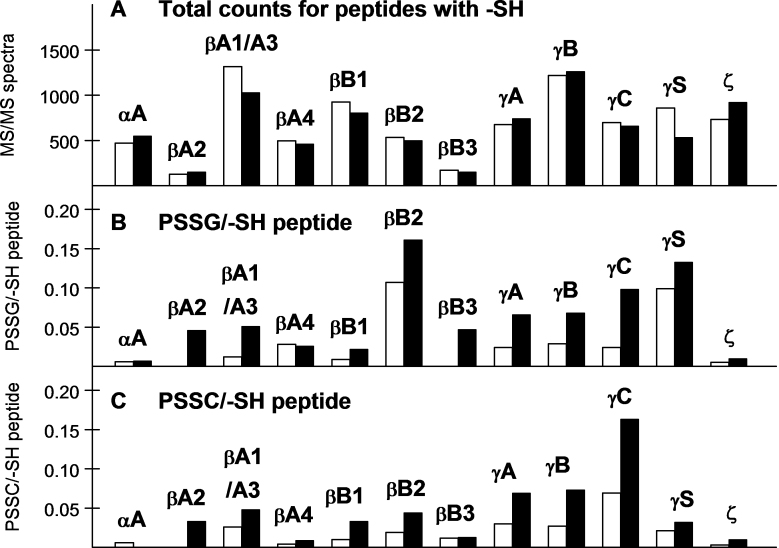
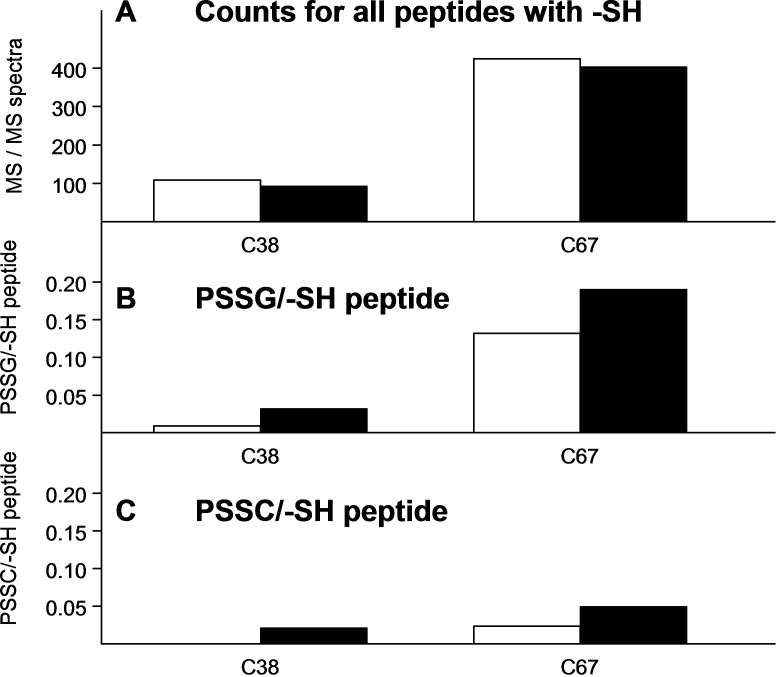
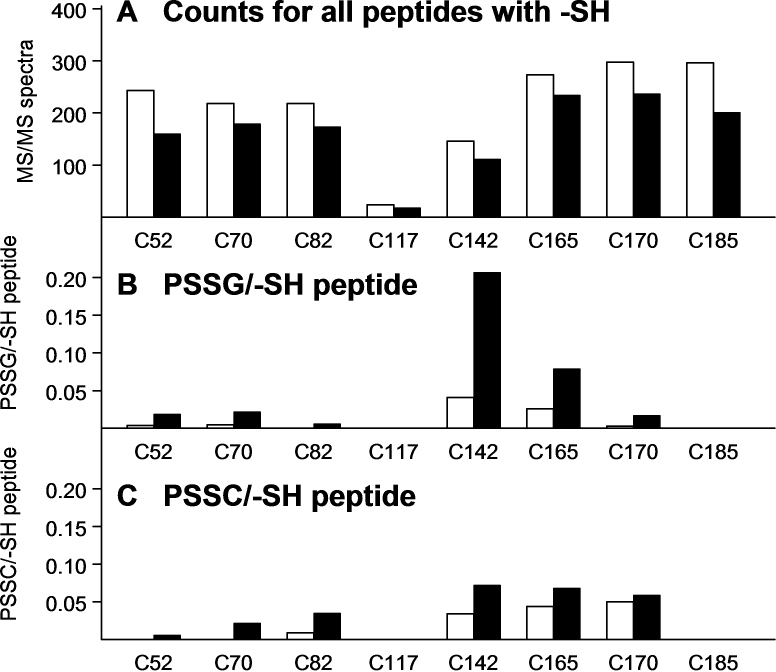
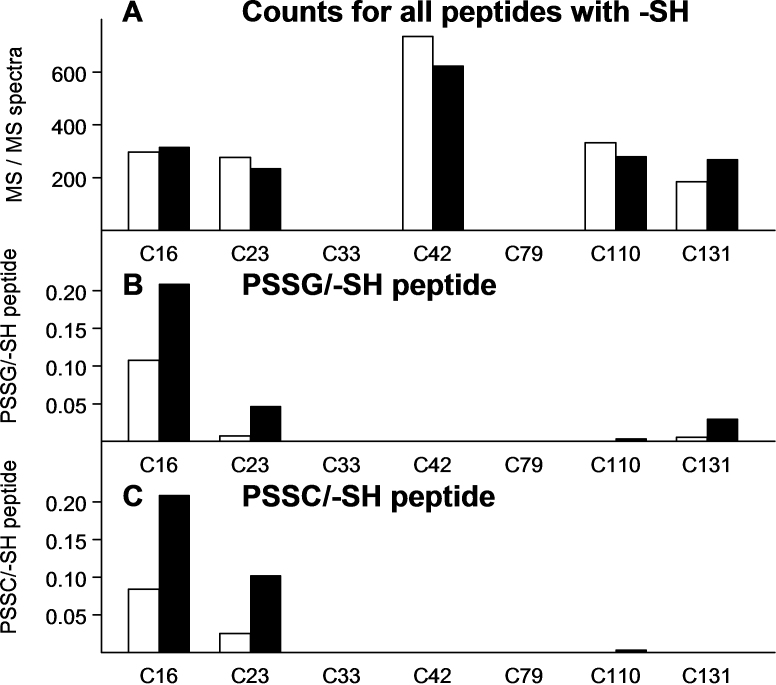
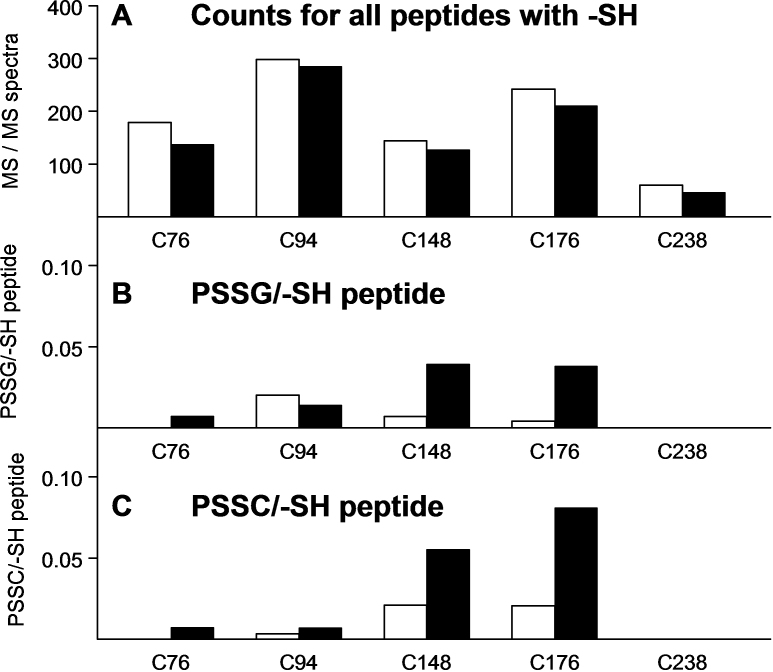
All major crystallins, except αB, were modified to some extent by either S-glutathiolation or S-cysteinylation. Overall, 72% of the cysteine residues of guinea pig lens nuclear crystallins were shown to be capable of binding glutathione, cysteine, or both molecules. The crystallin with the highest level of modification was βA1/A3 (six of eight -SH groups), and that with the lowest (two of five -SH groups) was βA2. O(2)-induced increases in PSSG levels were 2.8, 2.4, and 4.1 times control for γA-, γB-, and γC-crystallins, respectively. Comparable increases in PSSC levels for the three γ-crystallins were 2.3, 2.7, and 2.4 times control, respectively. βB2-crystallin showed the highest amount of O(2)-induced PSSG formation of any of the crystallins, as well as a substantial level of control PSSG, and nearly all of this was due to a single residue, C67, a site also present in human βB2-crystallin. Overall, 32 of the 44 modified cysteine residues were homologous with the human.
This large-scale study successfully identified lens crystallin cysteine residues that bound glutathione and/or cysteine under normal or oxidative stress conditions. The high percentage of protein -SH groups that are modified by S-thiolation in the guinea pig lens nucleus demonstrates the substantial protein sulfhydryl redox buffer capability present in the center of the lens. The results suggest that PSSG and PSSC formation may act to delay O(2)-induced insolubilization of γA-, γB-, and γC-crystallins, and β-crystallins, but with a greater effect on the γ-crystallins at an early stage of oxidative stress. The study has shown that technological approaches are now available to investigate in considerable detail the role of specific lens -SH groups in nuclear cataractogenesis.
比较用高压氧(HBO)处理动物后,12种不同豚鼠晶状体水溶性核晶状体蛋白中60多个半胱氨酸残基上发生的S-谷胱甘肽化和S-半胱氨酸化水平。
将豚鼠(初始年龄18个月)作为研究核性白内障形成的模型,用HBO(2.5个大气压100%氧气,持续2.5小时)处理30次(每周3次,共10周)。这种处理使晶状体核光散射适度增加(与80次HBO处理后发生的更密集散射相比),蛋白质结合型谷胱甘肽(PSSG)和蛋白质结合型半胱氨酸(PSSC)水平增加5至6倍。用二维液相色谱和质谱分析晶状体核水溶性蛋白的胰蛋白酶消化产物,以鉴定结合谷胱甘肽或半胱氨酸的特定半胱氨酸残基。将年龄匹配的未处理动物的晶状体核用作对照。
除αB外,所有主要晶状体蛋白都在一定程度上被S-谷胱甘肽化或S-半胱氨酸化修饰。总体而言,豚鼠晶状体核晶状体蛋白中72%的半胱氨酸残基显示能够结合谷胱甘肽、半胱氨酸或两者。修饰水平最高的晶状体蛋白是βA1/A3(八个-SH基团中的六个),最低的是βA2(五个-SH基团中的两个)。O₂诱导的PSSG水平增加,γA-、γB-和γC-晶状体蛋白分别是对照的2.8、2.4和