Department of Microbiology and Immunobiology, Harvard Medical School, Division of Neuroscience, New England Primate Research Center, Southborough, Massachusetts 01772, USA.
Nat Commun. 2013;4:1472. doi: 10.1038/ncomms2462.
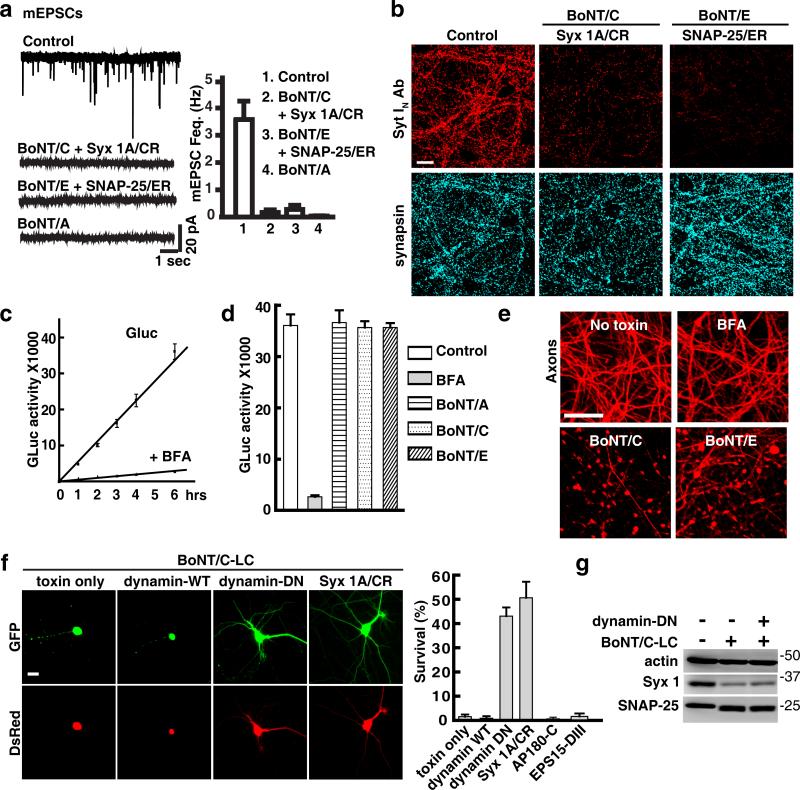
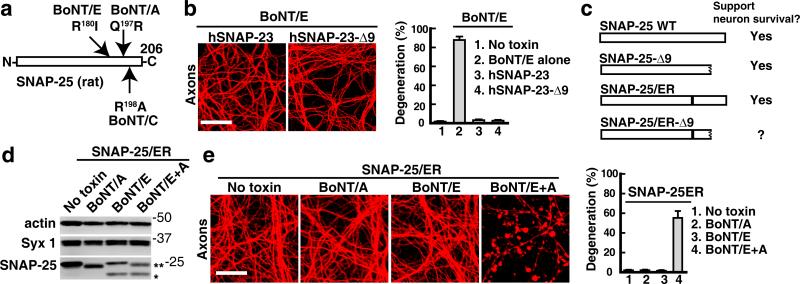
Botulinum neurotoxins (BoNT/A-G) act by blocking synaptic vesicle exocytosis. Whether BoNTs disrupt additional neuronal functions has not been addressed. Here we report that cleavage of syntaxin 1 by BoNT/C, and cleavage of SNAP-25 by BoNT/E both induce degeneration of neurons. Furthermore, although SNAP-25 cleaved by BoNT/A still supports neuron survival, it has reduced capacity to tolerate additional mutations. We demonstrate that syntaxin 1 and SNAP-25 cooperate as SNARE proteins to support neuron survival. Exogenous expression of other homologous SNARE proteins, syntaxin 2/3/4 and SNAP-23, which are resistant to BoNT/C and E in neurons, can substitute syntaxin 1/SNAP-25 and prevent toxin-induced neuron death. Finally, we find that neuronal death is due to blockage of plasma membrane recycling processes that utilize syntaxin 1/SNAP-25, independent of synaptic vesicle exocytosis. These findings establish neuronal cytotoxicity for BoNTs and reveal syntaxin 1/SNAP-25 as the ubiquitous and essential SNARE proteins mediating multiple fusion events on neuronal plasma membranes.
肉毒神经毒素(BoNT/A-G)通过阻断突触小泡胞吐作用发挥作用。BoNTs 是否破坏其他神经元功能尚未得到解决。在这里,我们报告 BoNT/C 对突触融合蛋白 1(syntaxin 1)的切割,以及 BoNT/E 对衔接蛋白 25(SNAP-25)的切割,都诱导神经元变性。此外,尽管 BoNT/A 切割的 SNAP-25 仍能支持神经元存活,但它耐受额外突变的能力降低。我们证明 syntaxin 1 和 SNAP-25 作为 SNARE 蛋白协同作用以支持神经元存活。外源性表达其他同源 SNARE 蛋白,如 syntaxin 2/3/4 和 SNAP-23,它们在神经元中对 BoNT/C 和 E 具有抗性,可以替代 syntaxin 1/SNAP-25,并防止毒素诱导的神经元死亡。最后,我们发现神经元死亡是由于利用 syntaxin 1/SNAP-25 的质膜回收过程受阻所致,与突触小泡胞吐作用无关。这些发现为 BoNTs 的神经毒性建立了基础,并揭示了 syntaxin 1/SNAP-25 作为普遍存在和必需的 SNARE 蛋白,介导神经元质膜上的多种融合事件。