Institut für Epidemiologie, Friedrich-Loeffler-Institut, Wusterhausen, Germany.
PLoS One. 2013;8(2):e55223. doi: 10.1371/journal.pone.0055223. Epub 2013 Feb 6.
Many networks exhibit time-dependent topologies, where an edge only exists during a certain period of time. The first measurements of such networks are very recent so that a profound theoretical understanding is still lacking. In this work, we focus on the propagation properties of infectious diseases in time-dependent networks. In particular, we analyze a dataset containing livestock trade movements. The corresponding networks are known to be a major route for the spread of animal diseases. In this context chronology is crucial. A disease can only spread if the temporal sequence of trade contacts forms a chain of causality. Therefore, the identification of relevant nodes under time-varying network topologies is of great interest for the implementation of counteractions.
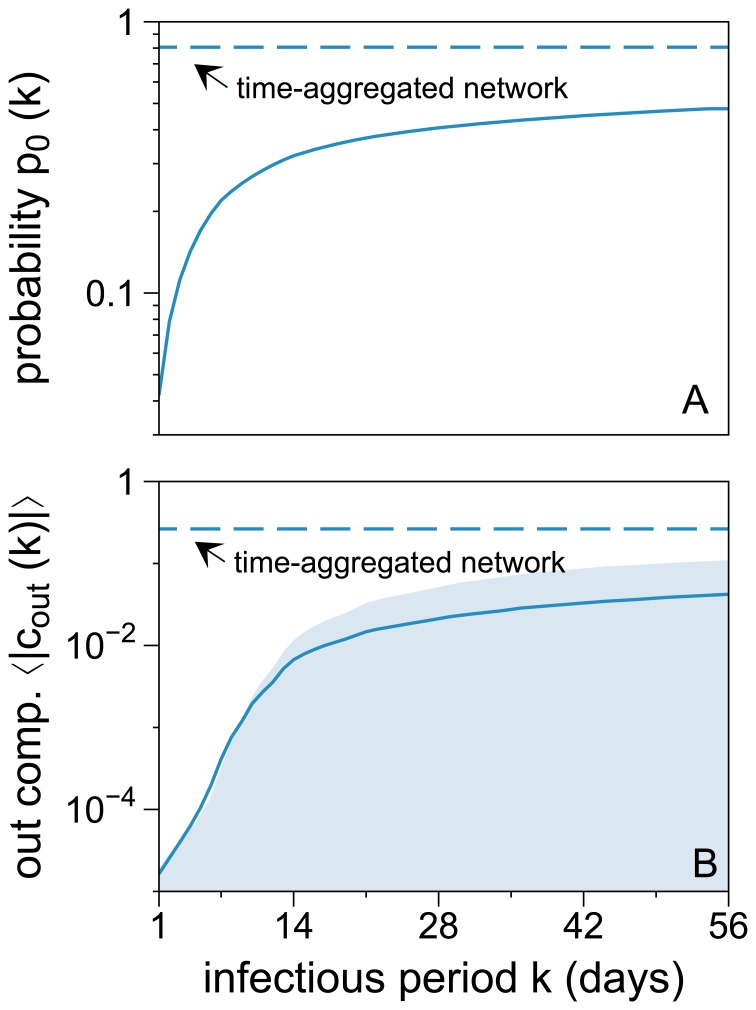
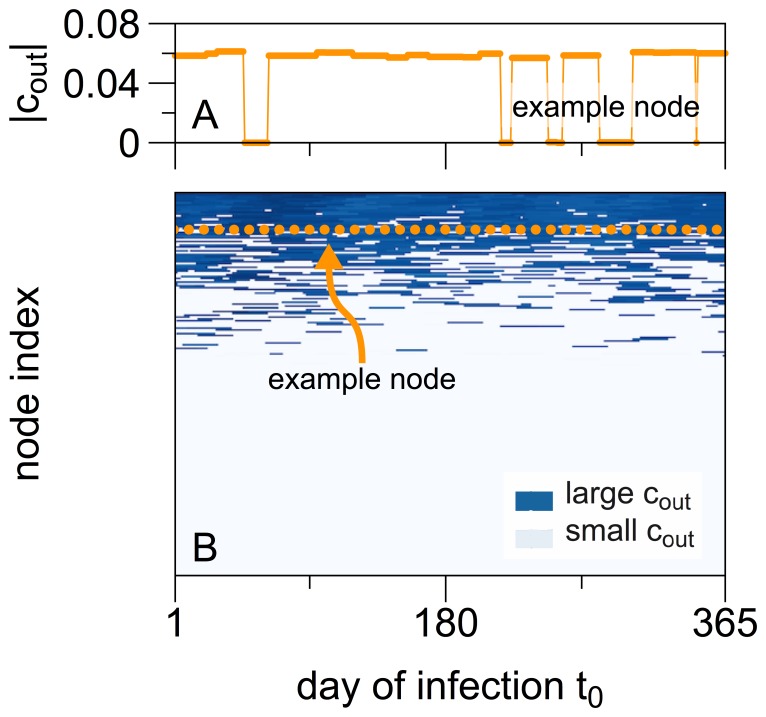
METHODOLOGY/FINDINGS: We find that a time-aggregated approach might fail to identify epidemiologically relevant nodes. Hence, we explore the adaptability of the concept of centrality of nodes to temporal networks using a data-driven approach on the example of animal trade. We utilize the size of the in- and out-component of nodes as centrality measures. Both measures are refined to gain full awareness of the time-dependent topology and finite infectious periods. We show that the size of the components exhibit strong temporal heterogeneities. In particular, we find that the size of the components is overestimated in time-aggregated networks. For disease control, however, a risk assessment independent of time and specific disease properties is usually favored. We therefore explore the disease parameter range, in which a time-independent identification of central nodes remains possible.
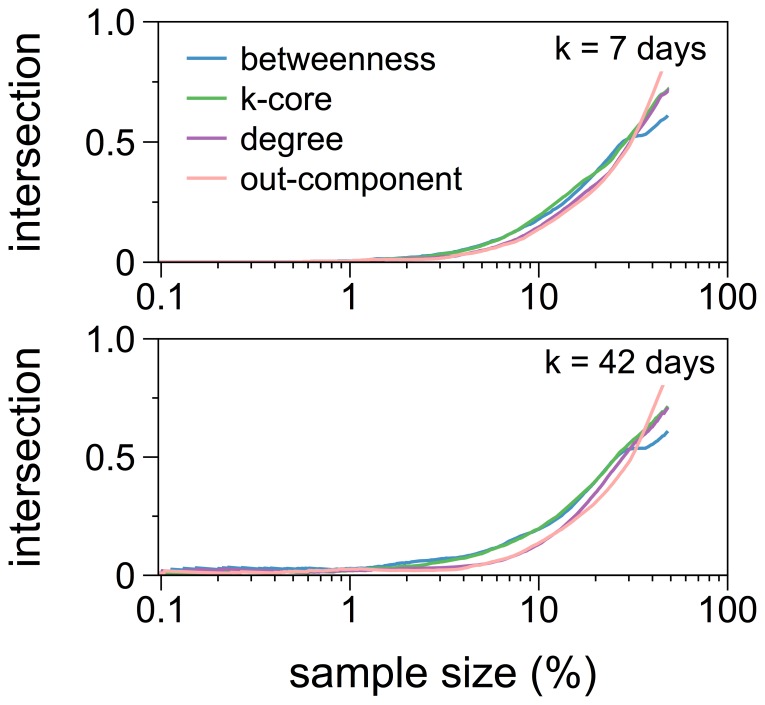
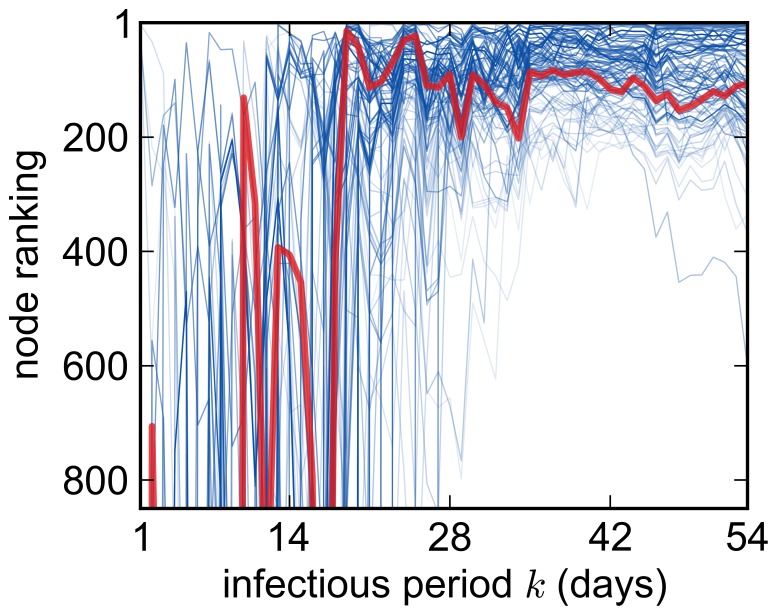
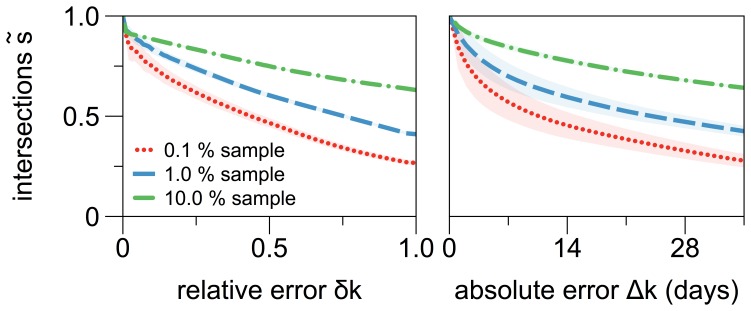
We find a ranking of nodes according to their component sizes reasonably stable for a wide range of infectious periods. Samples based on this ranking are robust enough against varying disease parameters and hence are promising tools for disease control.
许多网络具有时间依赖性拓扑结构,其中只有在特定时间段内才存在边。对这种网络的首次测量是最近才进行的,因此,其理论基础还很缺乏。在这项工作中,我们专注于时间相关网络中传染病的传播特性。具体来说,我们分析了一个包含牲畜贸易运动的数据。众所周知,这些网络是动物疾病传播的主要途径。在这种情况下,时间顺序至关重要。只有当贸易联系的时间顺序形成因果关系链时,疾病才能传播。因此,在时变网络拓扑结构下识别相关节点对于实施对策非常重要。
方法/发现:我们发现,时间聚合方法可能无法识别具有流行病学意义的相关节点。因此,我们使用基于数据的方法探索节点中心性概念对动物贸易的适应能力。我们利用节点的进出分量大小作为中心性度量。这两种度量都经过改进,以充分了解时间相关拓扑和有限的传染性周期。我们表明,分量的大小表现出很强的时间异质性。特别是,我们发现,在时间聚合网络中,分量的大小被高估了。但是,对于疾病控制,通常倾向于不依赖于时间和特定疾病特性的风险评估。因此,我们探索了在不依赖时间的情况下仍能识别中心节点的疾病参数范围。
我们发现,根据组件大小对节点进行排序的方法在广泛的传染性周期范围内具有相当稳定的排名。基于此排名的样本对不同的疾病参数具有足够的鲁棒性,因此是疾病控制的有前途的工具。