Evolutionary Theory Group, Max Planck Institute for Evolutionary Biology, Plön, Germany ; Institute of Animal Breeding and Husbandry, Christian-Albrechts-University, Kiel, Germany.
PLoS One. 2013 Sep 12;8(9):e74292. doi: 10.1371/journal.pone.0074292. eCollection 2013.
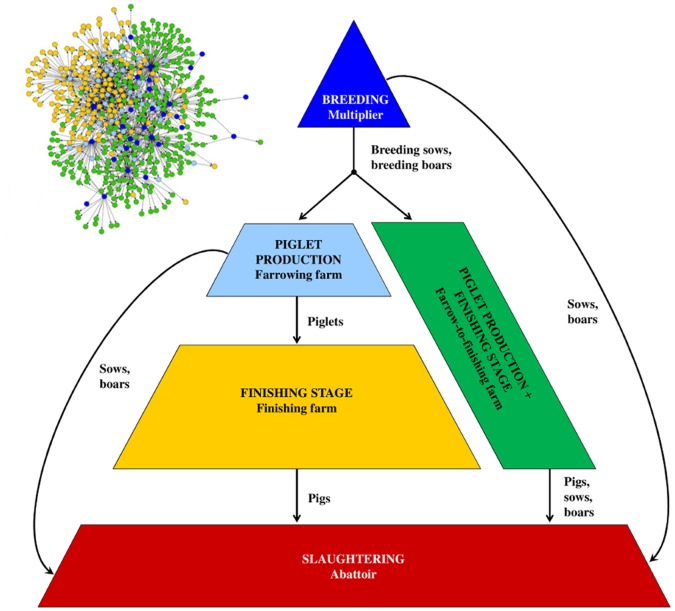
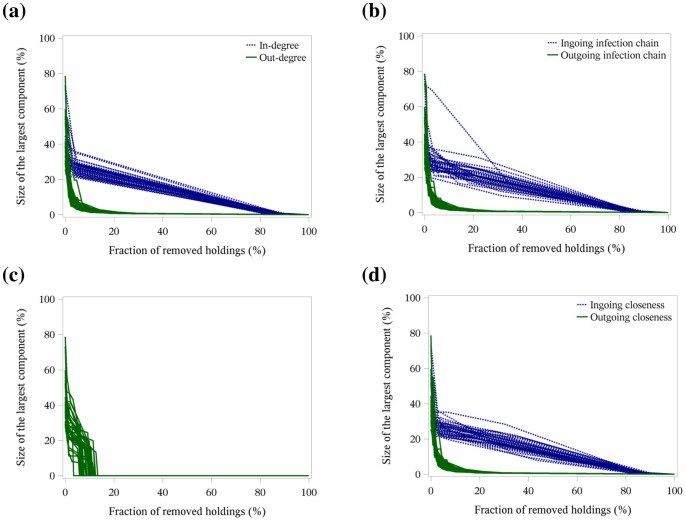
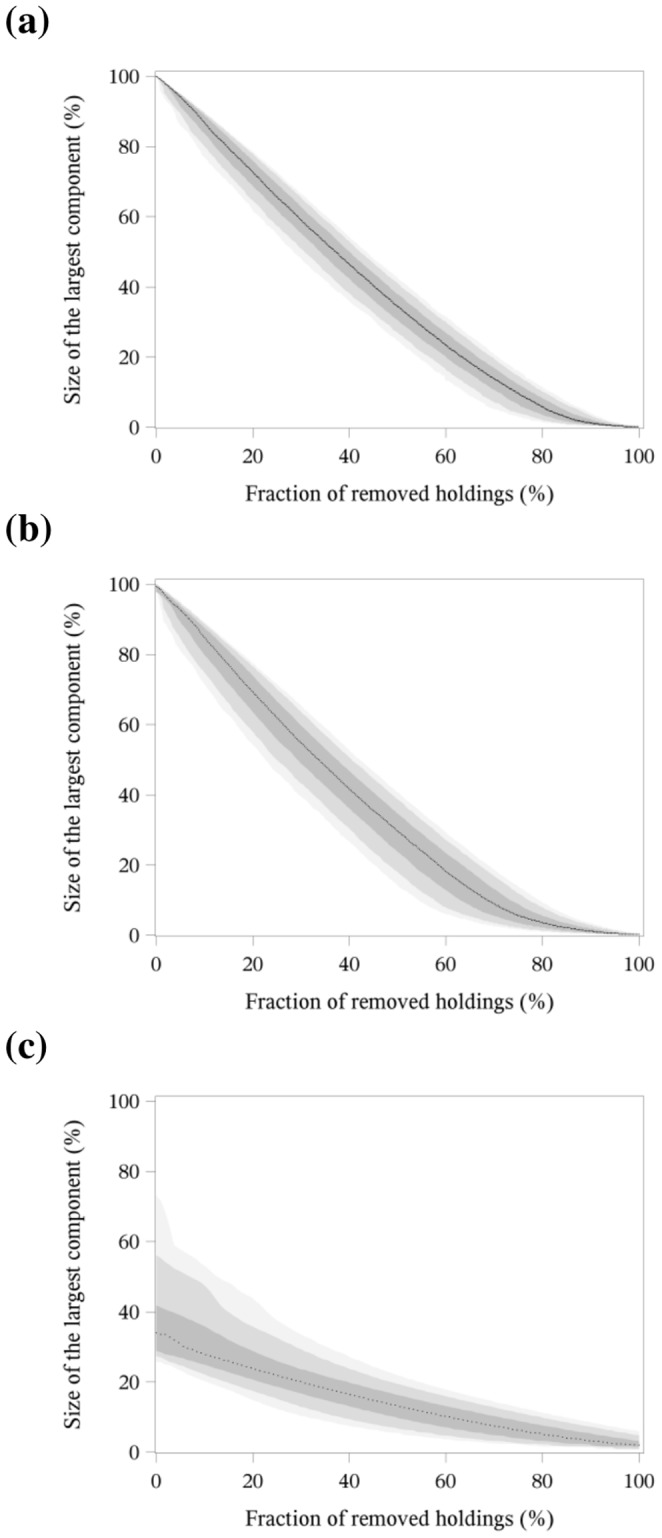
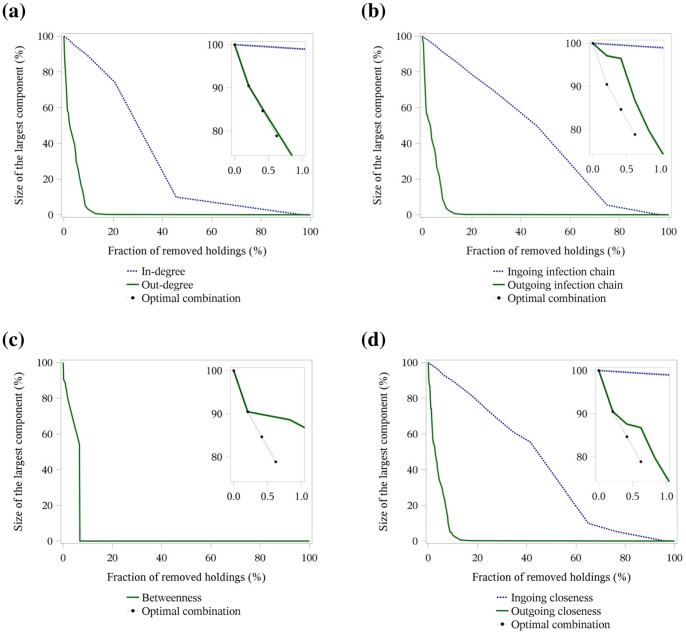
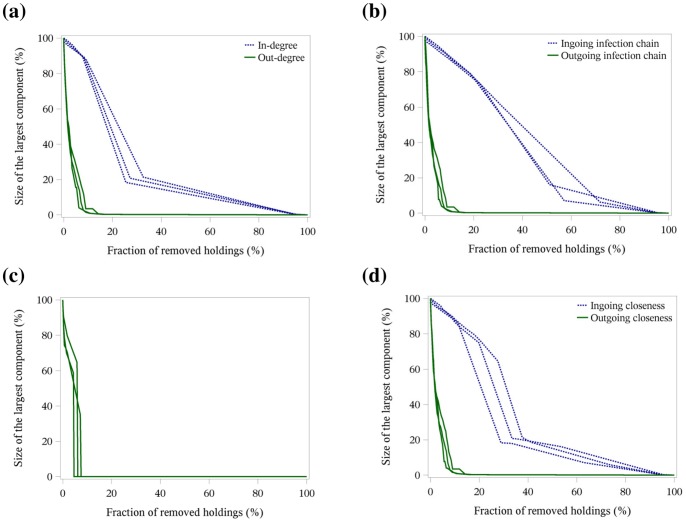
Centrality parameters in animal trade networks typically have right-skewed distributions, implying that these networks are highly resistant against the random removal of holdings, but vulnerable to the targeted removal of the most central holdings. In the present study, we analysed the structural changes of an animal trade network topology based on the targeted removal of holdings using specific centrality parameters in comparison to the random removal of holdings. Three different time periods were analysed: the three-year network, the yearly and the monthly networks. The aim of this study was to identify appropriate measures for the targeted removal, which lead to a rapid fragmentation of the network. Furthermore, the optimal combination of the removal of three holdings regardless of their centrality was identified. The results showed that centrality parameters based on ingoing trade contacts, e.g. in-degree, ingoing infection chain and ingoing closeness, were not suitable for a rapid fragmentation in all three time periods. More efficient was the removal based on parameters considering the outgoing trade contacts. In all networks, a maximum percentage of 7.0% (on average 5.2%) of the holdings had to be removed to reduce the size of the largest component by more than 75%. The smallest difference from the optimal combination for all three time periods was obtained by the removal based on out-degree with on average 1.4% removed holdings, followed by outgoing infection chain and outgoing closeness. The targeted removal using the betweenness centrality differed the most from the optimal combination in comparison to the other parameters which consider the outgoing trade contacts. Due to the pyramidal structure and the directed nature of the pork supply chain the most efficient interruption of the infection chain for all three time periods was obtained by using the targeted removal based on out-degree.
中心度参数在动物贸易网络中通常呈右偏分布,这意味着这些网络对持有物的随机移除具有很强的抵抗力,但容易受到最中心持有物的靶向移除的影响。在本研究中,我们分析了基于特定中心度参数的持有物靶向移除对动物贸易网络拓扑结构变化的影响,并与随机移除持有物进行了比较。分析了三个不同的时间段:三年网络、年度网络和月度网络。本研究的目的是确定靶向移除的适当措施,以迅速使网络碎片化。此外,还确定了无论其中心度如何,移除三个持有物的最佳组合。结果表明,基于传入贸易联系的中心度参数,例如入度、传入感染链和传入紧密性,在所有三个时间段内都不适合快速碎片化。考虑到传出贸易联系的参数的移除效率更高。在所有网络中,必须移除最多 7.0%(平均 5.2%)的持有物,才能使最大组件的大小减少 75%以上。基于出度的移除获得了所有三个时间段的最佳组合,平均移除 1.4%的持有物,其次是传出感染链和传出紧密性。与考虑传出贸易联系的其他参数相比,基于介数中心度的靶向移除与最佳组合的差异最大。由于猪肉供应链的金字塔结构和有向性质,对于所有三个时间段,使用基于出度的靶向移除可以最有效地中断感染链。