Center for AIDS Prevention Studies, University of California San Francisco, San Francisco, CA, USA.
PLoS One. 2013;8(2):e55397. doi: 10.1371/journal.pone.0055397. Epub 2013 Feb 6.
We assessed changes in sexual behavior among men who have sex with men (MSM), before and for several years after HIV diagnosis, accounting for adoption of a variety of seroadaptive practices.
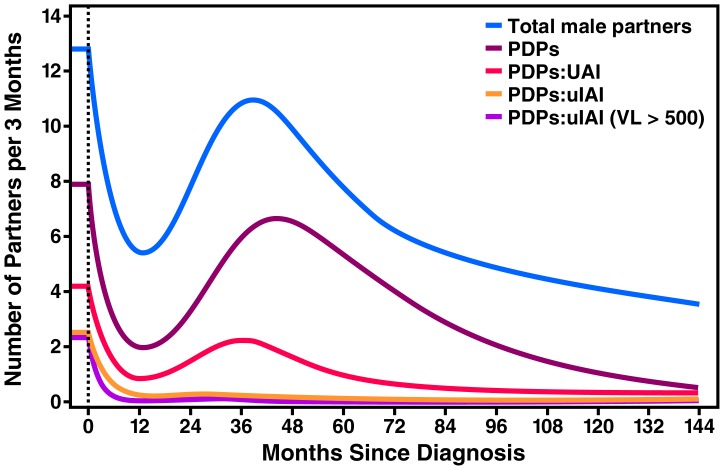
We collected self-reported sexual behavior data every 3 months from HIV-positive MSM at various stages of HIV infection. To establish population level trends in sexual behavior, we used negative binomial regression to model the relationship between time since diagnosis and several sexual behavior variables: numbers of (a) total partners, (b) potentially discordant partners (PDP; i.e., HIV-negative or unknown-status partners), (c) PDPs with whom unprotected anal intercourse (UAI) occurred, and (d) PDPs with whom unprotected insertive anal intercourse (uIAI) occurred.
A total of 237 HIV-positive MSM contributed 502 interviews. UAI with PDPs occurred with a mean of 4.2 partners in the 3 months before diagnosis. This declined to 0.9 partners/3 months at 12 months after diagnosis, and subsequently rose to 1.7 partners/3 months at 48 months, before falling again to 1.0 partners/3 months at 60 months. The number of PDPs with whom uIAI occurred dropped from 2.4 in the pre-diagnosis period to 0.3 partners/3 months (an 87.5% reduction) by 12 months after enrollment, and continued to decline over time.
Within months after being diagnosed with HIV, MSM adopted seroadaptive practices, especially seropositioning, where the HIV-positive partner was not in the insertive position during UAI, resulting in a sustained decline in the sexual activity associated with the highest risk of HIV transmission.
我们评估了男男性行为者(MSM)在 HIV 诊断前后数年的性行为变化,同时考虑了多种血清适应性实践的采用情况。
我们从不同 HIV 感染阶段的 HIV 阳性 MSM 中每 3 个月收集一次自我报告的性行为数据。为了建立性行为的人群水平趋势,我们使用负二项回归模型来分析时间与以下几个性行为变量之间的关系:(a)总性伴侣数、(b)潜在不和谐伴侣(PDP;即 HIV 阴性或未知状态的伴侣)数、(c)发生无保护肛交(UAI)的 PDP 数,以及(d)发生无保护插入性肛交(uIAI)的 PDP 数。
共有 237 名 HIV 阳性 MSM 参与了 502 次访谈。在诊断前的 3 个月内,与 PDP 发生 UAI 的平均伴侣数为 4.2 个。这一数字在诊断后 12 个月降至 0.9 个/3 个月,随后在 48 个月上升至 1.7 个/3 个月,然后再次下降至 60 个月时的 1.0 个/3 个月。与 uIAI 发生的 PDP 数从诊断前的 2.4 个降至 12 个月后 3 个月的 0.3 个(减少了 87.5%),并随着时间的推移继续下降。
在 HIV 诊断后的几个月内,MSM 采用了血清适应性实践,特别是血清定位,即 HIV 阳性伴侣在 UAI 中不处于插入位置,这导致与 HIV 传播风险最高相关的性行为持续下降。