Department of Epidemiology, Biostatistics, and Occupational Health, McGill University, Montreal, QC, Canada.
Direction Régionale de Santé Publique de Montréal, Montreal, QC, Canada.
AIDS Behav. 2021 Jan;25(1):269-283. doi: 10.1007/s10461-020-02965-4.
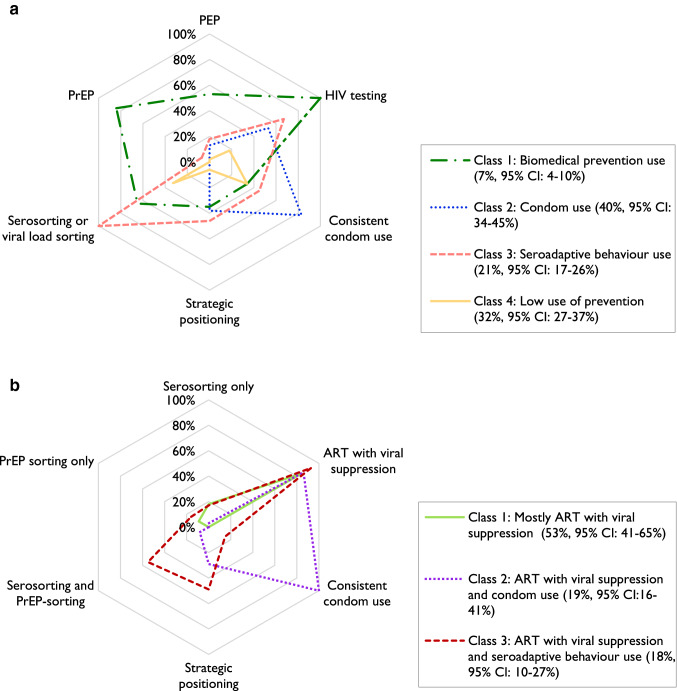
Pre-exposure prophylaxis (PrEP) became publicly available in Quebec for gay, bisexual and other men who have sex with men (GBM) in 2013. We used baseline data from Engage, a cohort of GBM recruited by respondent-driven sampling, to examine patterns of combination HIV prevention use among Montreal GBM since PrEP became available. Latent class analysis, stratified by HIV status, was used to categorize GBM by self-reported use of biomedical and behavioural prevention strategies. Correlates of resulting classes were identified using multinomial logistic regression. Among HIV-negative/unknown GBM (n = 968), we identified four classes: low use of prevention (32%), condoms (40%), seroadaptive behaviour (21%), and biomedical (including PrEP; 7%). Those using prevention (condoms, seroadaptive behaviour, and biomedical) had a higher number of anal sex partners and were more likely to report a recent sexually transmitted infection diagnosis. GBM using biomedical prevention also had a higher level of formal education. Among GBM living with HIV (n = 200), we identified three classes: mainly antiretroviral treatment (ART) with viral suppression (53%), ART with viral suppression and condoms (19%), and ART with viral suppression and seroadaptive behaviour (18%). Again, the number of anal sex partners was higher among those using condoms and seroadaptive behaviours. Our findings show antiretroviral-based prevention, either alone or in combination with other strategies, is clearly a component of the HIV prevention landscape for GBM in Montreal. Nevertheless, PrEP uptake remains low, and there is a need to promote its availability more widely.
暴露前预防(PrEP)于 2013 年在魁北克向男同性恋、双性恋和其他与男性发生性关系的男性(GBM)提供。我们使用了 Engage 的基线数据,这是一个通过应答者驱动抽样招募的 GBM 队列,以研究自 PrEP 问世以来,蒙特利尔 GBM 中联合 HIV 预防措施的使用模式。分层后,使用潜在类别分析将自我报告使用生物医学和行为预防策略的 GBM 进行分类。使用多项逻辑回归识别结果类别的相关性。在 HIV 阴性/未知的 GBM(n=968)中,我们确定了四个类别:预防措施使用率低(32%)、使用避孕套(40%)、血清适应性行为(21%)和生物医学(包括 PrEP;7%)。使用预防措施(避孕套、血清适应性行为和生物医学)的人有更多的肛交性伴侣,更有可能报告最近的性传播感染诊断。使用生物医学预防措施的 GBM 也具有更高的正规教育水平。在 HIV 感染者(n=200)中,我们确定了三个类别:主要使用抗逆转录病毒治疗(ART)和病毒抑制(53%)、使用 ART 和病毒抑制以及避孕套(19%)和使用 ART 和病毒抑制以及血清适应性行为(18%)。同样,使用避孕套和血清适应性行为的人肛交性伴侣数量更多。我们的研究结果表明,基于抗逆转录病毒的预防措施,无论是单独使用还是与其他策略联合使用,显然是蒙特利尔 GBM 艾滋病预防措施的一个组成部分。然而,PrEP 的使用率仍然很低,需要更广泛地推广其使用。