Clinical Research Center for Allergy and Rheumatology, Sagamihara Hospital, National Hospital Organization, 18-1 Sakuradai, Minami-ku, Sagamihara, Kanagawa, 252-0392, Japan.
BMC Immunol. 2013 Feb 14;14:9. doi: 10.1186/1471-2172-14-9.
Interstitial lung disease (ILD) is frequently associated with collagen diseases. The prognosis of acute-onset diffuse ILD (AoDILD) occurring in collagen disease patients is very poor. Here, we investigated serum biomarker profiles of AoDILD to find markers predicting outcome in patients with collagen diseases.
A solid-phase antibody array was used for screening 274 biomarkers in pooled sera from collagen disease patients in the AoDILD state and in the stable state. Biomarkers in individual sera were detected without pooling by bead-based immunoassay.
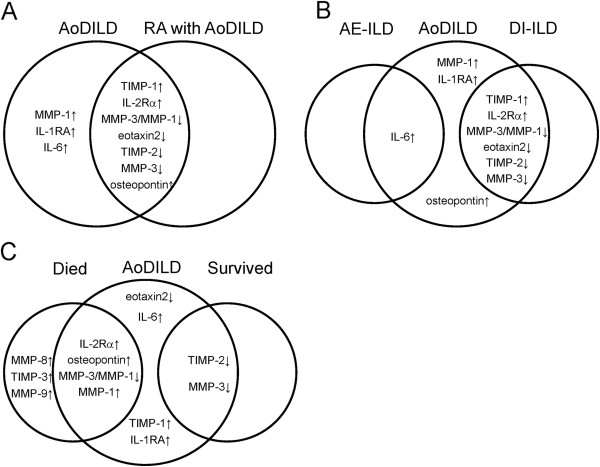
The serum levels of matrix metalloproteinase (MMP)-1, tissue inhibitor of metalloproteinase (TIMP)-1, osteopontin, interleukin (IL)-2 receptor α (IL-2Rα), and IL-1 receptor antagonist were significantly increased in AoDILD, but TIMP-2, MMP-3, and eotaxin 2 levels were decreased. The MMP-3 to MMP-1 ratio was reduced in AoDILD state. This tendency was also observed in RA patients with AoDILD. Moreover, serum IL-6 level was significantly increased in the AoDILD state in patients with acute exacerbation of ILD (AE-ILD). Serum TIMP-1 and IL-2Rα levels were significantly increased in the AoDILD state in patients with drug-induced ILD (DI-ILD), whereas TIMP-2, MMP-3, and eotaxin 2 levels were decreased. The MMP-3 to MMP-1 ratio was reduced in AoDILD state in patients with DI-ILD. The serum TIMP-3, MMP-9, osteopontin, IL-2Rα, MMP-1, and MMP-8 levels were significantly increased in the AoDILD state in patients who subsequently died, whereas TIMP-2 and MMP-3 levels were decreased in those who survived. The MMP-3 to MMP-1 ratio was reduced in AoDILD state in patients who died, but not in those who survived.
Serum biomarker profiles could represent prognosis markers for AoDILD in collagen diseases.
间质性肺病(ILD)常与胶原病有关。胶原病患者发生的急性发作性弥漫性ILD(AoDILD)的预后非常差。在这里,我们研究了 AoDILD 患者的血清生物标志物谱,以寻找预测胶原病患者预后的标志物。
使用固相抗体阵列筛选 AoDILD 状态和稳定状态胶原病患者混合血清中的 274 种生物标志物。通过基于珠的免疫测定法,在不混合的情况下检测个体血清中的生物标志物。
在 AoDILD 中,基质金属蛋白酶(MMP)-1、金属蛋白酶组织抑制剂(TIMP)-1、骨桥蛋白、白细胞介素(IL)-2 受体α(IL-2Rα)和 IL-1 受体拮抗剂的血清水平显着升高,但 TIMP-2、MMP-3 和嗜酸性粒细胞趋化因子 2 水平降低。MMP-3 与 MMP-1 的比值在 AoDILD 状态下降低。这种趋势在 AoDILD 的 RA 患者中也观察到。此外,在ILD 急性加重(AE-ILD)的 AoDILD 状态下,血清 IL-6 水平显着升高。在药物性 ILD(DI-ILD)的 AoDILD 状态下,血清 TIMP-1 和 IL-2Rα水平显着升高,而 TIMP-2、MMP-3 和嗜酸性粒细胞趋化因子 2 水平降低。在 DI-ILD 的 AoDILD 状态下,MMP-3 与 MMP-1 的比值降低。在随后死亡的 AoDILD 状态下,血清 TIMP-3、MMP-9、骨桥蛋白、IL-2Rα、MMP-1 和 MMP-8 水平显着升高,而在存活者中,TIMP-2 和 MMP-3 水平降低。在 AoDILD 状态下,死亡患者的 MMP-3 与 MMP-1 的比值降低,但存活患者的比值没有降低。
血清生物标志物谱可以代表胶原病 AoDILD 的预后标志物。