Laboratório de Biologia da Conservação, Departamento de Ecologia, Universidade Estadual Paulista, Rio Claro, Sao Paulo, Brazil.
PLoS One. 2013;8(2):e56252. doi: 10.1371/journal.pone.0056252. Epub 2013 Feb 7.
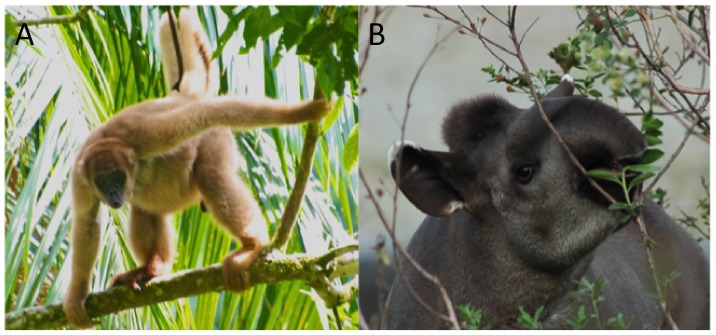
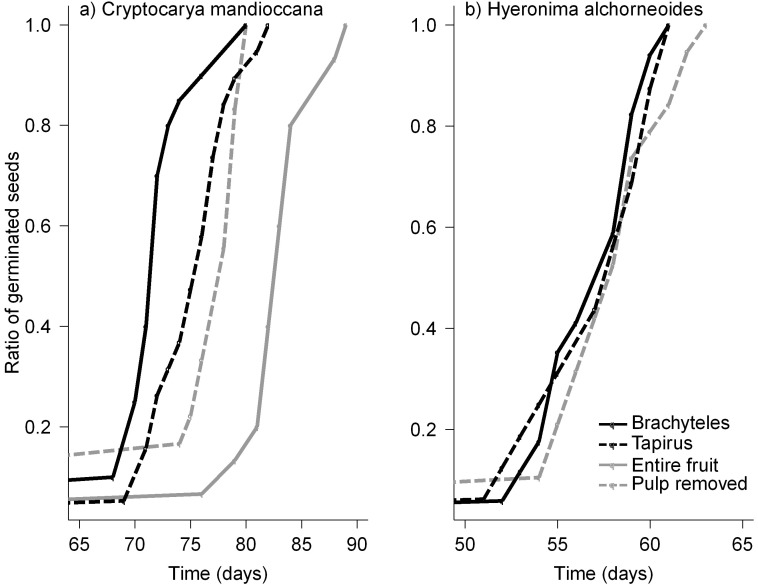
Functional redundancy has been debated largely in ecology and conservation, yet we lack detailed empirical studies on the roles of functionally similar species in ecosystem function. Large bodied frugivores may disperse similar plant species and have strong impact on plant recruitment in tropical forests. The two largest frugivores in the neotropics, tapirs (Tapirus terrestris) and muriquis (Brachyteles arachnoides) are potential candidates for functional redundancy on seed dispersal effectiveness. Here we provide a comparison of the quantitative, qualitative and spatial effects on seed dispersal by these megafrugivores in a continuous Brazilian Atlantic forest.
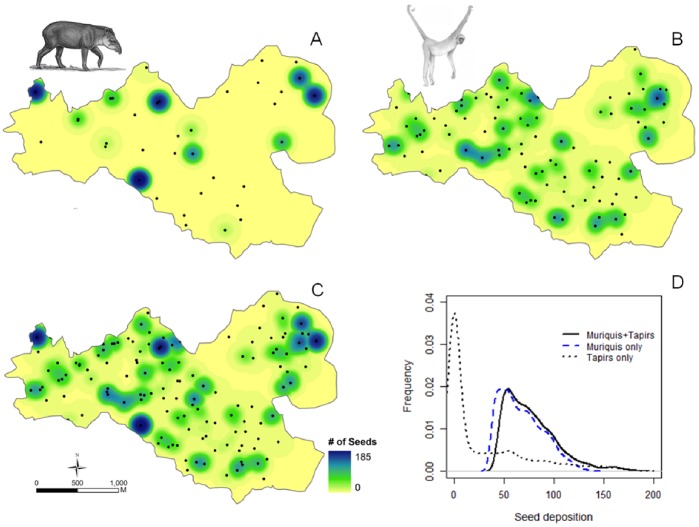
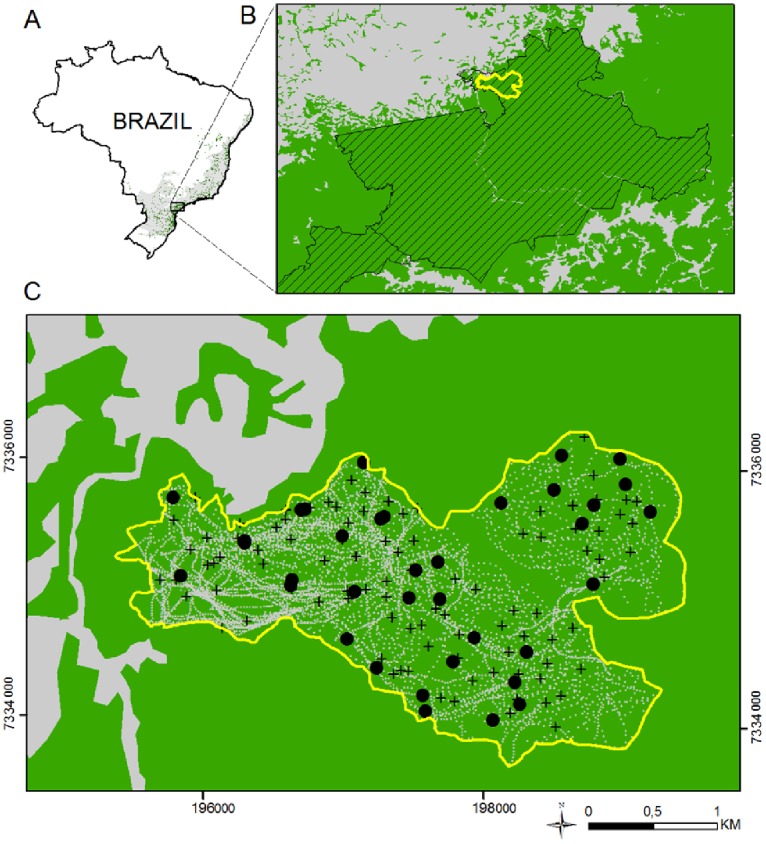
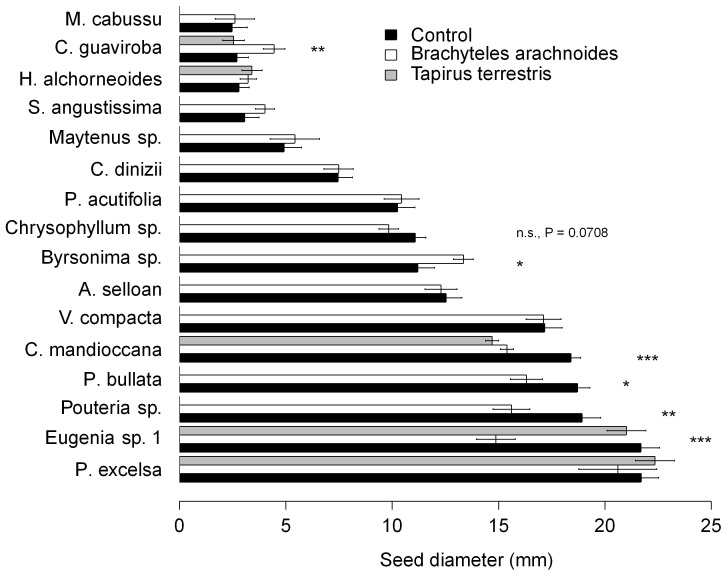
METHODOLOGY/PRINCIPAL FINDINGS: We found a low overlap of plant species dispersed by both muriquis and tapirs. A group of 35 muriquis occupied an area of 850 ha and dispersed 5 times more plant species, and 13 times more seeds than 22 tapirs living in the same area. Muriquis dispersed 2.4 times more seeds in any random position than tapirs. This can be explained mainly because seed deposition by muriquis leaves less empty space than tapirs. However, tapirs are able to disperse larger seeds than muriquis and move them into sites not reached by primates, such as large forest gaps, open areas and fragments nearby. Based on published information we found 302 plant species that are dispersed by at least one of these megafrugivores in the Brazilian Atlantic forest.
CONCLUSIONS/SIGNIFICANCE: Our study showed that both megafrugivores play complementary rather than redundant roles as seed dispersers. Although tapirs disperse fewer seeds and species than muriquis, they disperse larger-seeded species and in places not used by primates. The selective extinction of these megafrugivores will change the spatial seed rain they generate and may have negative effects on the recruitment of several plant species, particularly those with large seeds that have muriquis and tapirs as the last living seed dispersers.
功能冗余在生态学和保护生物学领域已经得到了广泛的讨论,但我们缺乏关于功能相似物种在生态系统功能中的作用的详细实证研究。大型食果动物可能会传播相似的植物物种,并对热带森林中的植物繁殖产生强烈影响。在新热带地区,两种最大的食果动物——貘(Tapirus terrestris)和毛丝鼠(Brachyteles arachnoides)——可能是在种子传播效果方面具有功能冗余的潜在候选者。在这里,我们提供了在巴西大西洋森林连续区域内,这两种大型食果动物在定量、定性和空间上对种子传播影响的比较。
方法/主要发现:我们发现毛丝鼠和貘传播的植物物种重叠度较低。一组 35 只毛丝鼠占据了 850 公顷的面积,传播的植物物种数量是生活在同一区域内 22 只貘的 5 倍,传播的种子数量是貘的 13 倍。毛丝鼠在任何随机位置传播的种子数量都比貘多 2.4 倍。这主要可以解释为毛丝鼠传播种子后留下的空旷空间比貘少。然而,貘能够传播比毛丝鼠更大的种子,并将它们传播到灵长类动物无法到达的地方,如大型森林空隙、开阔区域和附近的碎片。根据已发表的信息,我们发现有 302 种植物至少被这两种大型食果动物中的一种传播。
结论/意义:我们的研究表明,这两种大型食果动物在作为种子传播者方面发挥着互补而非冗余的作用。尽管貘传播的种子和物种数量比毛丝鼠少,但它们传播的是更大种子的物种,而且传播到了灵长类动物不使用的地方。这些大型食果动物的选择性灭绝将改变它们产生的空间种子雨,并可能对几种植物物种的繁殖产生负面影响,特别是那些具有大型种子的植物物种,而毛丝鼠和貘是它们最后的活体种子传播者。