Aslan Clare, Beckman Noelle G, Rogers Haldre S, Bronstein Judie, Zurell Damaris, Hartig Florian, Shea Katriona, Pejchar Liba, Neubert Mike, Poulsen John, HilleRisLambers Janneke, Miriti Maria, Loiselle Bette, Effiom Edu, Zambrano Jenny, Schupp Geno, Pufal Gesine, Johnson Jeremy, Bullock James M, Brodie Jedediah, Bruna Emilio, Cantrell Robert Stephen, Decker Robin, Fricke Evan, Gurski Katie, Hastings Alan, Kogan Oleg, Razafindratsima Onja, Sandor Manette, Schreiber Sebastian, Snell Rebecca, Strickland Christopher, Zhou Ying
Landscape Conservation Initiative, Northern Arizona University, Flagstaff, AZ, USA.
Department of Biology, Utah State University, Logan, UT, USA.
AoB Plants. 2019 Feb 7;11(2):plz006. doi: 10.1093/aobpla/plz006. eCollection 2019 Apr.
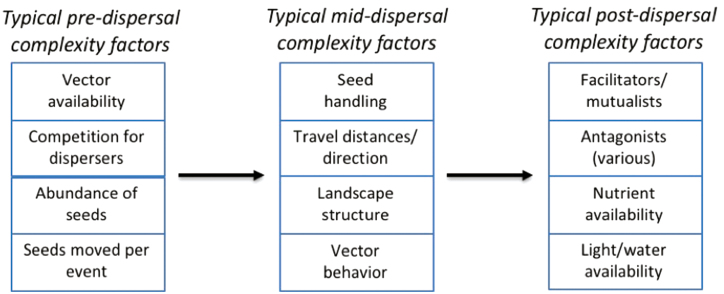
Seed dispersal enables plants to reach hospitable germination sites and escape natural enemies. Understanding when and how much seed dispersal matters to plant fitness is critical for understanding plant population and community dynamics. At the same time, the complexity of factors that determine if a seed will be successfully dispersed and subsequently develop into a reproductive plant is daunting. Quantifying all factors that may influence seed dispersal effectiveness for any potential seed-vector relationship would require an unrealistically large amount of time, materials and financial resources. On the other hand, being able to make dispersal predictions is critical for predicting whether single species and entire ecosystems will be resilient to global change. Building on current frameworks, we here posit that seed dispersal ecology should adopt plant functional groups as analytical units to reduce this complexity to manageable levels. Functional groups can be used to distinguish, for their constituent species, whether it matters (i) if seeds are dispersed, (ii) into what context they are dispersed and (iii) what vectors disperse them. To avoid overgeneralization, we propose that the utility of these functional groups may be assessed by generating predictions based on the groups and then testing those predictions against species-specific data. We suggest that data collection and analysis can then be guided by robust functional group definitions. Generalizing across similar species in this way could help us to better understand the population and community dynamics of plants and tackle the complexity of seed dispersal as well as its disruption.
种子传播使植物能够到达适宜发芽的地点并躲避天敌。了解种子传播的时间和程度对植物适合度的影响,对于理解植物种群和群落动态至关重要。与此同时,决定一粒种子能否成功传播并随后发育成一株能繁殖的植物的因素非常复杂,令人望而生畏。要量化任何潜在种子传播媒介关系中可能影响种子传播有效性的所有因素,都需要耗费大量不切实际的时间、材料和资金。另一方面,能够做出传播预测对于预测单个物种和整个生态系统是否能抵御全球变化至关重要。基于当前的框架,我们在此假定种子传播生态学应采用植物功能群作为分析单位,将这种复杂性降低到可管理的水平。功能群可用于为其组成物种区分以下几点是否重要:(i) 种子是否被传播;(ii) 种子被传播到何种环境中;(iii) 哪些传播媒介传播种子。为避免过度概括,我们建议可通过基于这些功能群进行预测,然后根据物种特异性数据检验这些预测,来评估这些功能群的效用。我们认为,数据收集和分析随后可由可靠的功能群定义来指导。以这种方式对相似物种进行概括,有助于我们更好地理解植物的种群和群落动态,并应对种子传播的复杂性及其受到的干扰。