Institute of Pathology, University Hospital Freiburg, Freiburg, Germany.
PLoS One. 2013;8(2):e56333. doi: 10.1371/journal.pone.0056333. Epub 2013 Feb 13.
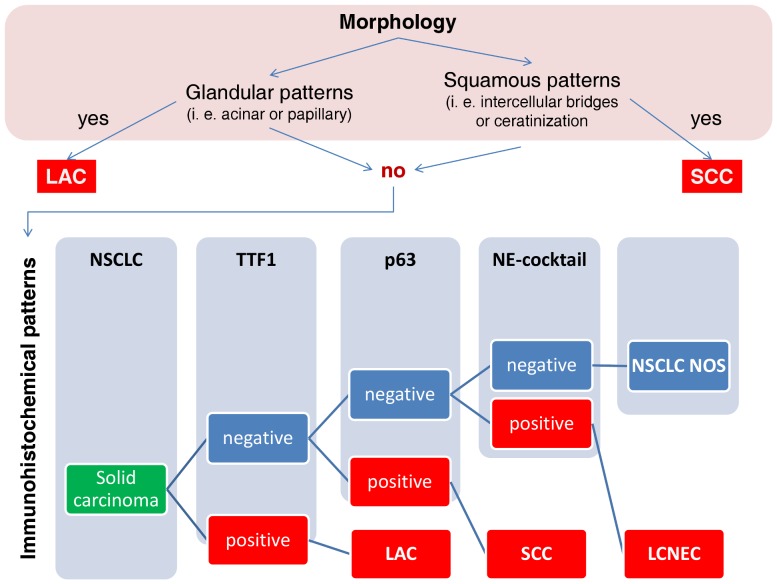
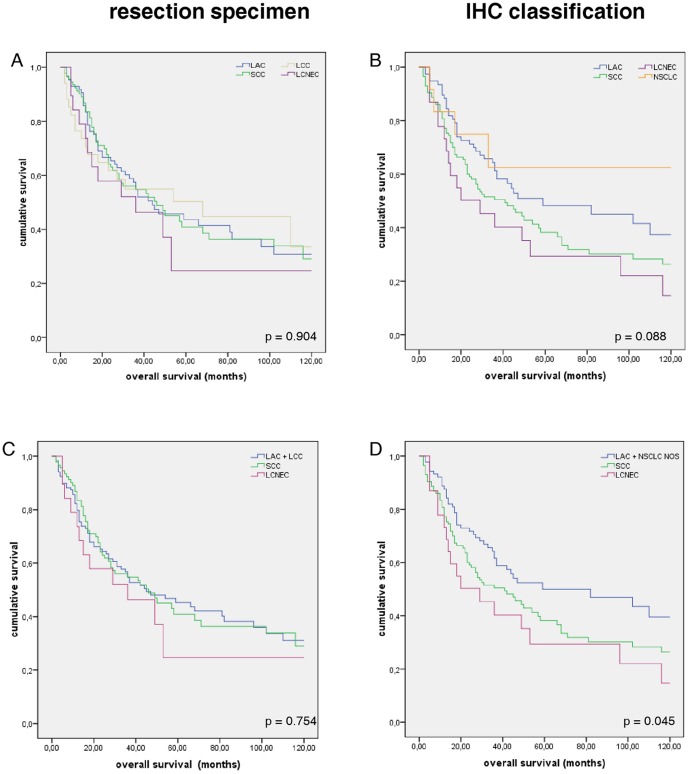
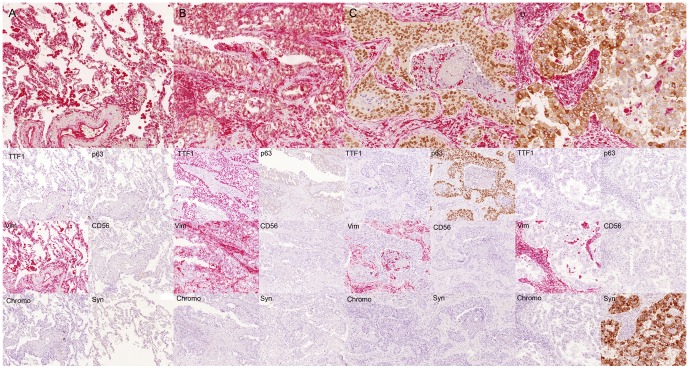
Histological subclassification of non-small cell lung cancer (NSCLC) has growing therapeutic impact. In advanced cancer stages tissue specimens are usually bioptically collected. These small samples are of extraordinary value since molecular analyses are gaining importance for targeted therapies. We therefore studied the feasibility, diagnostic accuracy, economic and prognostic effects of a tissue sparing simultaneous multi-antibody assay for subclassification of NSCLC. Of 265 NSCLC patients tissue multi arrays (TMA) were constructed to simulate biopsy samples. TMAs were stained by a simultaneous bi-color multi-antibody assay consisting of TTF1, Vimentin, p63 and neuroendocrine markers (CD56, chromogranin A, synaptophysin). Classification was based mainly on the current proposal of the IASLC with a hierarchical decision tree for subclassification into adenocarcinoma (LAC), squamous cell carcinoma (SCC), large cell neuroendocrine carcinoma (LCNEC) and NSCLC not otherwise specified. Investigation of tumor heterogeneity showed an explicit lower variation for immunohistochemical analyses compared to conventional classification. Furthermore, survival analysis of our combined immunohistochemical classification revealed distinct separation of each entity's survival curve. This was statistically significant for therapeutically important subgroups (p = 0.045). As morphological and molecular cancer testing is emerging, our multi-antibody assay in combination with standardized classification delivers accurate and reliable separation of histomorphological diagnoses. Additionally, it permits clinically relevant subtyping of NSCLC including LCNEC. Our multi-antibody assay may therefore be of special value, especially in diagnosing small biopsies. It futher delivers substantial prognostic information with therapeutic consequences. Integration of immunohistochemical subtyping including investigation of neuroendocrine differentiation into standard histopathological classification of NSCLC must, therefore, be considered.
非小细胞肺癌(NSCLC)的组织学分类对治疗具有重要影响。在晚期癌症阶段,通常通过活检采集组织标本。由于分子分析对靶向治疗越来越重要,这些小样本具有非凡的价值。因此,我们研究了一种组织节约型同时多抗体检测方法用于 NSCLC 分类的可行性、诊断准确性、经济性和预后影响。对 265 例 NSCLC 患者的组织多阵列(TMA)进行构建,以模拟活检样本。TMA 通过同时双色多抗体检测进行染色,该检测由 TTF1、波形蛋白、p63 和神经内分泌标志物(CD56、嗜铬粒蛋白 A、突触素)组成。分类主要基于 IASLC 的现行建议,采用分层决策树对腺癌(LAC)、鳞状细胞癌(SCC)、大细胞神经内分泌癌(LCNEC)和非特指性 NSCLC 进行分类。对肿瘤异质性的研究表明,与传统分类相比,免疫组织化学分析的变异性明显较低。此外,我们的联合免疫组织化学分类的生存分析显示,每种实体的生存曲线明显分开。这在治疗上重要的亚组中具有统计学意义(p=0.045)。由于形态学和分子癌症检测正在出现,我们的多抗体检测与标准化分类相结合,可准确可靠地分离组织形态学诊断。此外,它还允许对 NSCLC 进行包括 LCNEC 在内的临床相关亚型分类。因此,我们的多抗体检测可能具有特殊价值,特别是在诊断小活检时。它进一步提供了具有治疗意义的预后信息。因此,必须考虑将包括神经内分泌分化在内的免疫组织化学亚型分析纳入 NSCLC 的标准组织病理学分类。