Department of Geography and Environmental Studies, University of Haifa, Haifa, Israel.
PLoS One. 2013;8(2):e56398. doi: 10.1371/journal.pone.0056398. Epub 2013 Feb 19.
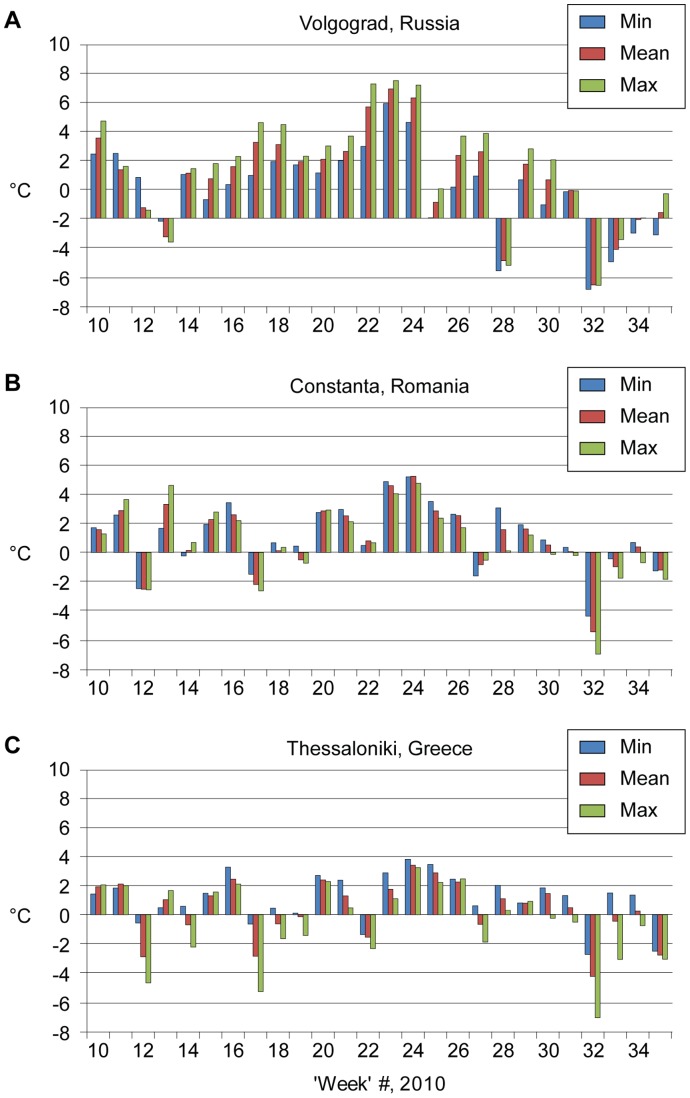
In the summer of 2010, Europe experienced outbreaks of West Nile Fever (WNF) in humans, which was preceded by hot spells. The objective of this study was to identify potential drivers of these outbreaks, such as spring and summer temperatures, relative humidity (RH), and precipitation.
Pearson and lag correlations, binary and multinomial logistic regressions were used to assess the relationship between the climatic parameters and these outbreaks.
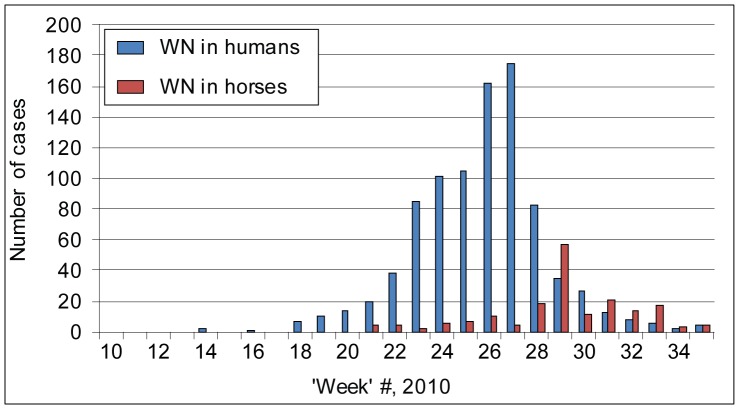
For human morbidity, significant (<0.05) positive correlations were observed between a number of WNF cases and temperature, with a geographic latitude gradient: northern ("colder") countries displayed strong correlations with a lag of up to four weeks, in contrast to southern ("warmer") countries, where the response was immediate. The correlations with RH were weaker, while the association with precipitation was not consistent. Horse morbidity started three weeks later than in humans where integrated surveillance was conducted, and no significant associations with temperature or RH were found for lags of 0 to 4 weeks.
Significant temperature deviations during summer months might be considered environmental precursors of WNF outbreaks in humans, particularly at more northern latitudes. These insights can guide vector abatement strategies by health practitioners in areas at risk for persistent transmission cycles.
2010 年夏天,欧洲爆发了人类西尼罗河热(WNF)疫情,此前经历了高温期。本研究的目的是确定这些疫情爆发的潜在驱动因素,如春季和夏季温度、相对湿度(RH)和降水。
采用皮尔逊和滞后相关、二项和多项逻辑回归来评估气候参数与这些疫情爆发之间的关系。
对于人类发病情况,观察到大量的 WNF 病例与温度之间存在显著(<0.05)正相关关系,存在地理纬度梯度:北部(“较冷”)国家的相关性很强,滞后可达四周,而南部(“较暖”)国家的反应则是即时的。与 RH 的相关性较弱,而与降水的关联并不一致。马的发病情况比人类发病情况滞后三周,在进行综合监测的地区,在 0 到 4 周的滞后时间内,与温度或 RH 没有发现显著关联。
夏季期间的显著温度偏差可能被视为人类西尼罗河热疫情爆发的环境前兆,特别是在更北的纬度地区。这些见解可以指导处于持续传播周期风险地区的卫生工作者制定病媒控制策略。