Case Western Reserve University, Cleveland, OH 44106, USA.
J Neuroeng Rehabil. 2013 Feb 27;10:25. doi: 10.1186/1743-0003-10-25.
Multi-contact stimulating electrodes are gaining acceptance as a means for interfacing with the peripheral nervous system. These electrodes can potentially activate many independent populations of motor units within a single peripheral nerve, but quantifying their recruitment properties and the overlap in stimulation between contacts is difficult and time consuming. Further, current methods for quantifying overlap between contacts are ambiguous and can lead to suboptimal selective stimulation parameters. This study describes a novel method for optimizing stimulation parameters for multi-contact peripheral stimulating electrodes to produce strong, selective muscle contractions. The method is tested with four-contact spiral nerve-cuff electrodes implanted on bilateral femoral nerves of two individuals with spinal cord injury, but it is designed to be extendable to other electrode technologies with higher densities of contacts.
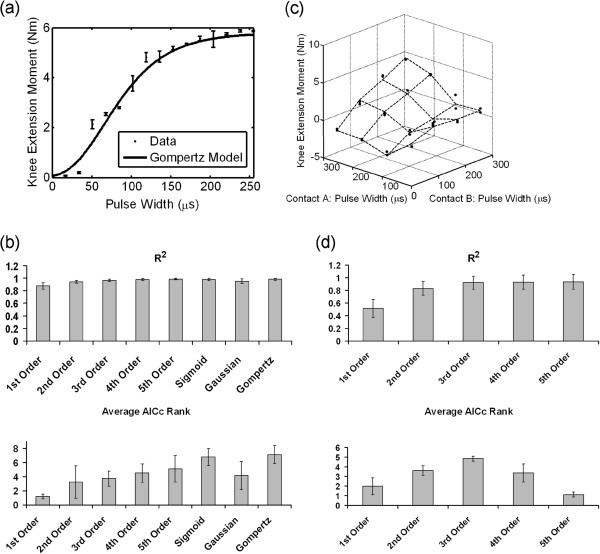
To optimize selective stimulation parameters for multi-contact electrodes, first, recruitment and overlap are characterized for all contacts within an electrode. Recruitment is measured with the twitch response to single stimulus pulses, and overlap between pairs of contacts is quantified by the deviation in their combined response from linear addition of individual responses. Simple mathematical models are fit to recruitment and overlap data, and a cost function is defined to maximize recruitment and minimize overlap between all contacts.
Results are presented for four-contact nerve-cuff electrodes stimulating bilateral femoral nerves of two human subjects with spinal cord injury. Knee extension moments between 11.6 and 43.2 Nm were achieved with selective stimulation through multiple contacts of each nerve-cuff with less than 10% overlap between pairs of contacts. The overlap in stimulation measured in response to selective stimulation parameters was stable at multiple repeated time points after implantation.
These results suggest that the method described here can provide an automated means of determining stimulus parameters to achieve strong muscle contractions via selective stimulation through multi-contact peripheral nerve electrodes.
多触点刺激电极作为与周围神经系统接口的一种手段正在被广泛接受。这些电极有可能在单个周围神经内激活许多独立的运动单位群体,但量化它们的募集特性和触点之间的刺激重叠是困难且耗时的。此外,目前用于量化触点之间重叠的方法存在歧义,可能导致次优的选择性刺激参数。本研究描述了一种优化多触点周围刺激电极刺激参数以产生强选择性肌肉收缩的新方法。该方法在两名脊髓损伤患者的双侧股神经上使用四触点螺旋神经袖电极进行了测试,但设计目的是可扩展到具有更高触点密度的其他电极技术。
为了优化多触点电极的选择性刺激参数,首先对电极内的所有触点进行募集和重叠特征描述。募集通过单个刺激脉冲的抽搐反应进行测量,触点之间的重叠通过其组合反应与单个反应的线性相加之间的偏差来量化。简单的数学模型拟合募集和重叠数据,并定义一个成本函数,以最大化所有触点的募集并最小化重叠。
结果显示,四名接触者的神经袖电极刺激了两名脊髓损伤患者的双侧股神经。通过选择性刺激每个神经袖的多个触点,实现了 11.6 到 43.2 Nm 的膝关节伸展力矩,触点对之间的重叠小于 10%。在植入后多个重复时间点测量到的选择性刺激参数的刺激重叠是稳定的。
这些结果表明,这里描述的方法可以提供一种自动确定刺激参数的方法,通过多触点周围神经电极的选择性刺激来实现强肌肉收缩。