Department of Health Services Research and Policy, London School of Hygiene and Tropical Medicine, London WC1H 9SH, UK.
BMJ. 2013 Feb 27;346:f1026. doi: 10.1136/bmj.f1026.
To compare the cost effectiveness of the three most commonly chosen types of prosthesis for total hip replacement.
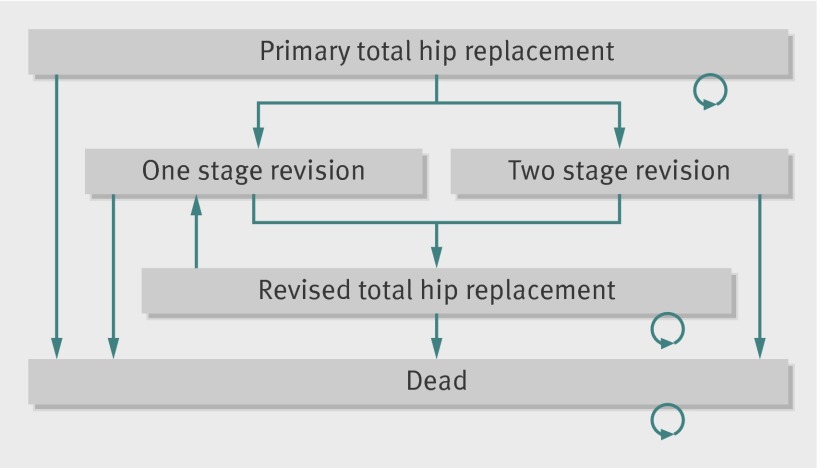
Lifetime cost effectiveness model with parameters estimated from individual patient data obtained from three large national databases.
English National Health Service.
Adults aged 55 to 84 undergoing primary total hip replacement for osteoarthritis.
Total hip replacement using either cemented, cementless, or hybrid prostheses.
Cost (£), quality of life (EQ-5D-3L, where 0 represents death and 1 perfect health), quality adjusted life years (QALYs), incremental cost effectiveness ratios, and the probability that each prosthesis type is the most cost effective at alternative thresholds of willingness to pay for a QALY gain.
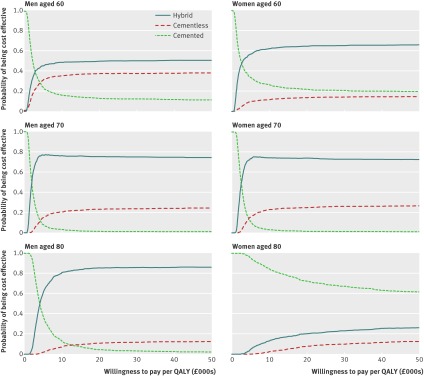
Lifetime costs were generally lowest with cemented prostheses, and postoperative quality of life and lifetime QALYs were highest with hybrid prostheses. For example, in women aged 70 mean costs were £6900 ($11 000; €8200) for cemented prostheses, £7800 for cementless prostheses, and £7500 for hybrid prostheses; mean postoperative EQ-5D scores were 0.78, 0.80, and 0.81, and the corresponding lifetime QALYs were 9.0, 9.2, and 9.3 years. The incremental cost per QALY for hybrid compared with cemented prostheses was £2500. If the threshold willingness to pay for a QALY gain exceeded £10 000, the probability that hybrid prostheses were most cost effective was about 70%. Hybrid prostheses have the highest probability of being the most cost effective in all subgroups, except in women aged 80, where cemented prostheses were most cost effective.
Cemented prostheses were the least costly type for total hip replacement, but for most patient groups hybrid prostheses were the most cost effective. Cementless prostheses did not provide sufficient improvement in health outcomes to justify their additional costs.
比较全髋关节置换术三种最常选用假体的成本效果。
基于来自三个大型国家数据库的个体患者数据,对参数进行估计的终生成本效果模型。
英国国家医疗服务体系。
55 至 84 岁因骨关节炎接受初次全髋关节置换术的成年人。
使用骨水泥固定型、非骨水泥固定型或混合假体进行全髋关节置换术。
成本(£)、生活质量(EQ-5D-3L,其中 0 代表死亡,1 代表完全健康)、质量调整生命年(QALYs)、增量成本效果比,以及在不同的意愿支付阈值下,每种假体类型作为最具成本效益的选择的概率,该阈值用于衡量 QALY 获益的增加。
在女性 70 岁患者中,骨水泥固定型假体的终生成本通常最低,而混合假体的术后生活质量和终生 QALYs 最高。例如,骨水泥固定型假体的平均成本为 6900 英镑(11000 美元;8200 欧元),非骨水泥固定型假体为 7800 英镑,混合假体为 7500 英镑;术后平均 EQ-5D 评分为 0.78、0.80 和 0.81,相应的终生 QALYs 分别为 9.0、9.2 和 9.3 年。与骨水泥固定型假体相比,混合假体的每 QALY 增量成本为 2500 英镑。如果 QALY 获益的意愿支付阈值超过 10000 英镑,混合假体最具成本效果的概率约为 70%。在所有亚组中,混合假体最有可能是最具成本效果的,除了 80 岁女性患者,此时骨水泥固定型假体最具成本效果。
在全髋关节置换术中,骨水泥固定型假体的成本最低,但对于大多数患者群体,混合假体的成本效果最佳。非骨水泥固定型假体并未在健康结果上有足够的改善,因此无法证明其额外成本是合理的。