• 文献检索
  • 文档翻译
  • 深度研究
  • 学术资讯
  • Suppr Zotero 插件Zotero 插件
  • 邀请有礼
  • 套餐&价格
  • 历史记录
应用&插件
Suppr Zotero 插件Zotero 插件浏览器插件Mac 客户端Windows 客户端微信小程序
定价
高级版会员购买积分包购买API积分包
服务
文献检索文档翻译深度研究API 文档MCP 服务
关于我们
关于 Suppr公司介绍联系我们用户协议隐私条款
关注我们

Suppr 超能文献

核心技术专利:CN118964589B侵权必究
粤ICP备2023148730 号-1Suppr @ 2026

文献检索

告别复杂PubMed语法,用中文像聊天一样搜索,搜遍4000万医学文献。AI智能推荐,让科研检索更轻松。

立即免费搜索

文件翻译

保留排版,准确专业,支持PDF/Word/PPT等文件格式,支持 12+语言互译。

免费翻译文档

深度研究

AI帮你快速写综述,25分钟生成高质量综述,智能提取关键信息,辅助科研写作。

立即免费体验

血浆肌酐浓度正常的脓毒症和创伤患者的肾脏清除率增加:识别高危患者。

Augmented renal clearance in septic and traumatized patients with normal plasma creatinine concentrations: identifying at-risk patients.

作者信息

Udy Andrew A, Roberts Jason A, Shorr Andrew F, Boots Robert J, Lipman Jeffrey

出版信息

Crit Care. 2013 Feb 28;17(1):R35. doi: 10.1186/cc12544.

DOI:10.1186/cc12544
PMID:23448570
原文链接:https://pmc.ncbi.nlm.nih.gov/articles/PMC4056783/
Abstract

INTRODUCTION

Improved methods to optimize drug dosing in the critically ill are urgently needed. Traditional prescribing culture involves recognition of factors that mandate dose reduction (such as renal impairment), although optimizing drug exposure, through more frequent or augmented dosing, represents an evolving strategy. Elevated creatinine clearance (CLCR) has been associated with sub-therapeutic antibacterial concentrations in the critically ill, a concept termed augmented renal clearance (ARC). We aimed to determine the prevalence of ARC in a cohort of septic and traumatized critically ill patients, while also examining demographic, physiological and illness severity characteristics that may help identify this phenomenon.

METHODS

This prospective observational study was performed in a 30-bed tertiary level, university affiliated, adult intensive care unit. Consecutive traumatized and septic critically ill patients, receiving antibacterial therapy, with a plasma creatinine concentration ≤110 μmol/L, were eligible for enrolment. Pulse contour analysis (Vigileo / Flo Trac system, Edwards Lifesciences, Irvine, CA, USA), was used to provide continuous cardiac index (CI) assessment over a single six-hour dosing interval. Urinary CLCR measures were obtained concurrently.

RESULTS

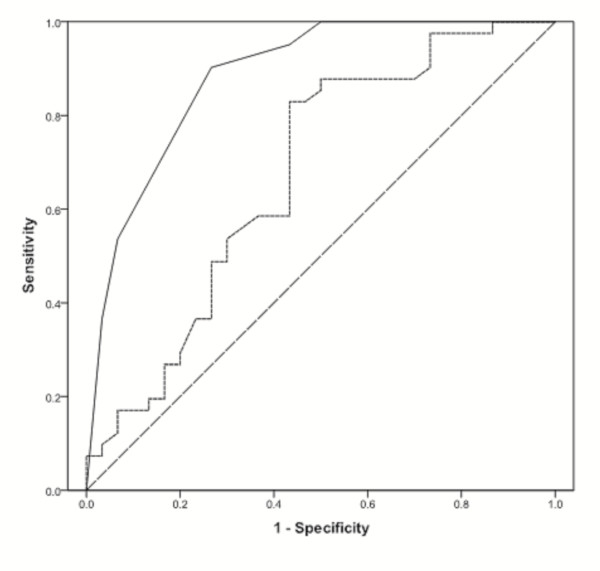
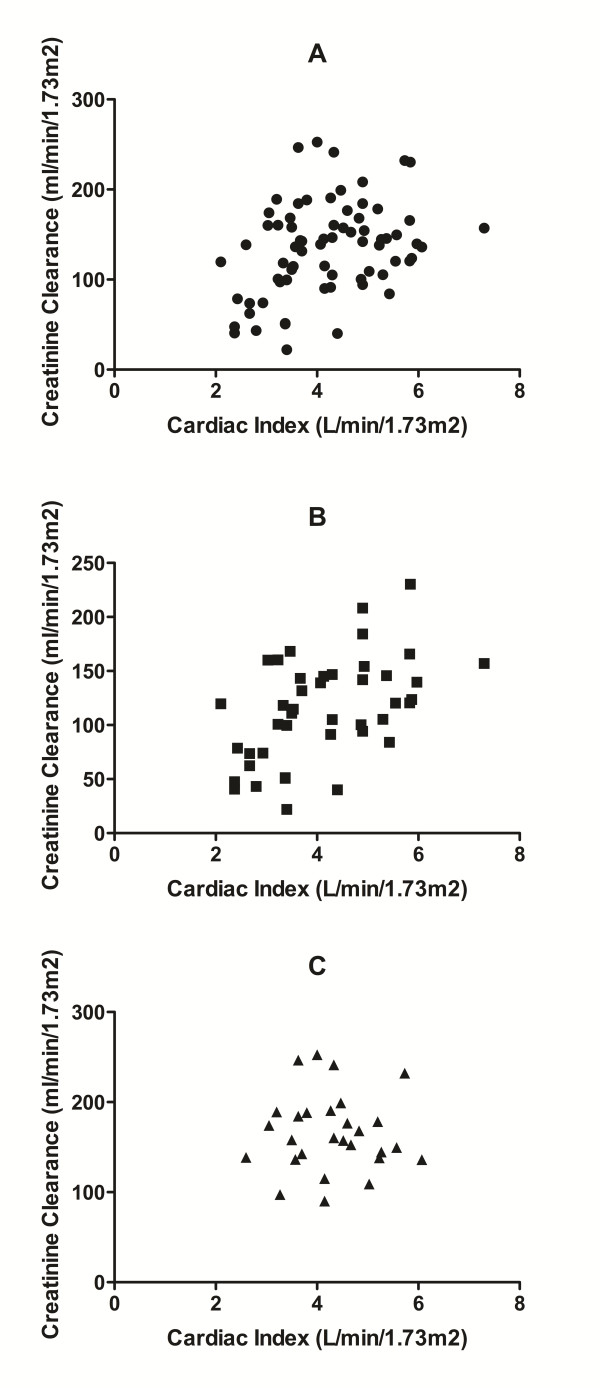
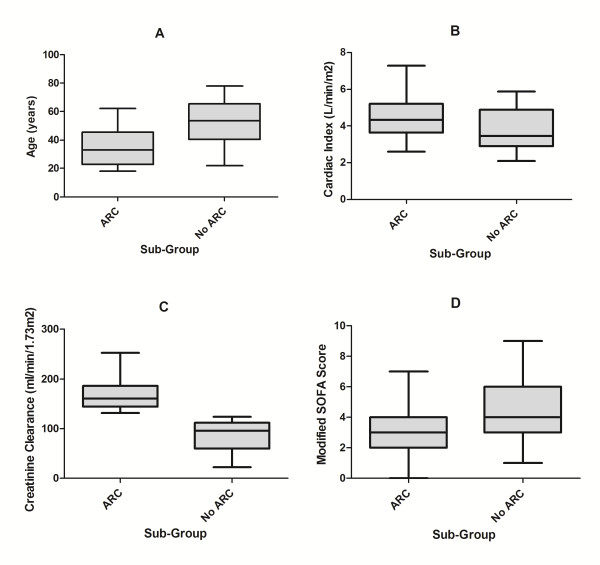
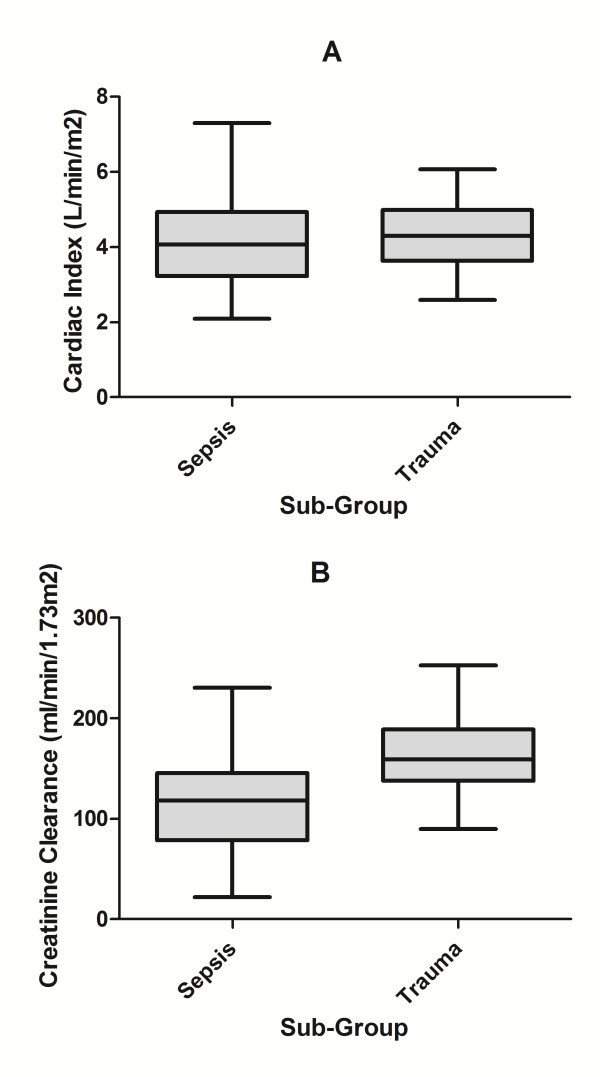
Seventy-one patients contributed data (sepsis n = 43, multi-trauma n = 28). Overall, 57.7% of the cohort manifested ARC, although there was a greater prevalence in trauma (85.7% versus 39.5%, P <0.001). In all patients, a weak correlation was noted between CI and CLCR (r = 0.346, P = 0.003). This was mostly driven by septic patients (r = 0.508, P = 0.001), as no correlation (r = -0.012, P = 0.951) was identified in trauma. Those manifesting ARC were younger (P <0.001), male (P = 0.012), with lower acute physiology and chronic health evaluation (APACHE) II (P= 0.008) and modified sequential organ failure assessment (SOFA) scores (P = 0.013), and higher cardiac indices (P = 0.013). In multivariate analysis, age ≤50 years, trauma, and a modified SOFA score ≤4, were identified as significant risk factors. These had greater utility in predicting ARC, compared with CI assessment alone.

CONCLUSIONS

Diagnosis, illness severity and age, are likely to significantly influence renal drug elimination in the critically ill, and must be regularly considered in future study design and daily prescribing practice.

摘要

引言

迫切需要改进重症患者药物剂量优化的方法。传统的处方习惯包括识别那些要求减少剂量的因素(如肾功能损害),尽管通过更频繁或增加剂量来优化药物暴露是一种不断发展的策略。肌酐清除率(CLCR)升高与重症患者抗菌药物浓度低于治疗水平有关,这一概念被称为肾脏清除率增加(ARC)。我们旨在确定脓毒症和创伤性重症患者队列中ARC的患病率,同时研究可能有助于识别这一现象的人口统计学、生理学和疾病严重程度特征。

方法

这项前瞻性观察性研究在一家拥有30张床位的大学附属三级成人重症监护病房进行。连续纳入接受抗菌治疗、血浆肌酐浓度≤110μmol/L的创伤性和脓毒症重症患者。采用脉搏轮廓分析(Vigileo / Flo Trac系统,美国加利福尼亚州尔湾市爱德华兹生命科学公司)在单个六小时给药间隔内提供连续的心指数(CI)评估。同时获取尿CLCR测量值。

结果

71名患者提供了数据(脓毒症n = 43,多发伤n = 28)。总体而言,该队列中57.7%表现出ARC,尽管创伤患者中的患病率更高(85.7%对39.5%,P <0.001)。在所有患者中,CI与CLCR之间存在弱相关性(r = 0.346,P = 0.003)。这主要由脓毒症患者驱动(r = 0.508,P = 0.001),因为在创伤患者中未发现相关性(r = -0.012,P = 0.951)。表现出ARC的患者更年轻(P <0.001)、为男性(P = 0.012),急性生理学与慢性健康状况评价(APACHE)II评分较低(P = 0.008)、改良序贯器官衰竭评估(SOFA)评分较低(P = 0.013),且心指数较高(P = 0.013)。在多变量分析中,年龄≤50岁、创伤和改良SOFA评分≤4被确定为显著危险因素。与单独的CI评估相比,这些因素在预测ARC方面具有更大的效用。

结论

诊断、疾病严重程度和年龄可能会显著影响重症患者的肾脏药物清除,在未来的研究设计和日常处方实践中必须经常予以考虑。
https://cdn.ncbi.nlm.nih.gov/pmc/blobs/8e3b/4056783/31099399809e/cc12544-5.jpg
https://cdn.ncbi.nlm.nih.gov/pmc/blobs/8e3b/4056783/e66bde43e589/cc12544-1.jpg
https://cdn.ncbi.nlm.nih.gov/pmc/blobs/8e3b/4056783/3369688e5ceb/cc12544-2.jpg
https://cdn.ncbi.nlm.nih.gov/pmc/blobs/8e3b/4056783/f8171ea39118/cc12544-3.jpg
https://cdn.ncbi.nlm.nih.gov/pmc/blobs/8e3b/4056783/830e08404fef/cc12544-4.jpg
https://cdn.ncbi.nlm.nih.gov/pmc/blobs/8e3b/4056783/31099399809e/cc12544-5.jpg
https://cdn.ncbi.nlm.nih.gov/pmc/blobs/8e3b/4056783/e66bde43e589/cc12544-1.jpg
https://cdn.ncbi.nlm.nih.gov/pmc/blobs/8e3b/4056783/3369688e5ceb/cc12544-2.jpg
https://cdn.ncbi.nlm.nih.gov/pmc/blobs/8e3b/4056783/f8171ea39118/cc12544-3.jpg
https://cdn.ncbi.nlm.nih.gov/pmc/blobs/8e3b/4056783/830e08404fef/cc12544-4.jpg
https://cdn.ncbi.nlm.nih.gov/pmc/blobs/8e3b/4056783/31099399809e/cc12544-5.jpg

相似文献

1
Augmented renal clearance in septic and traumatized patients with normal plasma creatinine concentrations: identifying at-risk patients.血浆肌酐浓度正常的脓毒症和创伤患者的肾脏清除率增加:识别高危患者。
Crit Care. 2013 Feb 28;17(1):R35. doi: 10.1186/cc12544.
2
Identifying patients at risk for augmented renal clearance in the ICU - limitations and challenges.识别重症监护病房中存在肾脏清除率增加风险的患者——局限性与挑战。
Crit Care. 2013 Apr 16;17(2):130. doi: 10.1186/cc12573.
3
Prevalence and Risk Factors for Augmented Renal Clearance in a Population of Critically Ill Patients.危重症患者群体中增强型肾脏清除率的流行情况及危险因素。
J Intensive Care Med. 2020 Oct;35(10):1044-1052. doi: 10.1177/0885066618809688. Epub 2018 Oct 29.
4
Determining the mechanisms underlying augmented renal drug clearance in the critically ill: use of exogenous marker compounds.确定危重症患者肾脏药物清除增加的潜在机制:外源性标记化合物的应用。
Crit Care. 2014 Nov 29;18(6):657. doi: 10.1186/s13054-014-0657-z.
5
Are standard doses of piperacillin sufficient for critically ill patients with augmented creatinine clearance?对于肌酐清除率增加的重症患者,哌拉西林的标准剂量是否足够?
Crit Care. 2015 Jan 30;19(1):28. doi: 10.1186/s13054-015-0750-y.
6
Augmented renal clearance is a common finding with worse clinical outcome in critically ill patients receiving antimicrobial therapy.增强型肾清除率是接受抗菌治疗的危重症患者的常见现象,与更差的临床结局相关。
J Crit Care. 2013 Oct;28(5):695-700. doi: 10.1016/j.jcrc.2013.03.003. Epub 2013 May 14.
7
Reliability of serum creatinine-based formulae estimating renal function in non-critically ill surgery patients: Focus on augmented renal clearance.基于血清肌酐的公式估算非危重症手术患者肾功能的可靠性:聚焦于肾脏清除率增加。
J Clin Pharm Ther. 2018 Oct;43(5):695-706. doi: 10.1111/jcpt.12695. Epub 2018 May 7.
8
Augmented Renal Clearance in Traumatic Brain Injury: A Single-Center Observational Study of Atrial Natriuretic Peptide, Cardiac Output, and Creatinine Clearance.创伤性脑损伤中的肾清除率增加:一项关于心房利钠肽、心输出量和肌酐清除率的单中心观察性研究。
J Neurotrauma. 2017 Jan 1;34(1):137-144. doi: 10.1089/neu.2015.4328. Epub 2016 Aug 16.
9
Augmented renal clearance in the ICU: results of a multicenter observational study of renal function in critically ill patients with normal plasma creatinine concentrations*.ICU 中的增强型肾清除率:一项对伴有正常血浆肌酐浓度的危重症患者肾功能的多中心观察性研究结果*。
Crit Care Med. 2014 Mar;42(3):520-7. doi: 10.1097/CCM.0000000000000029.
10
Select critically ill patients at risk of augmented renal clearance: experience in a Malaysian intensive care unit.筛选存在肾脏清除率增加风险的重症患者:马来西亚重症监护病房的经验
Anaesth Intensive Care. 2014 Nov;42(6):715-22. doi: 10.1177/0310057X1404200606.

引用本文的文献

1
Pharmacotherapy variability and precision medicine in neurocritical care.神经重症监护中的药物治疗变异性与精准医学
Front Neurol. 2025 Jul 18;16:1630163. doi: 10.3389/fneur.2025.1630163. eCollection 2025.
2
Machine learning for the prediction of augmented renal clearance (ARC) in patients with sepsis in critical care units.用于预测重症监护病房脓毒症患者肾脏清除率增加(ARC)的机器学习
Sci Rep. 2025 Jul 18;15(1):26119. doi: 10.1038/s41598-025-11313-2.
3
The Definition, Prevalence, and Risk Factors of Augmented Renal Clearance in Adult Patients on Antimicrobial Therapy: A Scoping Review.

本文引用的文献

1
Four hour creatinine clearance is better than plasma creatinine for monitoring renal function in critically ill patients.对于危重症患者肾功能的监测,4小时肌酐清除率比血肌酐更具优势。
Crit Care. 2012 Jun 19;16(3):R107. doi: 10.1186/cc11391.
2
Cardiac output by Flotrac/VigileoTM validation trials: are there reliable conclusions?弗洛特拉克/ VigileoTM心输出量验证试验:是否有可靠的结论?
Rev Recent Clin Trials. 2012 Aug;7(3):181-6. doi: 10.2174/157488712802281367.
3
What's behind the failure of emerging antibiotics in the critically ill? Understanding the impact of altered pharmacokinetics and augmented renal clearance.
抗菌治疗成年患者中强化肾清除率的定义、患病率及危险因素:一项范围综述
Infect Dis Clin Microbiol. 2025 Jun 26;7(2):123-132. doi: 10.36519/idcm.2025.504. eCollection 2025 Jun.
4
Renal resistive index for the prediction of augmented renal clearance: a prospective observational study.肾阻力指数预测肾脏清除率增加:一项前瞻性观察研究。
J Ultrasound. 2025 Jun 23. doi: 10.1007/s40477-025-01035-6.
5
First dose target attainment with extended infusion regimens of piperacillin and meropenem.哌拉西林和美罗培南延长输注方案的首次剂量达标情况。
Crit Care. 2025 May 22;29(1):208. doi: 10.1186/s13054-025-05445-0.
6
Challenges of Serum Creatinine Level in GFR Assessment and Drug Dosing Decisions in Kidney Injury.肾小球滤过率评估中血清肌酐水平的挑战以及肾损伤时的给药决策
Adv Pharm Bull. 2024 Dec 30;14(4):745-758. doi: 10.34172/apb.42345. Epub 2024 Dec 8.
7
Augmented renal clearance in neurocritical patients: An epidemiological investigation and risk-factor analysis.神经重症患者的肾脏清除率增加:一项流行病学调查及危险因素分析。
Zhong Nan Da Xue Xue Bao Yi Xue Ban. 2024 Nov 28;49(11):1711-1721. doi: 10.11817/j.issn.1672-7347.2024.240448.
8
The Impact of Augmented Renal Clearance on the Pharmacokinetics of Levetiracetam in Critically Ill Patients: A Literature Review.肾脏清除率增加对危重症患者左乙拉西坦药代动力学的影响:一项文献综述
J Clin Pharmacol. 2025 Jul;65(7):815-834. doi: 10.1002/jcph.70007. Epub 2025 Feb 19.
9
Haemodynamic management of septic shock.脓毒性休克的血流动力学管理
Burns Trauma. 2025 Jan 15;13:tkae081. doi: 10.1093/burnst/tkae081. eCollection 2025.
10
Development and validation of the prediction score for augmented renal clearance in critically Ill Japanese adults.危重症日本成年人强化肾清除率预测评分的开发与验证
J Pharm Health Care Sci. 2024 Nov 6;10(1):69. doi: 10.1186/s40780-024-00394-2.
危重症患者中新型抗生素治疗失败的原因是什么?了解药代动力学改变和肾脏清除率增加的影响。
Int J Antimicrob Agents. 2012 Jun;39(6):455-7. doi: 10.1016/j.ijantimicag.2012.02.010. Epub 2012 Apr 6.
4
Subtherapeutic initial β-lactam concentrations in select critically ill patients: association between augmented renal clearance and low trough drug concentrations.在某些危重症患者中初始β-内酰胺类药物浓度低于治疗范围:增强的肾脏清除率与低药物谷浓度之间的关系。
Chest. 2012 Jul;142(1):30-39. doi: 10.1378/chest.11-1671.
5
Do we understand the impact of altered physiology, consequent interventions and resultant clinical scenarios in the intensive care unit? The antibiotic story.我们是否了解重症监护病房中生理机能改变、后续干预措施及由此产生的临床情况所带来的影响?抗生素的情况。
Anaesth Intensive Care. 2011 Nov;39(6):999-1000. doi: 10.1177/0310057X1103900602.
6
Implications of augmented renal clearance in critically ill patients.危重症患者肾清除增强的意义。
Nat Rev Nephrol. 2011 Jul 19;7(9):539-43. doi: 10.1038/nrneph.2011.92.
7
Pitfalls of using estimations of glomerular filtration rate in an intensive care population.在重症监护人群中使用肾小球滤过率估计值的陷阱。
Intern Med J. 2011 Jul;41(7):537-43. doi: 10.1111/j.1445-5994.2009.02160.x.
8
A comparison of estimates of glomerular filtration in critically ill patients with augmented renal clearance.比较伴有急性肾清除增加的危重症患者肾小球滤过率的估算值。
Crit Care. 2011 Jun 8;15(3):R139. doi: 10.1186/cc10262.
9
Antibiotic dosing in the 'at risk' critically ill patient: Linking pathophysiology with pharmacokinetics/pharmacodynamics in sepsis and trauma patients.危重症感染和创伤患者的抗生素给药:脓毒症和创伤患者的病理生理学与药代动力学/药效学关联
BMC Anesthesiol. 2011 Feb 20;11:3. doi: 10.1186/1471-2253-11-3.
10
Increased creatinine clearance in polytrauma patients with normal serum creatinine: a retrospective observational study.多发伤患者血清肌酐正常时肌酐清除率升高:一项回顾性观察研究。
Crit Care. 2011;15(1):R49. doi: 10.1186/cc10013. Epub 2011 Feb 3.