Department of Chemistry, Faculty of Science, University of Alexandria, PO Box 426, Ibrahimia 21321, Alexandria, Egypt.
Molecules. 2013 Feb 28;18(3):2683-711. doi: 10.3390/molecules18032683.
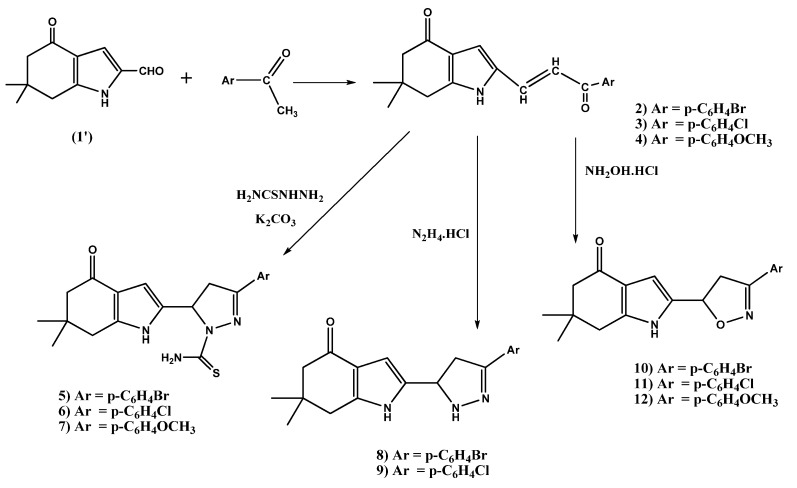
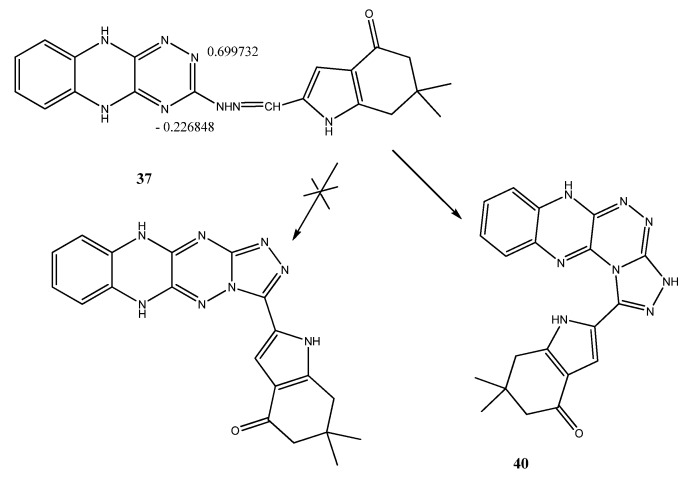
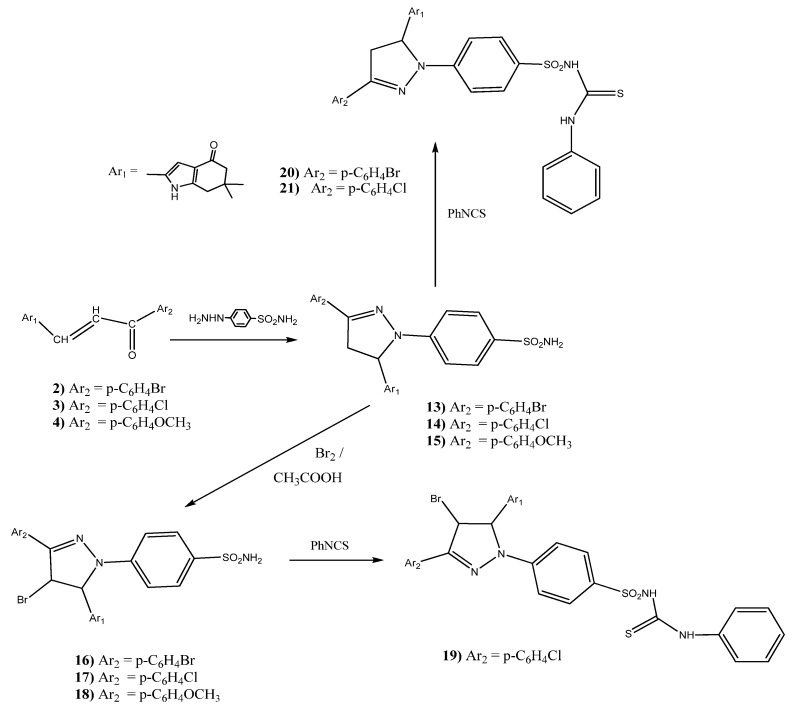
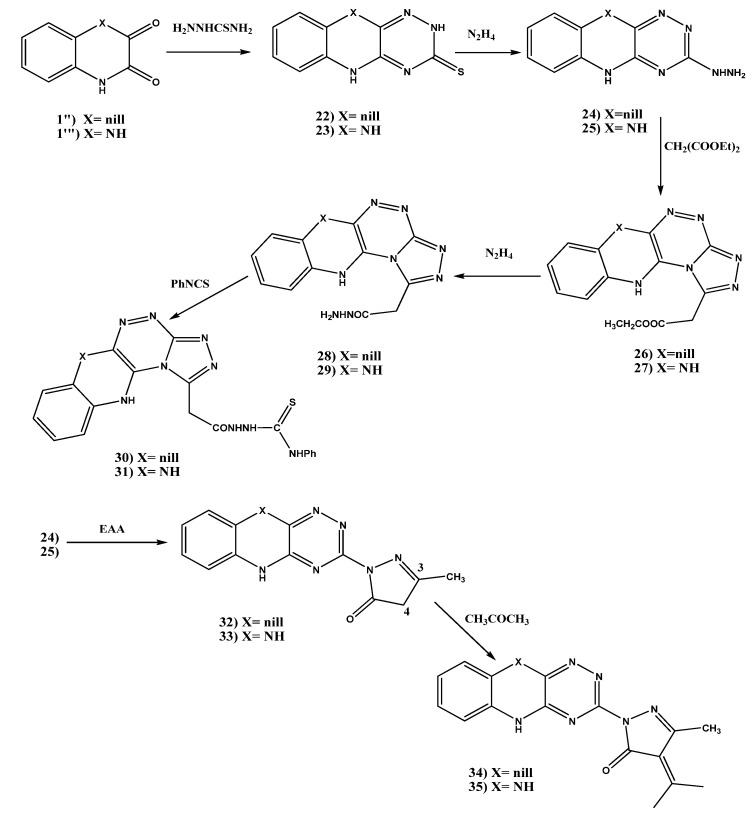
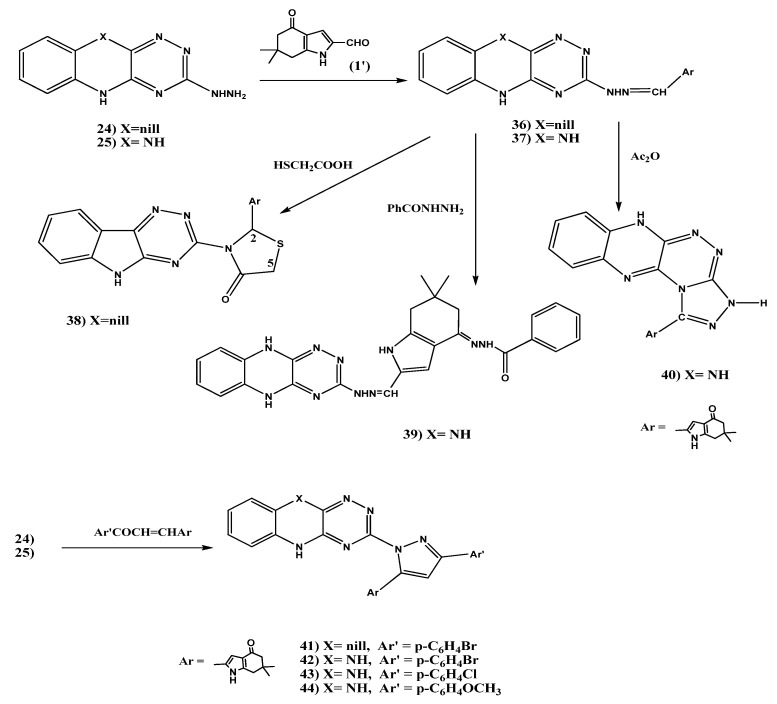
A series of 2-pyrazolines 5-9 have been synthesized from α,β-unsaturated ketones 2-4. New 2-pyrazoline derivatives 13-15 bearing benzenesulfonamide moieties were then synthesized by condensing the appropriate chalcones 2-4 with 4-hydrazinyl benzenesulfonamide hydrochloride. Ethyl [1,2,4] triazolo[3,4-c][1,2,4]triazino[5,6-b]-5H-indole-5-ethanoate (26) and 1-(5H-[1,2,4]triazino[5,6-b] indol-3-yl)-3-methyl-1H-pyrazol-5(4H)-one (32) were synthesized from 3-hydrazinyl-5H-[1,2,4]triazino[5,6-b]indole (24). On the other hand ethyl[1,2,4]triazolo[3,4-c][1,2,4]triazino[5,6-b]-5,10-dihydroquinoxaline- 5-ethanoate (27) and 1-(5,10-dihydro-[1,2,4]triazino[5,6-b]quinoxalin-3-yl)-3-methyl-1H-pyrazol-5(4H)-one (33) were synthesized from 3-hydrazinyl-5,10-dihydro-[1,2,4]triazino[5,6-b]quinoxaline (25) by reaction with diethyl malonate or ethyl acetoacetate, respectively. Condensation of 6,6-dimethyl-4-oxo-4,5,6,7-tetrahydro-1H-indole-2-carbaldehyde (1') with compound 24 or 25 afforded the corresponding Schiff's bases 36 and 37, respectively. Reaction of the Schiff's base 37 with benzoyl hydrazine or acetic anhydride afforded benzohydrazide derivative 39 and the cyclized compound 40, respectively. Furthermore, the pyrazole derivatives 42-44 were synthesized by cyclization of hydrazine derivative 25 with the prepared chalcones 2-4. All the newly synthesized compounds have been characterized on the basis of IR and 1H-NMR spectral data as well as physical data. Antimicrobial activity against the organisms E. coli ATCC8739 and P. aeruginosa ATCC 9027 as examples of Gram-negative bacteria, S. aureus ATCC 6583P as an example of Gram-positive bacteria and C. albicans ATCC 2091 as an example of a yeast-like fungus have been studied using the Nutrient Agar (NA) and Sabouraud Dextrose Agar (SDA) diffusion methods. The best performance was found for the compounds 16, 17, 19 and 20.
一系列 2-吡唑啉 5-9 是由α,β-不饱和酮 2-4 合成的。然后,通过将适当的查耳酮 2-4 与 4-肼基苯磺酰胺盐酸盐缩合,合成了具有苯磺酰胺部分的新的 2-吡唑啉衍生物 13-15。乙基[1,2,4]三唑并[3,4-c][1,2,4]三唑并[5,6-b]-5H-吲哚-5-乙酰胺(26)和 1-(5H-[1,2,4]三唑并[5,6-b]吲哚-3-基)-3-甲基-1H-吡唑-5(4H)-酮(32)是由 3-肼基-5H-[1,2,4]三唑并[5,6-b]吲哚(24)合成的。另一方面,乙基[1,2,4]三唑并[3,4-c][1,2,4]三唑并[5,6-b]-5,10-二氢喹喔啉-5-乙酰胺(27)和 1-(5,10-二氢-[1,2,4]三唑并[5,6-b]喹喔啉-3-基)-3-甲基-1H-吡唑-5(4H)-酮(33)是由 3-肼基-5,10-二氢-[1,2,4]三唑并[5,6-b]喹喔啉(25)与丙二酸二乙酯或乙酰乙酸乙酯分别反应合成的。6,6-二甲基-4-氧代-4,5,6,7-四氢-1H-吲哚-2-甲醛(1')与化合物 24 或 25 缩合得到相应的席夫碱 36 和 37。席夫碱 37 与苯甲酰肼或乙酸酐反应得到苯甲酰肼衍生物 39 和环化化合物 40。此外,通过将肼衍生物 25 与制备的查耳酮 2-4 环化,合成了吡唑衍生物 42-44。所有新合成的化合物均基于 IR 和 1H-NMR 光谱数据以及物理数据进行了表征。采用营养琼脂(NA)和沙保罗葡萄糖琼脂(SDA)扩散法,研究了它们对大肠杆菌 ATCC8739 和铜绿假单胞菌 ATCC 9027 等革兰氏阴性菌、金黄色葡萄球菌 ATCC 6583P 等革兰氏阳性菌和白色念珠菌 ATCC 2091 等酵母样真菌的抗菌活性。发现化合物 16、17、19 和 20 的性能最佳。