Department of Pharmacognosy, School of Pharmacy, 3rd Military Medical University, Chongqing, China.
Cell Death Dis. 2013 Feb 28;4(2):e515. doi: 10.1038/cddis.2013.41.
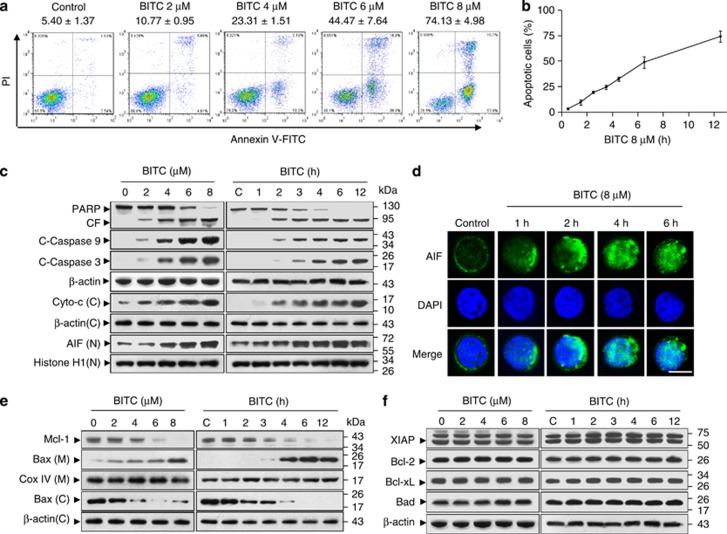
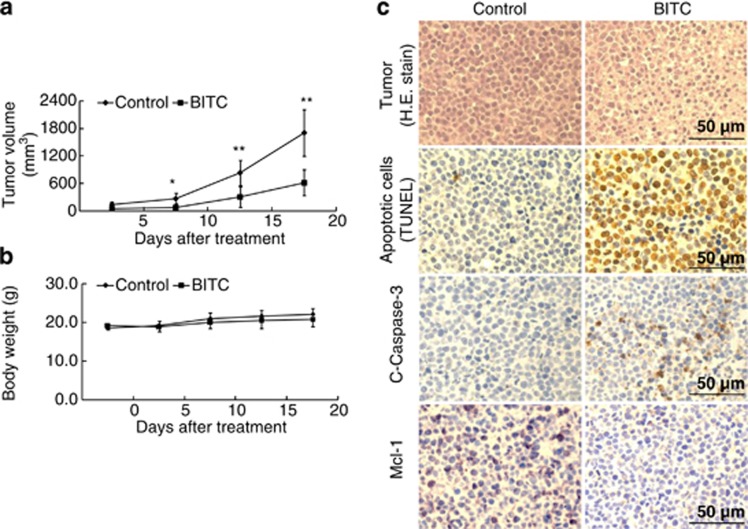
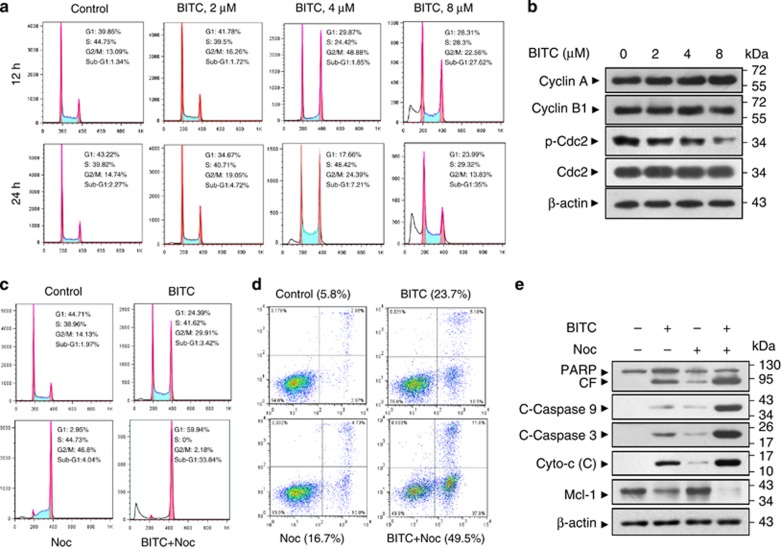
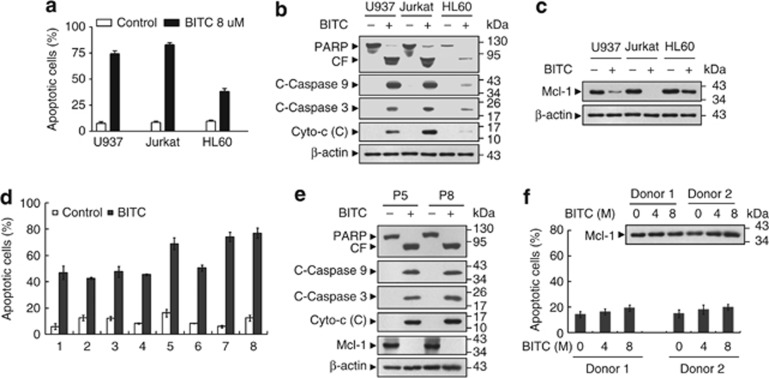
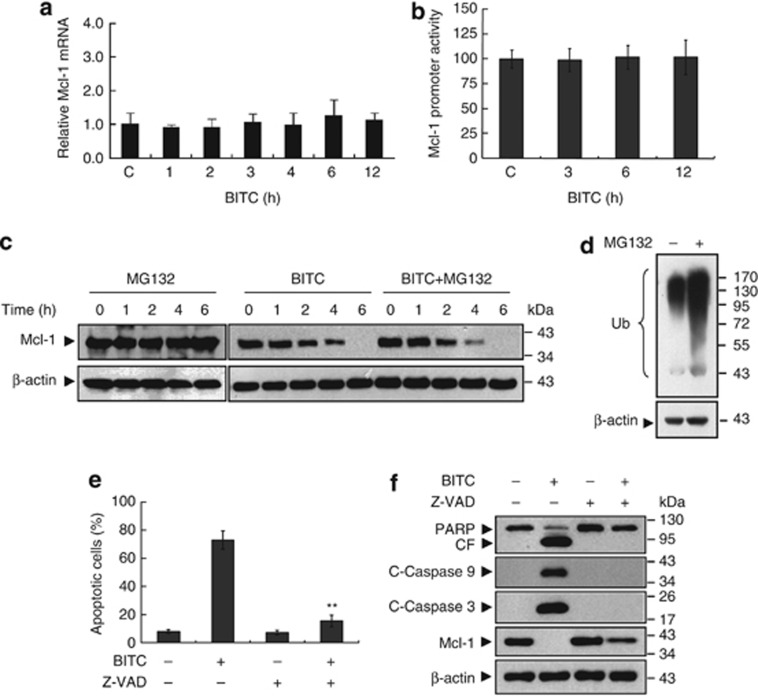
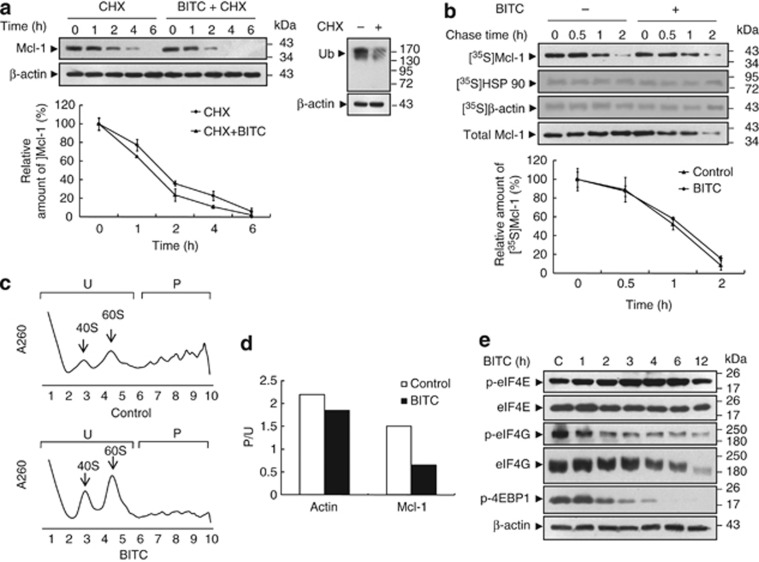
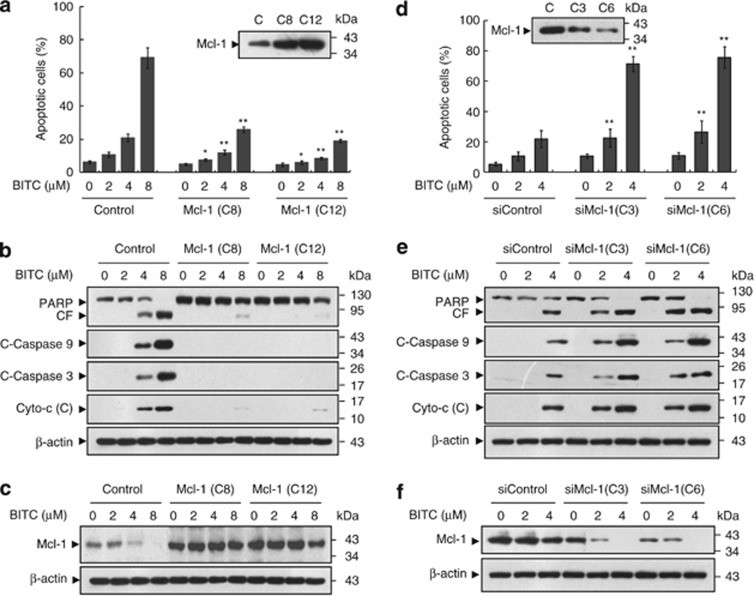
Benzyl isothiocyanate (BITC) is one of the compounds of ITCs' family that has attracted a great deal of interest because of its ability to exhibit anticancer activity. In this study, we investigated the effects of BITC on cell cycle arrest and apoptosis in human leukemia cell lines, primary leukemia cells, and nude mice Jurkat xenograft. Exposure of Jurkat cells to BITC resulted in dose- and time-dependent increase in apoptosis, caspase activation, cytochrome c release, nuclear apoptosis-inducing factor (AIF) accumulation, Bcl2-associated X protein (Bax) translocation, and myeloid cell leukemia-1 (Mcl-1) downregulation. Treatment with these cells also resulted in cell cycle arrest at the G2/M phase. The G2/M-arrested cells are more sensitive to undergoing Mcl-1 downregulation and apoptosis mediated by BITC. BITC downregulates Mcl-1 expression through inhibition of translation, rather than through a transcriptional, post-translational, or caspase-dependent mechanism. Dephosphorylation of eukaryotic initiation factor 4G could contribute to the inhibition of Mcl-1 translation mediated by BITC. Furthermore, ectopic expression of Mcl-1 substantially attenuates BITC-mediated lethality in these cells, whereas knockdown of Mcl-1 through small interfering RNA significantly enhances BITC-mediated lethality. Finally, administration of BITC markedly inhibited tumor growth and induced apoptosis in Jurkat xenograft model in association with the downregulation of Mcl-1. Taken together, these findings represent a novel mechanism by which agents targeting Mcl-1 potentiate BITC lethality in transformed and primary human leukemia cells and inhibitory activity of tumor growth of Jurkat xenograft model.
苄基异硫氰酸酯(BITC)是异硫氰酸酯家族的化合物之一,由于其表现出抗癌活性的能力而引起了极大的关注。在这项研究中,我们研究了 BITC 对人白血病细胞系、原代白血病细胞和裸鼠 Jurkat 异种移植中细胞周期停滞和细胞凋亡的影响。Jurkat 细胞暴露于 BITC 会导致细胞凋亡、半胱天冬酶激活、细胞色素 c 释放、核凋亡诱导因子(AIF)积累、Bcl2 相关 X 蛋白(Bax)易位和髓细胞白血病-1(Mcl-1)下调呈剂量和时间依赖性增加。用这些细胞处理也会导致细胞周期停滞在 G2/M 期。处于 G2/M 期的细胞对 BITC 介导的 Mcl-1 下调和细胞凋亡更为敏感。BITC 通过抑制翻译而不是通过转录、翻译后或半胱天冬酶依赖机制下调 Mcl-1 表达。真核起始因子 4G 的去磷酸化可能有助于 BITC 介导的 Mcl-1 翻译抑制。此外,Mcl-1 的异位表达可显著减轻这些细胞中 BITC 介导的致死性,而通过小干扰 RNA 敲低 Mcl-1 则显著增强 BITC 介导的致死性。最后,给予 BITC 可显著抑制 Jurkat 异种移植模型中的肿瘤生长并诱导细胞凋亡,同时下调 Mcl-1。总之,这些发现代表了一种新的机制,即靶向 Mcl-1 的药物可增强转化和原代人白血病细胞中 BITC 的致死性,并抑制 Jurkat 异种移植模型中的肿瘤生长活性。