Department of Biomedical Sciences and Cancer Biology Center, School of Pharmacy, Texas Tech University Health Sciences Center, Amarillo, Texas 79106, USA.
Clin Cancer Res. 2011 Apr 1;17(7):1784-95. doi: 10.1158/1078-0432.CCR-10-1891. Epub 2011 Feb 24.
Our previous studies have shown that benzyl isothiocyanate (BITC) suppress pancreatic cancer growth by inducing apoptosis but the molecular mechanism was unclear. In this study we hypothesized the involvement of PI3K/AKT/FOXO pathway in BITC-induced apoptosis.
Mice were implanted BxPC-3 tumor xenografts and orally gavaged with 12 μmol BITC. Plasma and tumor BITC concentration was estimated by liquid chromatography/tandem mass spectrometry. BxPC-3 and PanC-1 cells were used to elucidate PI3K/AKT/FOXO pathway. Electrophoretic mobility shift assay (EMSA), DNA binding activity, immunofluorescence, and gene transfection were used to delineate the mechanism.
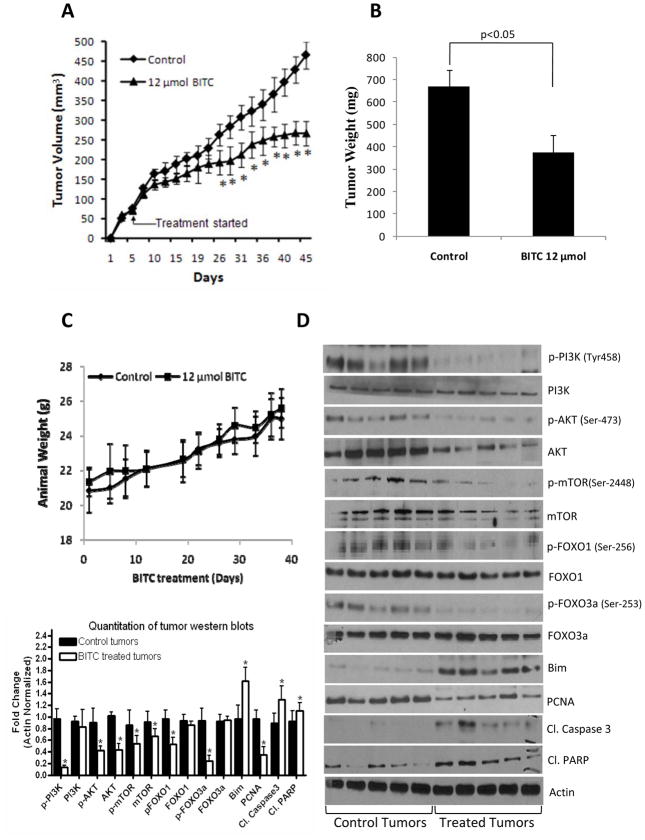
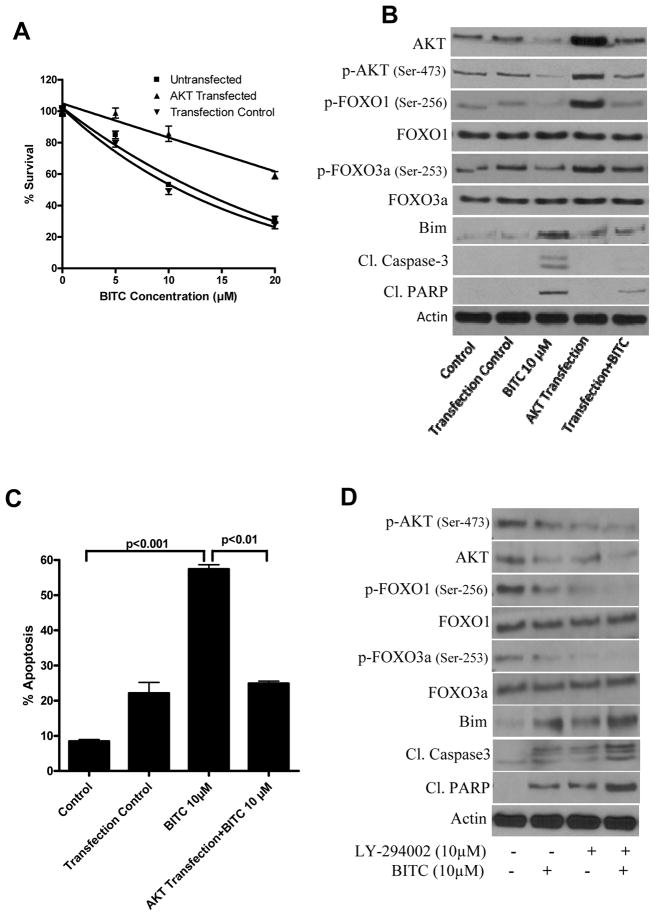
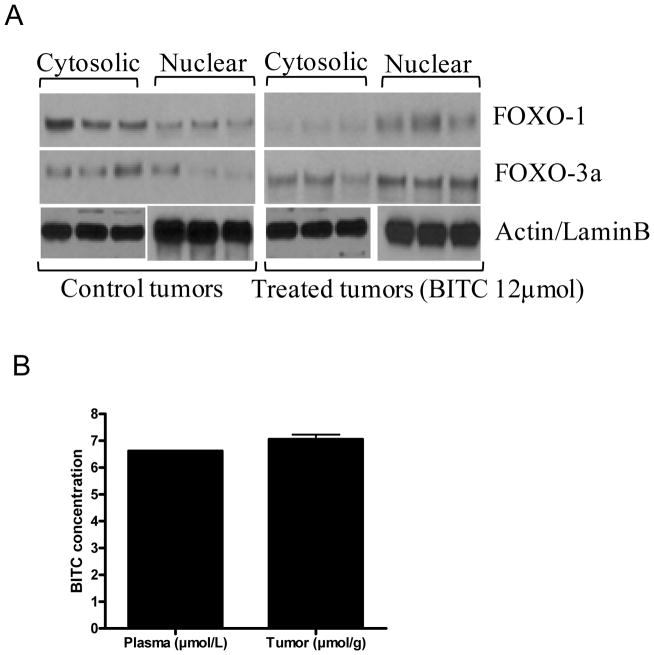
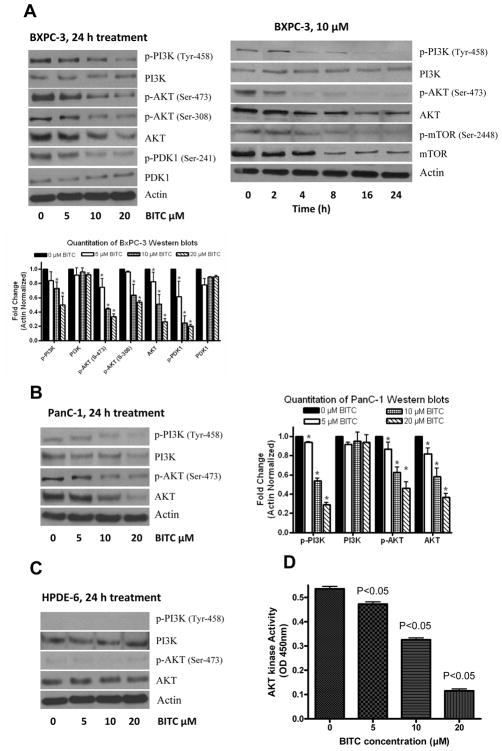
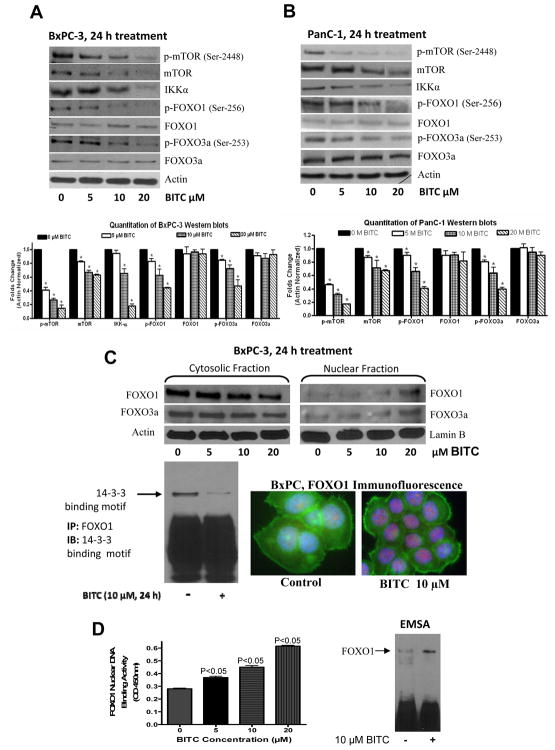
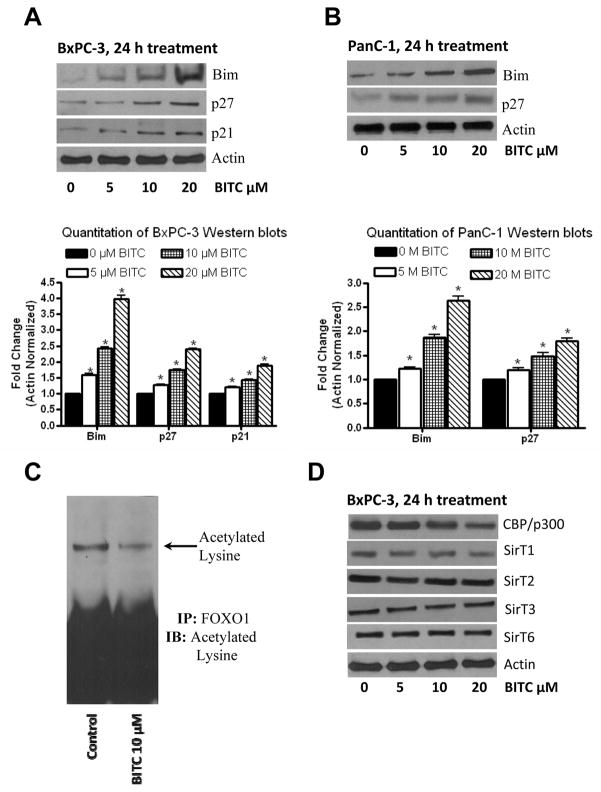
BITC-treated mice showed 43% less tumor growth as compared with control mice and correlated well with the therapeutic concentrations of 6.5 μmol/L BITC achieved in plasma and 7.5 μmol/g BITC in tumor tissue. Western blot analyses and immunohistochemistry revealed that tumors from BITC-treated mice showed reduced phosphorylation of PI3K, AKT, PDK1, mTOR, FOXO1, and FOXO3a and increased apoptosis. Complementing our in vivo results, we made similar observations in a dose- and time-dependent manner in BITC-treated BxPC-3 and Panc-1 cells. Binding of FOXO1 with 14-3-3 proteins was also reduced drastically by BITC treatment indicating nuclear retention of FOXO1 and this observation was further confirmed with EMSA, immunofluorescence, DNA binding, and upregulation of FOXO-responsive proteins Bim, p27, and p21 in BxPC-3 cells. Overexpression of AKT by transient transfection significantly blocked the modulation of FOXO proteins and protected the cells from BITC-mediated apoptosis and growth suppression.
Our results provide convincing evidence on the involvement of PI3K/AKT/FOXO pathway in BITC-mediated pancreatic tumor growth suppression.
我们之前的研究表明,苄基异硫氰酸酯(BITC)通过诱导细胞凋亡来抑制胰腺癌的生长,但具体的分子机制尚不清楚。在这项研究中,我们假设 PI3K/AKT/FOXO 通路参与了 BITC 诱导的细胞凋亡。
将 BxPC-3 肿瘤异种移植到小鼠体内,并通过口服给予 12 μmol BITC。通过液相色谱/串联质谱法测定血浆和肿瘤中的 BITC 浓度。使用 BxPC-3 和 PanC-1 细胞来阐明 PI3K/AKT/FOXO 通路。使用电泳迁移率变动分析(EMSA)、DNA 结合活性、免疫荧光和基因转染来阐明机制。
与对照组小鼠相比,BITC 处理的小鼠肿瘤生长减少了 43%,这与血浆中 6.5 μmol/L BITC 和肿瘤组织中 7.5 μmol/g BITC 的治疗浓度密切相关。Western blot 分析和免疫组化显示,BITC 处理的肿瘤中 PI3K、AKT、PDK1、mTOR、FOXO1 和 FOXO3a 的磷酸化水平降低,凋亡增加。补充我们的体内研究结果,我们在剂量和时间依赖性方式下在 BITC 处理的 BxPC-3 和 Panc-1 细胞中也观察到了类似的结果。BITC 处理还大大降低了 FOXO1 与 14-3-3 蛋白的结合,表明 FOXO1 核保留,这一观察结果通过 EMSA、免疫荧光、DNA 结合和 BxPC-3 细胞中 FOXO 反应蛋白 Bim、p27 和 p21 的上调进一步得到证实。瞬时转染 AKT 的过表达显著阻断了 FOXO 蛋白的调节,并保护细胞免受 BITC 介导的凋亡和生长抑制。
我们的研究结果提供了令人信服的证据,表明 PI3K/AKT/FOXO 通路参与了 BITC 介导的胰腺肿瘤生长抑制。