State Key Laboratory of Urban and Regional Ecology, Research Center for Eco-Environmental Sciences, Chinese Academy of Sciences, Beijing, China.
PLoS One. 2013;8(2):e57593. doi: 10.1371/journal.pone.0057593. Epub 2013 Feb 25.
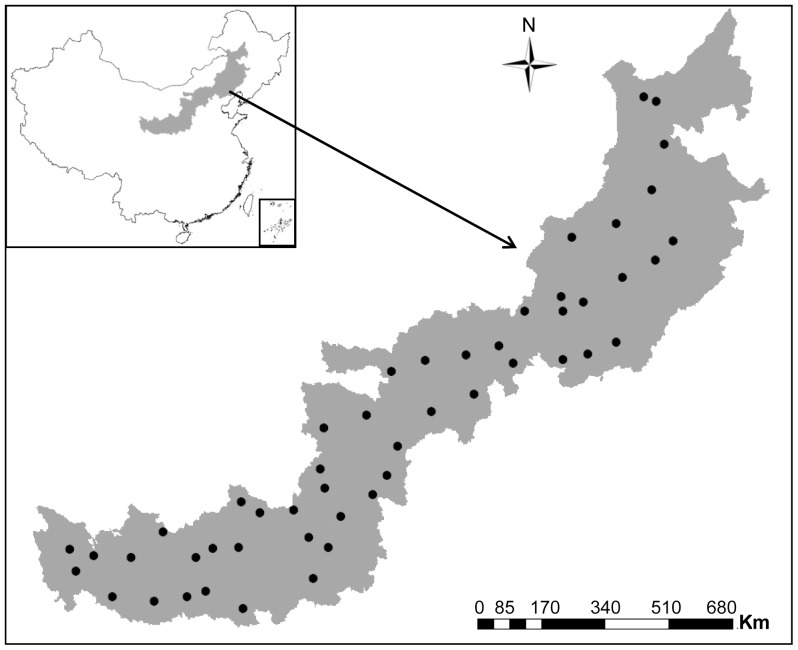
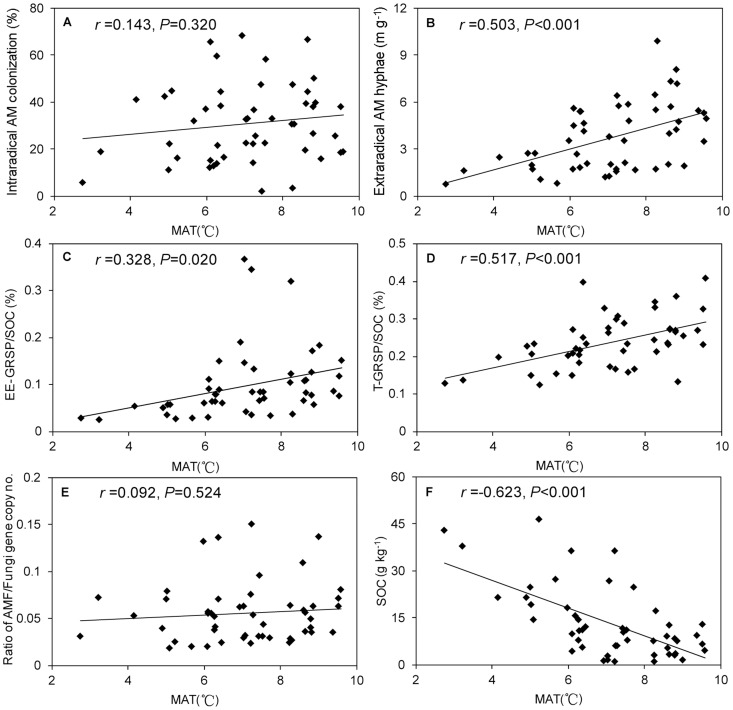
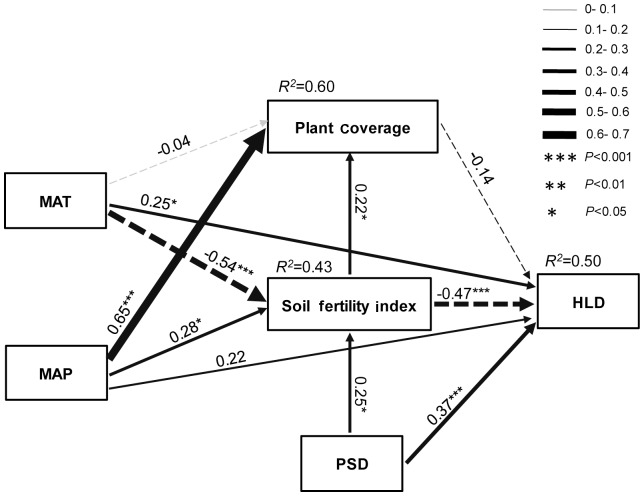
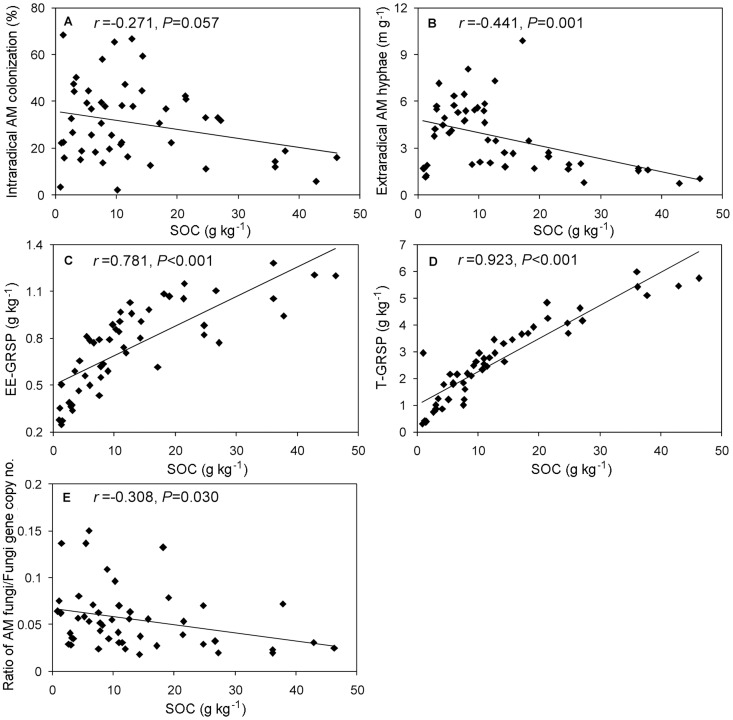
Arbuscular mycorrhizal (AM) fungi are ubiquitous symbionts of higher plants in terrestrial ecosystems, while the occurrence of the AM symbiosis is influenced by a complex set of abiotic and biotic factors. To reveal the regional distribution pattern of AM fungi as driven by multiple environmental factors, and to understand the ecological importance of AM fungi in natural ecosystems, we conducted a field investigation on AM fungal abundance along environmental gradients in the arid and semi-arid grasslands of northern China. In addition to plant parameters recorded in situ, soil samples were collected, and soil chemo-physical and biological parameters were measured in the lab. Statistical analyses were performed to reveal the relative contribution of climatic, edaphic and vegetation factors to AM fungal abundance, especially for extraradical hyphal length density (HLD) in the soil. The results indicated that HLD were positively correlated with mean annual temperature (MAT), soil clay content and soil pH, but negatively correlated with both soil organic carbon (SOC) and soil available N. The multiple regressions and structural equation model showed that MAT was the key positive contributor and soil fertility was the key negative contributor to HLD. Furthermore, both the intraradical AM colonization (IMC) and relative abundance of AM fungi, which was quantified by real-time PCR assay, tended to decrease along the increasing SOC content. With regard to the obvious negative correlation between MAT and SOC in the research area, the positive correlation between MAT and HLD implied that AM fungi could potentially mitigate soil carbon losses especially in infertile soils under global warming. However, direct evidence from long-term experiments is still expected to support the AM fungal contribution to soil carbon pools.
丛枝菌根(AM)真菌是陆地生态系统中高等植物普遍存在的共生体,而 AM 共生体的发生受到一系列复杂的非生物和生物因素的影响。为了揭示 AM 真菌受多种环境因素驱动的区域分布模式,并了解 AM 真菌在自然生态系统中的生态重要性,我们在中国北方干旱半干旱草原的环境梯度上进行了 AM 真菌丰度的实地调查。除了原位记录植物参数外,还采集了土壤样本,并在实验室测量了土壤化学物理和生物学参数。进行了统计分析,以揭示气候、土壤和植被因素对 AM 真菌丰度的相对贡献,特别是对土壤中根外菌丝长度密度(HLD)的影响。结果表明,HLD 与年平均温度(MAT)、土壤粘粒含量和土壤 pH 值呈正相关,而与土壤有机碳(SOC)和土壤有效氮呈负相关。多元回归和结构方程模型表明,MAT 是 HLD 的关键正贡献因素,土壤肥力是 HLD 的关键负贡献因素。此外,通过实时 PCR 测定定量的根内 AM 定殖(IMC)和 AM 真菌相对丰度都倾向于随着 SOC 含量的增加而减少。鉴于研究区域中 MAT 和 SOC 之间存在明显的负相关,MAT 和 HLD 之间的正相关表明 AM 真菌可能有助于减轻土壤碳损失,特别是在全球变暖下贫瘠土壤中的土壤碳损失。然而,仍需要长期实验的直接证据来支持 AM 真菌对土壤碳库的贡献。