Ernest Gallo Clinic and Research Center, Emeryville, California, United States of America.
PLoS One. 2013;8(2):e57857. doi: 10.1371/journal.pone.0057857. Epub 2013 Feb 25.
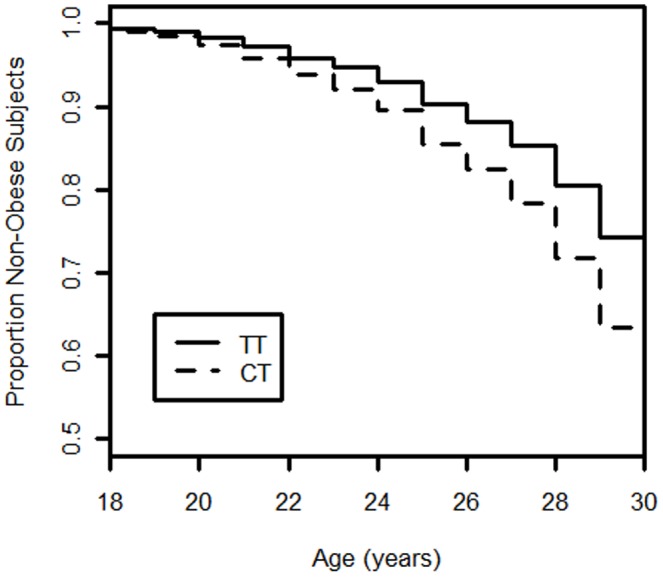
Common PCSK1 variants (notably rs6232 and rs6235) have been shown to be associated with obesity in European, Asian and Mexican populations. To determine whether common PCSK1 variants contribute to obesity in American population, we conducted association analyses in 8,359 subjects using two multi-ethnic American studies: the Coronary Artery Risk Development in Young Adults (CARDIA) study and the Multi-Ethnic Study of Atherosclerosis (MESA). By evaluating the contribution of rs6232 and rs6235 in each ethnic group, we found that in European-American subjects from CARDIA, only rs6232 was associated with BMI (P = 0.006) and obesity (P = 0.018) but also increased the obesity incidence during the 20 years of follow-up (HR = 1.53 [1.07-2.19], P = 0.019). Alternatively, in African-American subjects from CARDIA, rs6235 was associated with BMI (P = 0.028) and obesity (P = 0.018). Further, by combining the two case-control ethnic groups from the CARDIA study in a meta-analysis, association between rs6235 and obesity risk remained significant (OR = 1.23 [1.05-1.45], P = 9.5×10(-3)). However, neither rs6232 nor rs6235 was associated with BMI or obesity in the MESA study. Interestingly, rs6232 was associated with BMI (P = 4.2×10(-3)) and obesity (P = 3.4×10(-3)) in the younger European-American group combining samples from the both studies [less than median age (53 years)], but not among the older age group (P = 0.756 and P = 0.935 for BMI and obesity, respectively). By combining all the case-control ethnic groups from CARDIA and MESA in a meta-analysis, we found no significant association for the both variants and obesity risk. Finally, by exploring the full PCSK1 locus, we observed that no variant remained significant after correction for multiple testing. These results indicate that common PCSK1 variants (notably rs6232 and rs6235) contribute modestly to obesity in multi-ethnic American population. Further, these results suggest that the association of rs6232 with obesity may be age-dependent in European-Americans. However, multiple replication studies in multi-ethnic American population are needed to confirm our findings.
常见的 PCSK1 变异体(尤其是 rs6232 和 rs6235)已被证明与欧洲、亚洲和墨西哥人群的肥胖有关。为了确定常见的 PCSK1 变异体是否与美国人群的肥胖有关,我们使用两个多民族美国研究(冠状动脉风险发展在年轻人(CARDIA)研究和多民族动脉粥样硬化研究(MESA))在 8359 名受试者中进行了关联分析。通过评估 rs6232 和 rs6235 在每个种族群体中的贡献,我们发现 CARDIA 的欧洲裔美国人中,只有 rs6232 与 BMI(P=0.006)和肥胖(P=0.018)有关,但也增加了 20 年随访期间的肥胖发生率(HR=1.53 [1.07-2.19],P=0.019)。相反,CARDIA 的非裔美国人中,rs6235 与 BMI(P=0.028)和肥胖(P=0.018)有关。此外,通过对 CARDIA 研究中的两个病例对照种族群体进行荟萃分析,rs6235 与肥胖风险之间的关联仍然显著(OR=1.23 [1.05-1.45],P=9.5×10(-3))。然而,rs6232 和 rs6235 在 MESA 研究中均与 BMI 或肥胖无关。有趣的是,rs6232 与 BMI(P=4.2×10(-3))和肥胖(P=3.4×10(-3))在两个研究的合并样本中年轻的欧洲裔美国人组中有关(年龄中位数以下(53 岁)),但在年龄较大的组中无关(BMI 和肥胖的 P 值分别为 0.756 和 0.935)。通过对 CARDIA 和 MESA 的所有病例对照种族群体进行荟萃分析,我们发现这两个变体与肥胖风险之间没有显著关联。最后,通过探索完整的 PCSK1 基因座,我们发现经过多次检验校正后,没有变体仍然具有统计学意义。这些结果表明,常见的 PCSK1 变体(尤其是 rs6232 和 rs6235)在多民族的美国人群中对肥胖有一定的贡献。此外,这些结果表明 rs6232 与肥胖的关联可能在欧洲裔美国人中与年龄有关。然而,需要在多民族的美国人群中进行多次复制研究来证实我们的发现。