National Parkinson Foundation Centre of Excellence and National RLS, King's College Hospital, 9th Floor Ruskin Wing, Denmark Hill, London, SE5 9RS, UK.
J Neural Transm (Vienna). 2013 Sep;120(9):1305-20. doi: 10.1007/s00702-013-0981-5. Epub 2013 Mar 2.
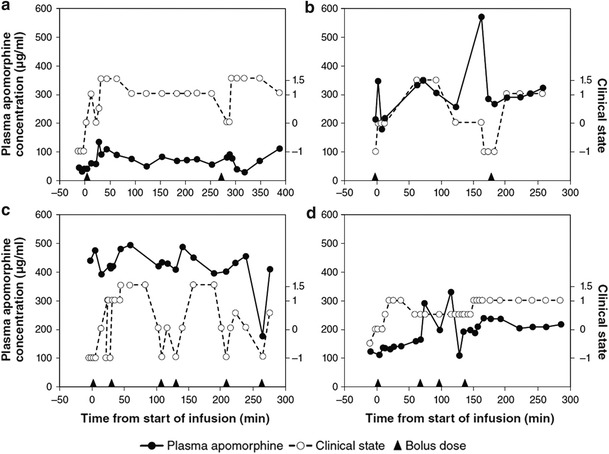
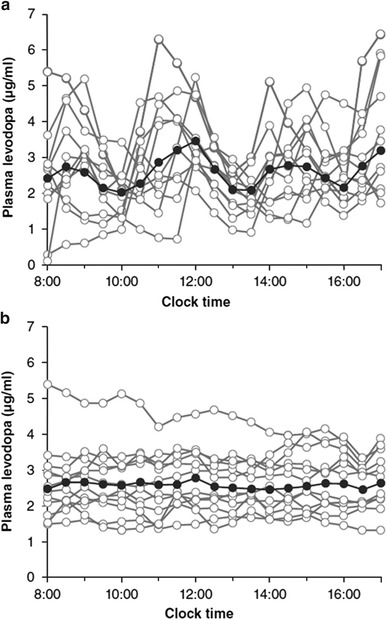
The complications of long-term levodopa therapy for Parkinson's disease (PD) include motor fluctuations, dyskinesias, and also nonmotor fluctuations-at least equally common, but less well appreciated-in autonomic, cognitive/psychiatric, and sensory symptoms. In seeking the pathophysiologic mechanisms, the leading hypothesis is that in the parkinsonian brain, intermittent, nonphysiological stimulation of striatal dopamine receptors destabilizes an already unstable system. Accordingly, a major goal of PD treatment in recent years has been the attainment of continuous dopaminergic stimulation (CDS)-or, less theoretically (and more clinically verifiable), continuous drug delivery (CDD). Improvements in the steadiness of the plasma profiles of various dopaminergic therapies may be a signal of progress. However, improvements in plasma profile do not necessarily translate into CDS, or even into CDD to the brain. Still, it is reassuring that clinical studies of approaches to CDD have generally been positive. Head-to-head comparative trials have often failed to uncover evidence favoring such approaches over an intermittent therapy. Nevertheless, the findings among recipients of subcutaneous apomorphine infusion or intrajejunal levodopa/carbidopa intestinal gel suggest that nonmotor PD symptoms or complications may improve in tandem with motor improvement. In vivo receptor binding studies may help to determine the degree of CDS that a dopaminergic therapy can confer. This may be a necessary first step toward establishing whether CDS is, in fact, an important determinant of clinical efficacy. Certainly, the complexities of optimal PD management, and the rationale for an underlying strategy such as CDS or CDD, have not yet been thoroughly elucidated.
长期左旋多巴治疗帕金森病(PD)的并发症包括运动波动、运动障碍,以及自主神经、认知/精神和感觉症状等非运动波动,这些波动至少同样常见,但人们的认识却较少。在寻找病理生理机制时,主要假说认为,在帕金森大脑中,间歇性、非生理性的纹状体多巴胺受体刺激会破坏原本不稳定的系统。因此,近年来 PD 治疗的一个主要目标是实现持续多巴胺能刺激(CDS)-或者,理论上较少(但更能在临床上验证),持续药物输送(CDD)。各种多巴胺能治疗方法的血浆谱稳定性的提高可能是进展的信号。然而,血浆谱的改善并不一定转化为 CDS,甚至转化为大脑的 CDD。尽管如此,令人欣慰的是,对 CDD 方法的临床研究通常是积极的。头对头的比较试验往往未能发现支持这些方法优于间歇性治疗的证据。然而,皮下给予阿扑吗啡输注或空肠内左旋多巴/卡比多巴肠凝胶的受者的研究结果表明,非运动性 PD 症状或并发症可能与运动改善同时改善。体内受体结合研究可能有助于确定多巴胺能治疗方法可以提供的 CDS 程度。这可能是确定 CDS 是否实际上是临床疗效的重要决定因素的必要第一步。当然,最佳 PD 管理的复杂性,以及 CDS 或 CDD 等潜在策略的基本原理,尚未得到彻底阐明。