Marine Biodiversity Unit/Global Marine Species Assessment, Global Species Programme, International Union for Conservation of Nature, Gland, Switzerland.
PLoS One. 2013;8(2):e56245. doi: 10.1371/journal.pone.0056245. Epub 2013 Feb 15.
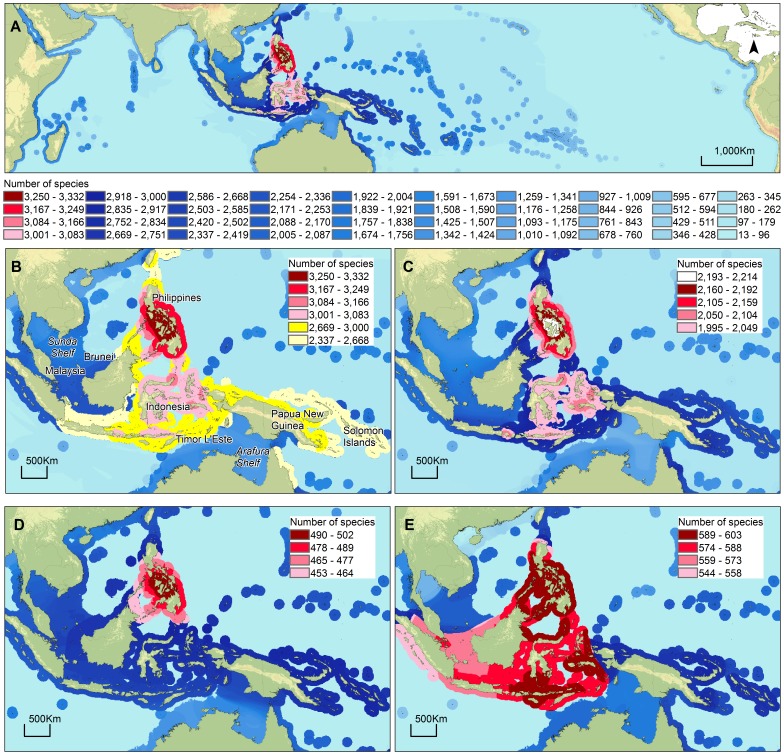
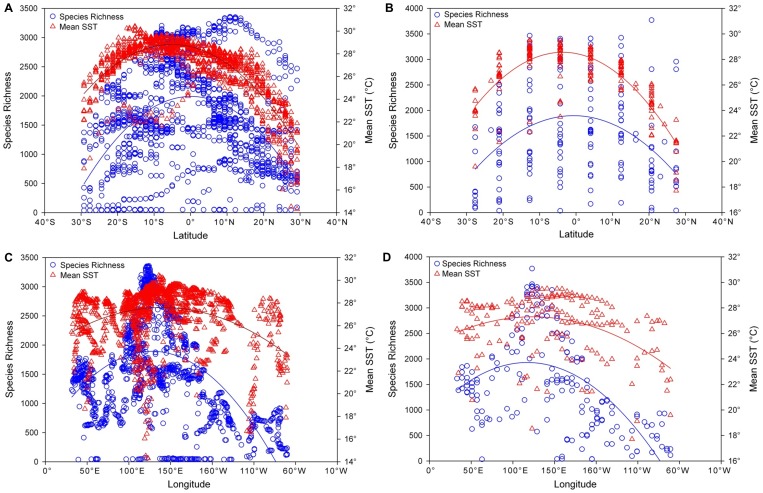
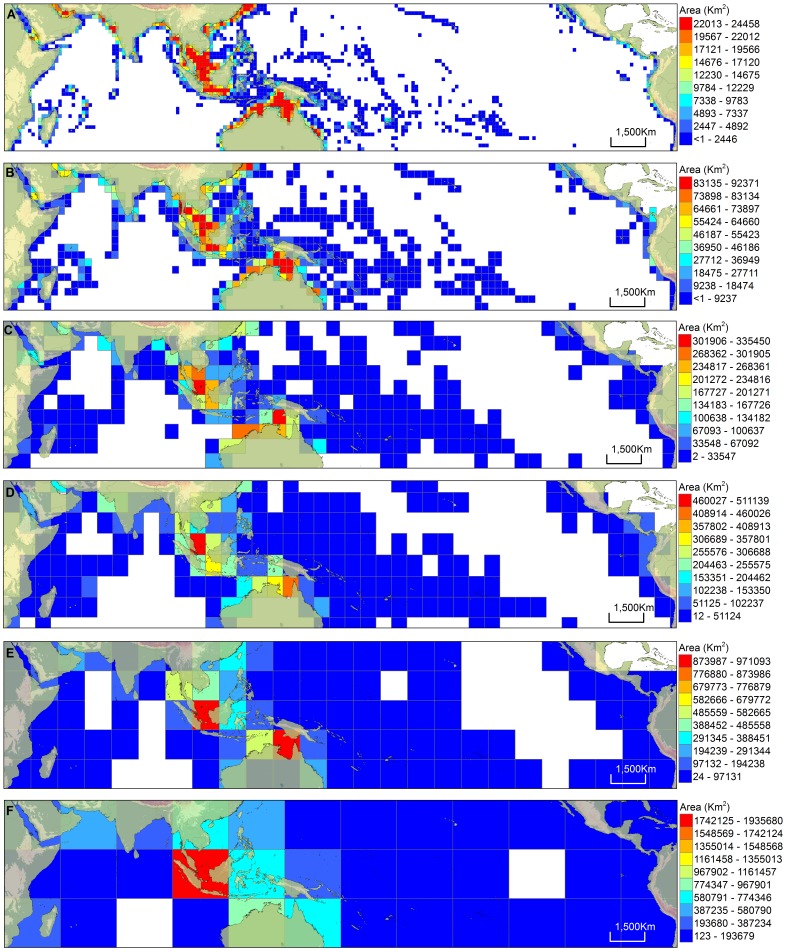
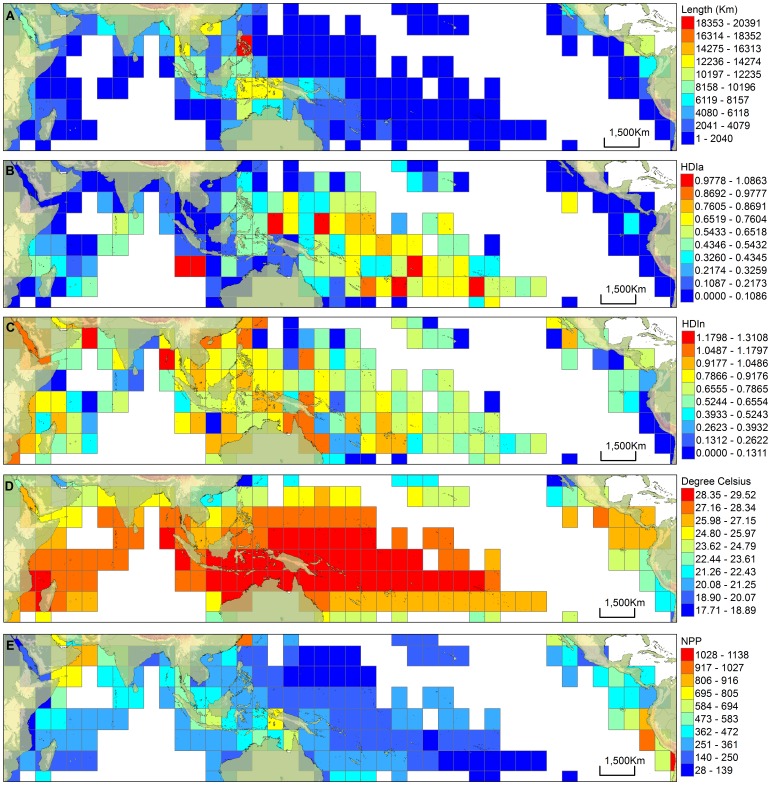
Range overlap patterns were observed in a dataset of 10,446 expert-derived marine species distribution maps, including 8,295 coastal fishes, 1,212 invertebrates (crustaceans and molluscs), 820 reef-building corals, 50 seagrasses, and 69 mangroves. Distributions of tropical Indo-Pacific shore fishes revealed a concentration of species richness in the northern apex and central region of the Coral Triangle epicenter of marine biodiversity. This pattern was supported by distributions of invertebrates and habitat-forming primary producers. Habitat availability, heterogeneity, and sea surface temperatures were highly correlated with species richness across spatial grains ranging from 23,000 to 5,100,000 km(2) with and without correction for autocorrelation. The consistent retention of habitat variables in our predictive models supports the area of refuge hypothesis which posits reduced extinction rates in the Coral Triangle. This does not preclude support for a center of origin hypothesis that suggests increased speciation in the region may contribute to species richness. In addition, consistent retention of sea surface temperatures in models suggests that available kinetic energy may also be an important factor in shaping patterns of marine species richness. Kinetic energy may hasten rates of both extinction and speciation. The position of the Indo-Pacific Warm Pool to the east of the Coral Triangle in central Oceania and a pattern of increasing species richness from this region into the central and northern parts of the Coral Triangle suggests peripheral speciation with enhanced survival in the cooler parts of the Coral Triangle that also have highly concentrated available habitat. These results indicate that conservation of habitat availability and heterogeneity is important to reduce extinction of marine species and that changes in sea surface temperatures may influence the evolutionary potential of the region.
在一个包含 10446 种专家绘制的海洋物种分布图谱的数据集,包括 8295 种沿海鱼类、1212 种无脊椎动物(甲壳类和软体动物)、820 种造礁珊瑚、50 种海草和 69 种红树林中,观察到了范围重叠模式。热带印度洋-太平洋沿岸鱼类的分布表明,物种丰富度集中在珊瑚三角区海洋生物多样性中心的北部顶点和中部地区。这种模式得到了无脊椎动物和形成栖息地的初级生产者分布的支持。栖息地的可用性、异质性和海面温度与物种丰富度高度相关,跨越从 23000 到 5100000 平方公里的空间粒度,无论是否校正自相关。在我们的预测模型中,栖息地变量的一致保留支持了避难所假说,该假说认为珊瑚三角区的灭绝率降低。这并不排除起源中心假说的支持,该假说认为该地区的物种形成可能有助于物种丰富度的增加。此外,海面温度在模型中的一致保留表明,可用的动能也可能是塑造海洋物种丰富度模式的一个重要因素。动能可能会加速灭绝和物种形成的速度。印度洋-太平洋暖池位于珊瑚三角区以东的中大洋,以及从该区域向珊瑚三角区中部和北部物种丰富度增加的模式表明,在珊瑚三角区较冷的地区有边缘物种形成,同时也有高度集中的可用栖息地,从而提高了生存能力。这些结果表明,保护栖息地的可用性和异质性对于减少海洋物种的灭绝非常重要,而海面温度的变化可能会影响该地区的进化潜力。