School of Public Health, Guangzhou Medical University, Guangzhou 510182, China.
Int J Mol Sci. 2013 Mar 4;14(3):5182-97. doi: 10.3390/ijms14035182.
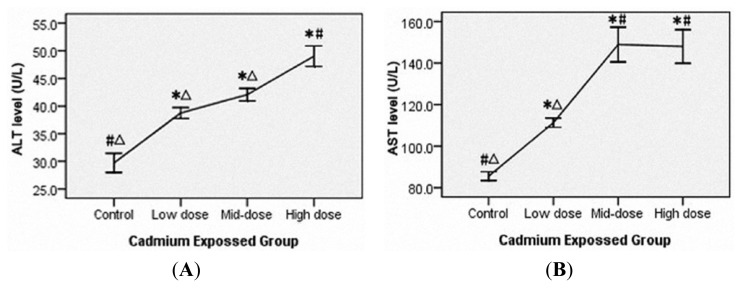
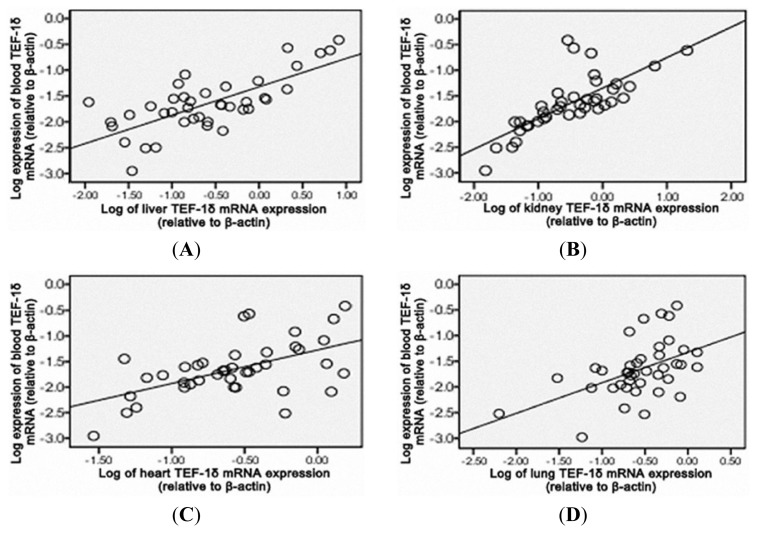
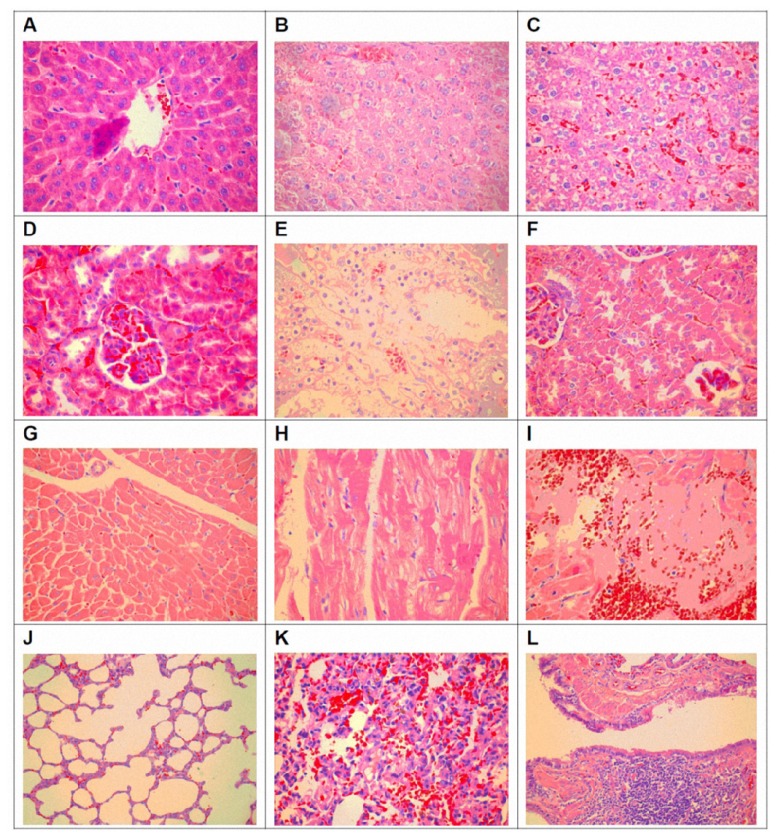
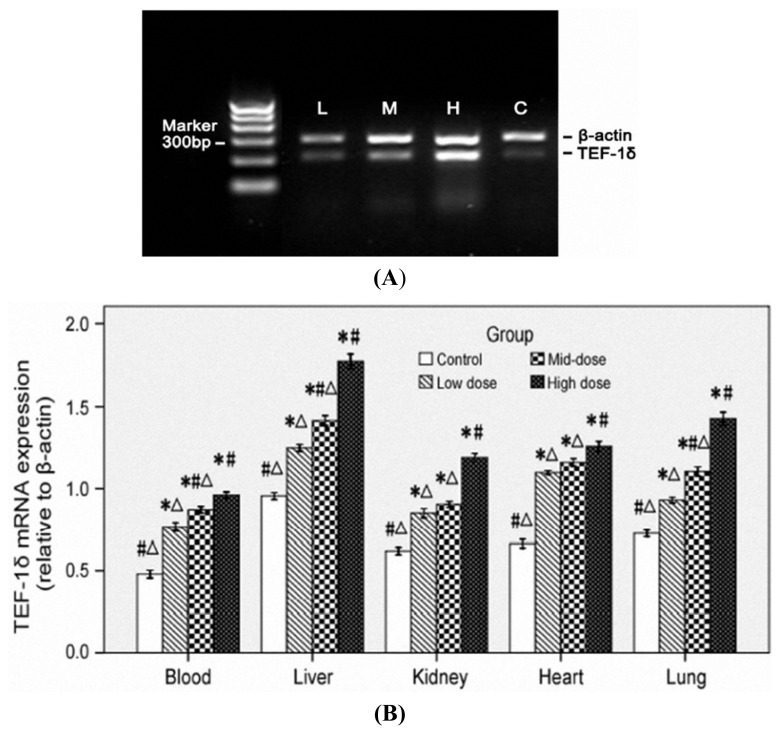
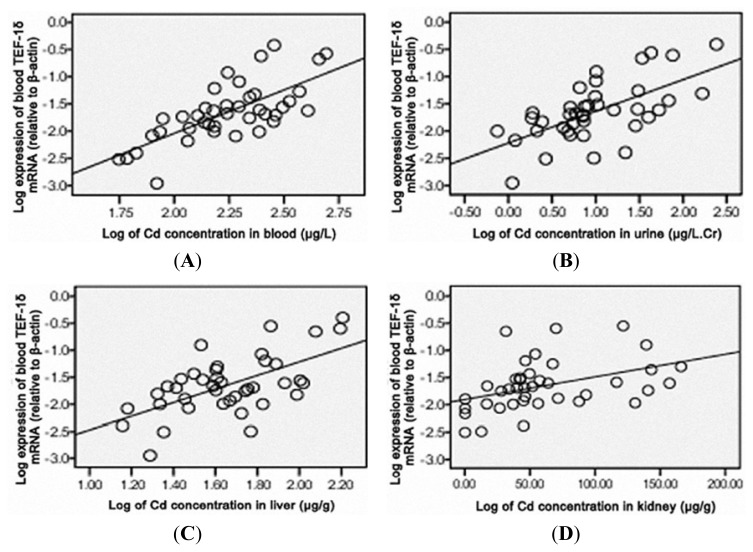
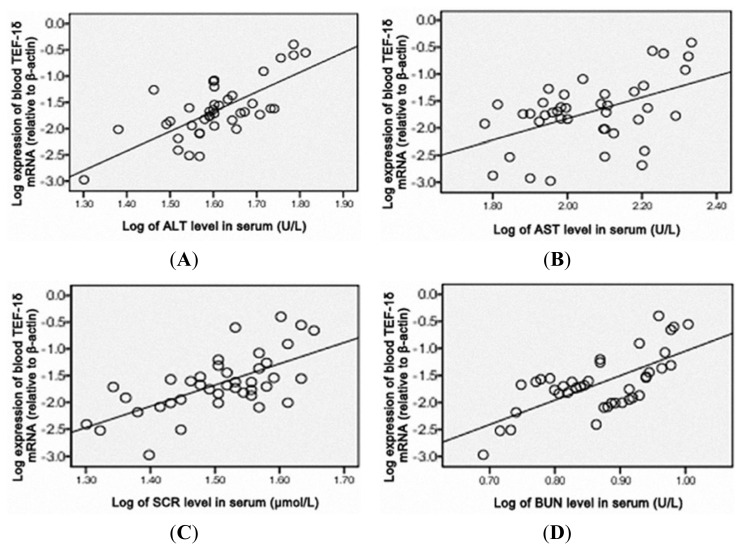
Translation elongation factor-1d (TEF-1δ) has been identified as a novel cadmium-responsive proto-oncogene. However, it is still unclear whether TEF-1δ could be a potential biomarker of cadmium exposure. Rats were treated with CdCl2 at different concentrations (high dose 1.225, mid-dose 0.612 and low dose 0.306 mg/kg body weight, respectively) for 14 weeks, and the cadmium levels, weight coefficients, serum alanine aminotransferase (ALT), aspartate aminotransferase (AST), blood urea nitrogen (BUN), serum creatinine (SCR), 24-h urine protein (24hPro), urinary creatinine (Cr) and pathological features were determined. The TEF-1δ expression in white blood cells and multiple organs were examined by reverse transcription polymerase chain reaction (PCR) and were also confirmed with fluorescence quantitative PCR. A cadmium dose-dependent increase (p < 0.05) of cadmium levels in blood, urine, liver, kidney, heart and lung, and the weight coefficients was observed. The liver and renal function indictors including AST, ALT, SCR, BUN and 24hPro, were elevated in a cadmium dose-dependent manner (p < 0.05). Significant pathological changes in liver, kidney, heart and lung were indicated. The TEF-1δ expression was up-regulated in both blood and organs (p < 0.05). Moreover, the expression level of blood TEF-1δ was positively correlated to TEF-1δ expression level, cadmium level and toxicity in the organs (p < 0.01). This study indicates that blood TEF-1δ is a novel valuable biomarker for cadmium exposure and its organ toxicity.
翻译延伸因子-1d(TEF-1δ)已被确定为一种新型的镉反应原癌基因。然而,目前尚不清楚 TEF-1δ 是否可以作为镉暴露的潜在生物标志物。将大鼠用 CdCl2 以不同浓度(高剂量 1.225、中剂量 0.612 和低剂量 0.306mg/kg 体重)处理 14 周,测定镉水平、体重系数、血清丙氨酸氨基转移酶(ALT)、天冬氨酸氨基转移酶(AST)、血尿素氮(BUN)、血清肌酐(SCR)、24 小时尿蛋白(24hPro)、尿肌酐(Cr)和病理特征。采用逆转录聚合酶链反应(PCR)和荧光定量 PCR 检测白细胞和多个器官中的 TEF-1δ 表达,并进行了验证。观察到血液、尿液、肝脏、肾脏、心脏和肺部的镉水平以及体重系数呈镉剂量依赖性增加(p<0.05)。AST、ALT、SCR、BUN 和 24hPro 等肝肾功能指标呈镉剂量依赖性升高(p<0.05)。表明肝、肾、心、肺均有明显的病理变化。血液和器官中的 TEF-1δ 表达均上调(p<0.05)。此外,血液 TEF-1δ 的表达水平与器官中 TEF-1δ 的表达水平、镉水平和毒性呈正相关(p<0.01)。本研究表明,血液 TEF-1δ 是镉暴露及其器官毒性的一种新型有价值的生物标志物。