Chernyavsky Alex I, Marchenko Steve, Phillips Courtney, Grando Sergei A
Departments of Dermatology and Biochemistry; University of California; Irvine, CA USA.
Dermatoendocrinol. 2012 Jul 1;4(3):324-30. doi: 10.4161/derm.22594.
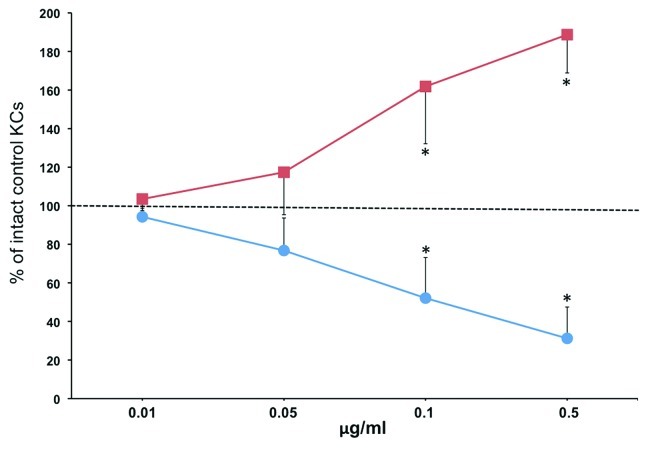
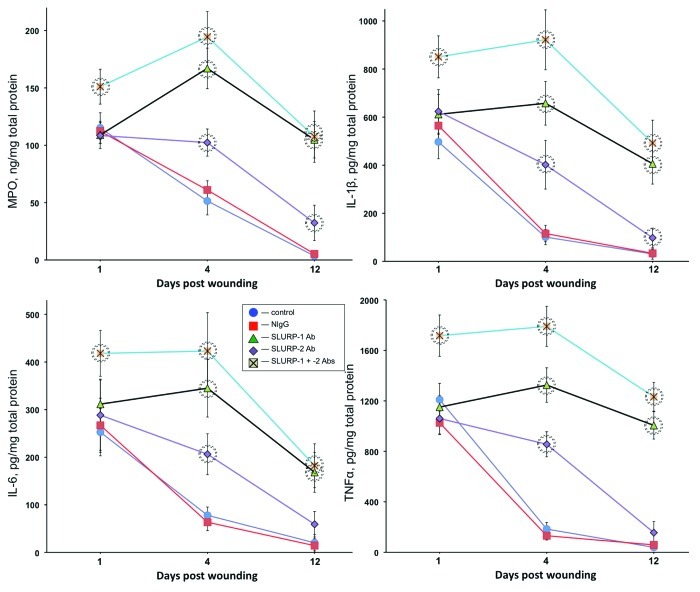
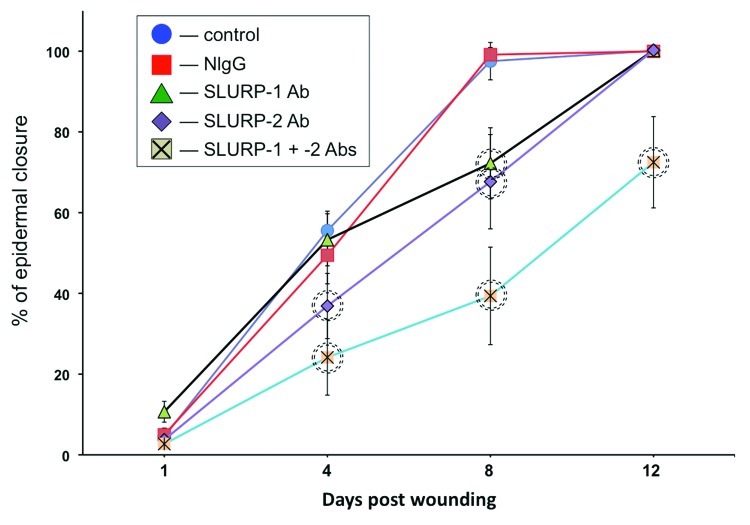
Restoration of epidermal barrier (epithelialization), is a major component of cutaneous response to stress imposed by wounding. Learning physiologic regulation of epithelialization may lead to novel treatments of chronic wounds. The non-canonical ligands of nicotinic acetylcholine receptors SLURP (secreted mammalian Ly-6/urokinase-type plasminogen activator receptor-related proteins)-1 and -2 are produced by keratinocytes (KCs) and inflammatory cells to augment physiologic responses to non-neuronal acetylcholine, suggesting that they can affect wound epithelialization and inflammation. In this study, recombinant (r)SLURP-1 and -2 exhibited dose dependent effects on migration of cultured KCs, and monoclonal antibodies inactivating auto/paracrine SLURPs in mouse skin delayed wound epithelialization. While effects of rSLURPs on migration were opposite, with rSLURP-1 inhibiting and rSLURP-2 stimulating migration of KCs, each anti-SLURP antibody produced a negative effect on epithelialization in vivo, suggesting their more extensive than regulation of keratinocyte migration involvement in wound repair. Since inflammation plays an important role in stress response to wounding, we measured inflammation biomarkers in wounds treated with anti-SLURP antibodies. Both anti-SLURP-1 and -2 antibodies, or their mixture, caused significant elevation of wound myeloperoxidase, IL-1β, IL-6 and TNFα. Taken together, results of this study demonstrated that SLURP-1 slows crawling locomotion of KCs, and exhibits a strong anti-inflammatory activity in wound tissue. In contrast, SLURP-2 facilitates lateral migration of KCs, but shows a lesser anti-inflammatory capacity. Thus, combined biologic activities of both SLURPs may be required for normal stress response to skin wounding, which favors clinical trial of rSLURP-1 and -2 in wounds that fail to heal.
表皮屏障的修复(上皮形成)是皮肤对创伤应激反应的主要组成部分。了解上皮形成的生理调节可能会带来慢性伤口的新治疗方法。烟碱型乙酰胆碱受体的非经典配体SLURP(分泌型哺乳动物Ly-6/尿激酶型纤溶酶原激活剂受体相关蛋白)-1和-2由角质形成细胞(KC)和炎性细胞产生,以增强对非神经元乙酰胆碱的生理反应,这表明它们可影响伤口上皮形成和炎症。在本研究中,重组(r)SLURP-1和-2对培养的KC迁移表现出剂量依赖性效应,而使小鼠皮肤中自分泌/旁分泌SLURP失活的单克隆抗体延迟了伤口上皮形成。虽然rSLURP对迁移的影响相反,rSLURP-1抑制KC迁移而rSLURP-2刺激KC迁移,但每种抗SLURP抗体在体内均对上皮形成产生负面影响,表明它们在伤口修复中的作用比调节角质形成细胞迁移更为广泛。由于炎症在伤口应激反应中起重要作用,我们测量了用抗SLURP抗体处理的伤口中的炎症生物标志物。抗SLURP-1和-2抗体或其混合物均导致伤口髓过氧化物酶、IL-1β、IL-6和TNFα显著升高。综上所述,本研究结果表明,SLURP-1减缓KC的爬行运动,并在伤口组织中表现出强大的抗炎活性。相比之下,SLURP-2促进KC的侧向迁移,但抗炎能力较弱。因此,皮肤伤口正常应激反应可能需要两种SLURP的联合生物学活性,这有利于对rSLURP-1和-2在不愈合伤口中进行临床试验。