HIV-Specific Immunity Section, Laboratory of Immunoregulation, National Institute of Allergy and Infectious Diseases, National Institutes of Health, Bethesda, Maryland, United States of America.
PLoS Pathog. 2013 Feb;9(2):e1003195. doi: 10.1371/journal.ppat.1003195. Epub 2013 Feb 28.
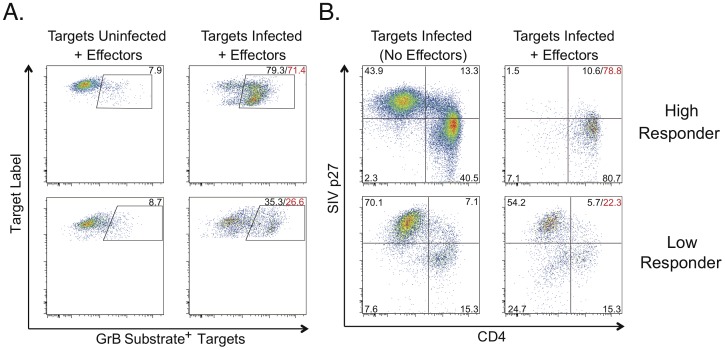
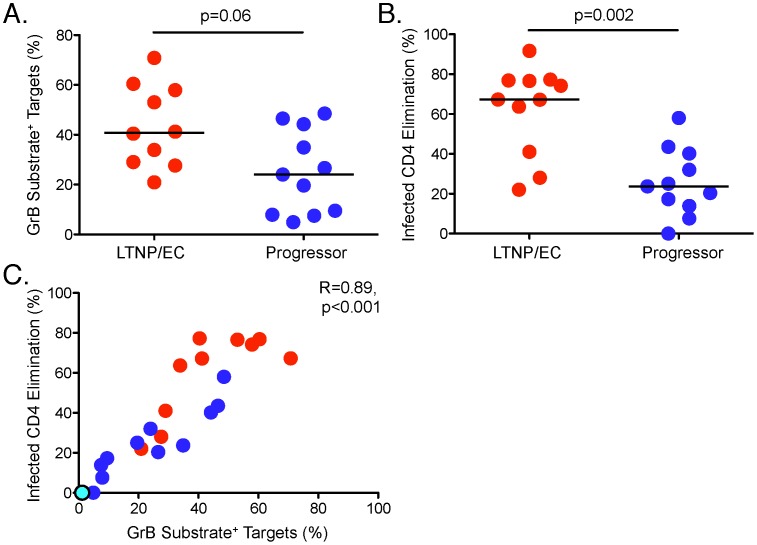
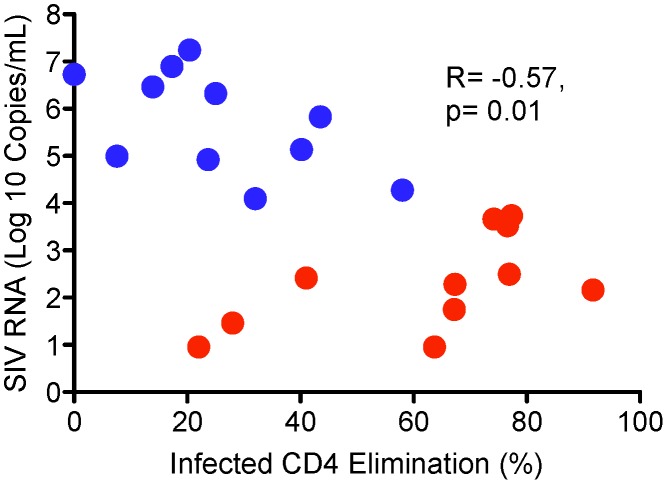
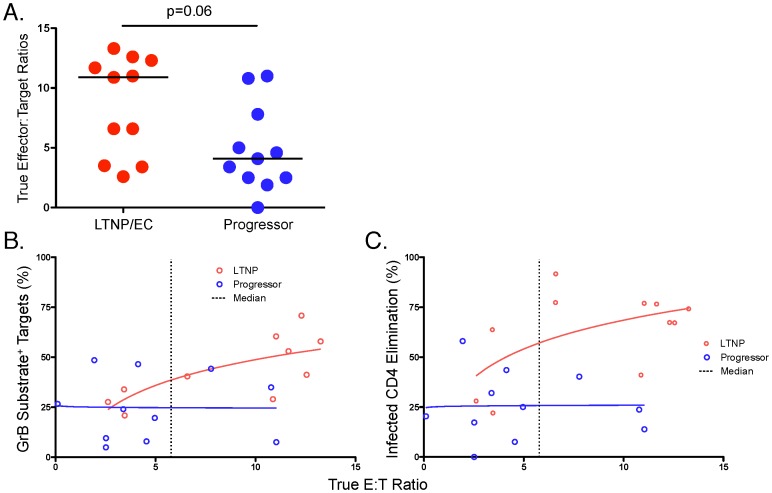
Although the study of non-human primates has resulted in important advances for understanding HIV-specific immunity, a clear correlate of immune control over simian immunodeficiency virus (SIV) replication has not been found to date. In this study, CD8(+) T-cell cytotoxic capacity was examined to determine whether this function is a correlate of immune control in the rhesus macaque (RM) SIV infection model as has been suggested in chronic HIV infection. SIVmac251-infected human reverse transcriptase (hTERT)-transduced CD4(+) T-cell clone targets were co-incubated with autologous macaque effector cells to measure infected CD4(+) T-cell elimination (ICE). Twenty-three SIV-infected rhesus macaques with widely varying plasma viral RNA levels were evaluated in a blinded fashion. Nineteen of 23 subjects (83%) were correctly classified as long-term nonprogressor/elite controller (LTNP/EC), slow progressor, progressor or SIV-negative rhesus macaques based on measurements of ICE (weighted Kappa 0.75). LTNP/EC had higher median ICE than progressors (67.3% [22.0-91.7%] vs. 23.7% [0.0-58.0%], p = 0.002). In addition, significant correlations between ICE and viral load (r = -0.57, p = 0.01), and between granzyme B delivery and ICE (r = 0.89, p<0.001) were observed. Furthermore, the CD8(+) T cells of LTNP/EC exhibited higher per-cell cytotoxic capacity than those of progressors (p = 0.004). These findings support that greater lytic granule loading of virus-specific CD8(+) T cells and efficient delivery of active granzyme B to SIV-infected targets are associated with superior control of SIV infection in rhesus macaques, consistent with observations of HIV infection in humans. Therefore, such measurements appear to represent a correlate of control of viral replication in chronic SIV infection and their role as predictors of immunologic control in the vaccine setting should be evaluated.
虽然对非人类灵长类动物的研究为理解 HIV 特异性免疫做出了重要贡献,但迄今为止,尚未发现与猿猴免疫缺陷病毒 (SIV) 复制的免疫控制相关的明确指标。在这项研究中,检查了 CD8(+)T 细胞的细胞毒性能力,以确定该功能是否与恒河猴 SIV 感染模型中的免疫控制相关,正如在慢性 HIV 感染中所观察到的那样。将 SIVmac251 感染的人类端粒酶逆转录酶 (hTERT) 转导的 CD4(+)T 细胞克隆靶标与自体猕猴效应细胞共孵育,以测量感染的 CD4(+)T 细胞消除 (ICE)。以盲法评估了 23 只具有广泛不同血浆病毒 RNA 水平的 SIV 感染恒河猴。根据 ICE 测量结果,19/23 例(83%)被正确分类为长期非进展/精英控制者(LTNP/EC)、慢进展者、进展者或 SIV 阴性恒河猴(加权 Kappa 0.75)。LTNP/EC 的 ICE 中位数高于进展者(67.3%[22.0-91.7%] vs. 23.7%[0.0-58.0%],p=0.002)。此外,还观察到 ICE 与病毒载量(r=-0.57,p=0.01)和颗粒酶 B 传递与 ICE 之间(r=0.89,p<0.001)存在显著相关性。此外,LTNP/EC 的 CD8(+)T 细胞比进展者具有更高的每细胞细胞毒性能力(p=0.004)。这些发现支持病毒特异性 CD8(+)T 细胞中更多的裂解颗粒装载和有效的将活性颗粒酶 B 传递到 SIV 感染的靶标与恒河猴中 SIV 感染的更好控制相关,与人类中 HIV 感染的观察结果一致。因此,这些测量似乎代表了慢性 SIV 感染中病毒复制控制的相关指标,并且它们作为疫苗环境中免疫控制预测因子的作用应该得到评估。