Laboratory of Experimental Psychology, KU Leuven, Leuven, Belgium.
PLoS One. 2013;8(2):e56978. doi: 10.1371/journal.pone.0056978. Epub 2013 Feb 27.
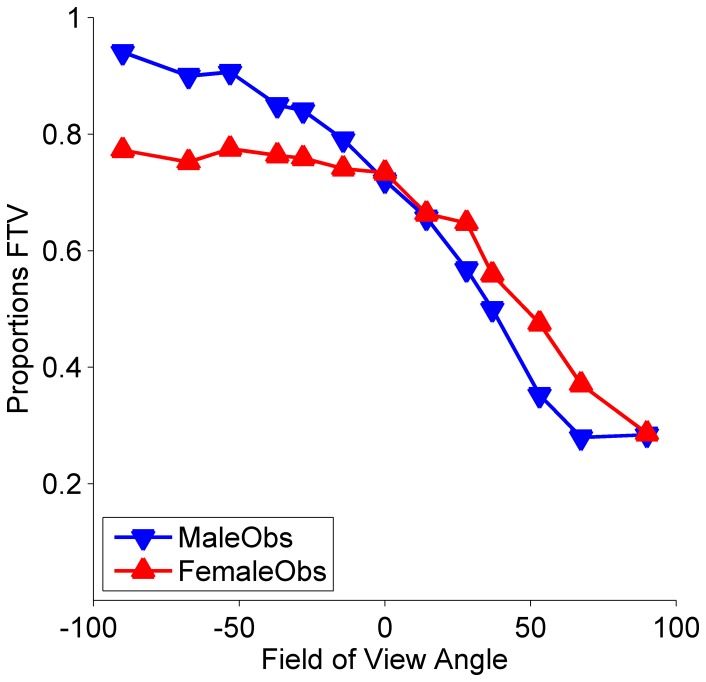
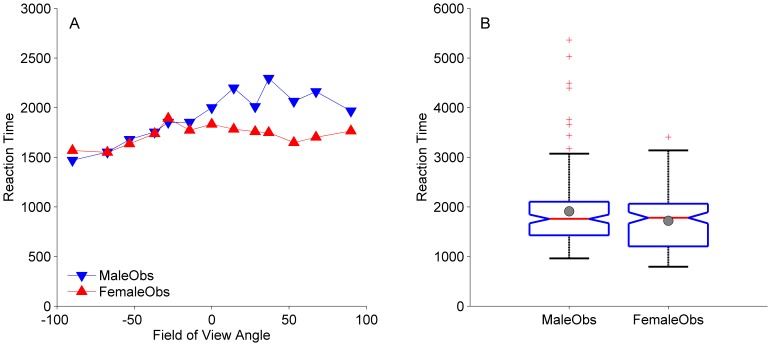
The human visual system has evolved to be highly sensitive to visual information about other persons and their movements as is illustrated by the effortless perception of point-light figures or 'biological motion'. When presented orthographically, a point-light walker is interpreted in two anatomically plausible ways: As 'facing the viewer' or as 'facing away' from the viewer. However, human observers show a 'facing bias': They perceive such a point-light walker as facing towards them in about 70-80% of the cases. In studies exploring the role of social and biological relevance as a possible account for the facing bias, we found a 'figure gender effect': Male point-light figures elicit a stronger facing bias than female point-light figures. Moreover, we also found an 'observer gender effect': The 'figure gender effect' was stronger for male than for female observers. In the present study we presented to 11 males and 11 females point-light walkers of which, very subtly, the perspective information was manipulated by modifying the earlier reported 'perspective technique'. Proportions of 'facing the viewer' responses and reaction times were recorded. Results show that human observers, even in the absence of local shape or size cues, easily pick up on perspective cues, confirming recent demonstrations of high visual sensitivity to cues on whether another person is potentially approaching. We also found a consistent difference in how male and female observers respond to stimulus variations (figure gender or perspective cues) that cause variations in the perceived in-depth orientation of a point-light walker. Thus, the 'figure gender effect' is possibly caused by changes in the relative locations and motions of the dots that the perceptual system tends to interpret as perspective cues. Third, reaction time measures confirmed the existence of the facing bias and recent research showing faster detection of approaching than receding biological motion.
人类视觉系统对外界人物及其运动的视觉信息非常敏感,这一点可以从轻松感知点光源人物或“生物运动”中得到说明。当以正交方式呈现时,点光源步行者可以以两种解剖上合理的方式进行解释:“面向观察者”或“背对观察者”。然而,人类观察者表现出“面向偏好”:他们在大约 70-80%的情况下将这样的点光源步行者感知为面向他们。在探索社会和生物相关性作为面向偏好可能解释的研究中,我们发现了“人物性别效应”:男性点光源人物比女性点光源人物引起更强的面向偏好。此外,我们还发现了“观察者性别效应”:对于男性观察者来说,“人物性别效应”比女性观察者更强。在本研究中,我们向 11 名男性和 11 名女性呈现了点光源步行者,非常微妙地通过修改先前报告的“视角技术”来操纵视角信息。记录了“面向观察者”的反应比例和反应时间。结果表明,即使在没有局部形状或大小线索的情况下,人类观察者也很容易接收到视角线索,这证实了最近对另一个人是否可能靠近的感知深度方向的变化,观察者的视觉敏感性很高的演示。我们还发现,男性和女性观察者对引起点光源步行者感知深度方向变化的刺激变化(人物性别或视角线索)的反应存在一致差异。因此,“人物性别效应”可能是由于感知系统倾向于解释为视角线索的点的相对位置和运动的变化引起的。第三,反应时间测量证实了存在面向偏好,并且最近的研究表明,接近生物运动的检测速度比远离生物运动的检测速度更快。