Faculty of Infectious and Tropical Diseases, London School of Hygiene and Tropical Medicine, London, United Kingdom.
PLoS Negl Trop Dis. 2013;7(2):e2057. doi: 10.1371/journal.pntd.0002057. Epub 2013 Feb 28.
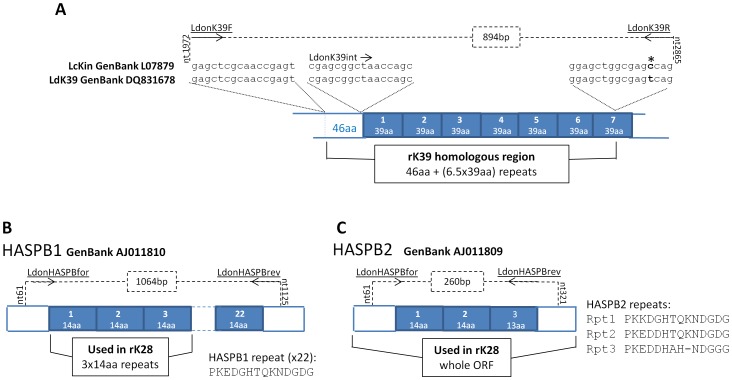
Visceral leishmaniasis (VL), caused by infection with Leishmania donovani complex, remains a major public health problem in endemic regions of South Asia, East Africa, and Brazil. If untreated, symptomatic VL is usually fatal. Rapid field diagnosis relies principally on demonstration of anti-Leishmania antibodies in clinically suspect cases. The rK39 immunochromatographic rapid diagnostic test (RDT) is based on rK39, encoded by a fragment of a kinesin-related gene derived from a Brazilian L. chagasi, now recognised as L. infantum, originating from Europe. Despite its reliability in South Asia, the rK39 test is reported to have lower sensitivity in East Africa. A reason for this differential response may reside in the molecular diversity of the rK39 homologous sequences among East African L. donovani strains.
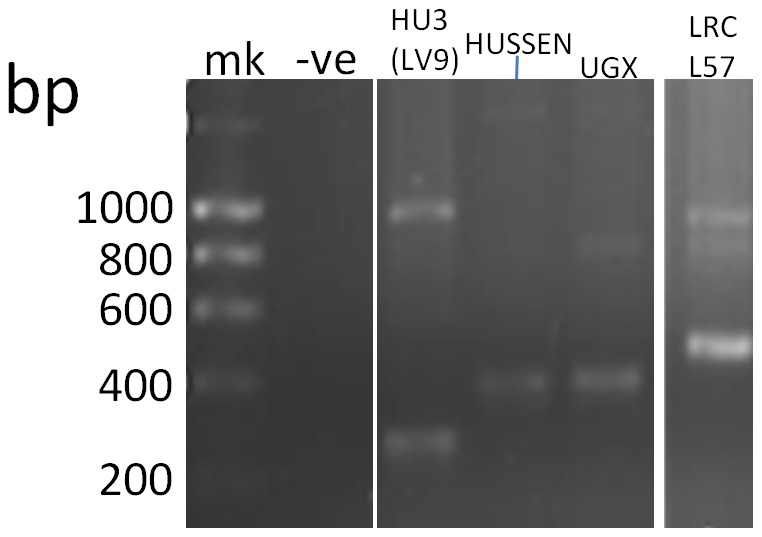
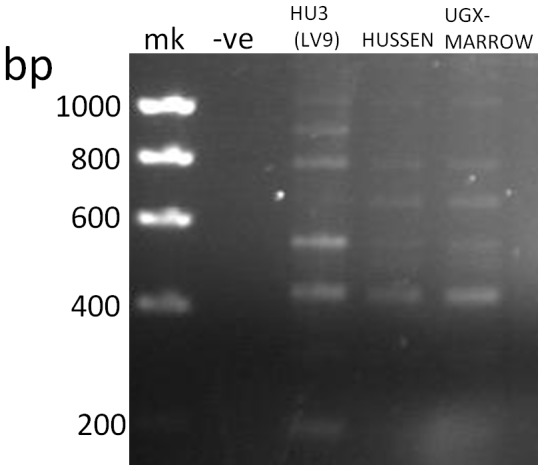
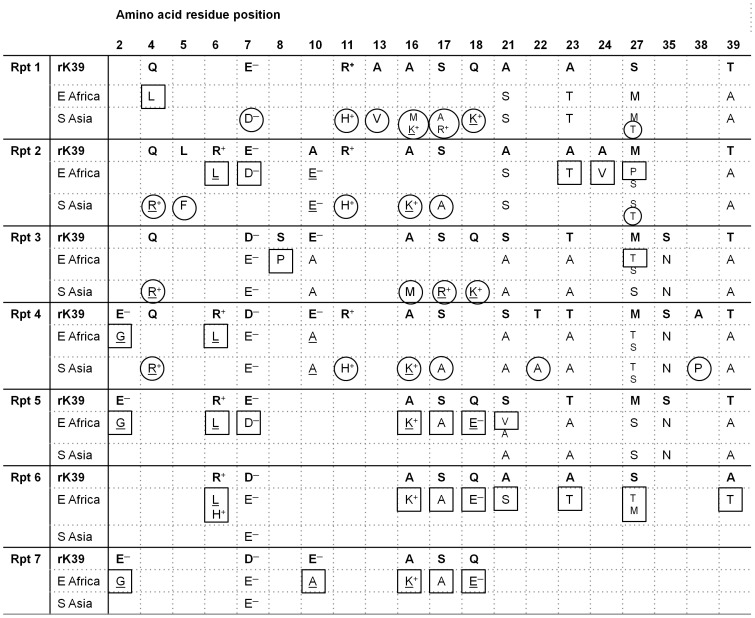
METHODOLOGY/PRINCIPAL FINDINGS: Coding sequences of rK39 homologues from East African L. donovani strains were amplified from genomic DNA, analysed for diversity from the rK39 sequence, and compared to South Asian sequences. East African sequences were revealed to display significant diversity from rK39. Most coding changes in the 5' half of repeats were non-conservative, with multiple substitutions involving charge changes, whereas amino acid substitutions in the 3' half of repeats were conservative. Specific polymorphisms were found between South Asian and East African strains. Diversity of HASPB1 and HASPB2 gene repeat sequences, used to flank sequences of a kinesin homologue in the synthetic antigen rK28 designed to reduce variable RDT performance, was also investigated. Non-canonical combination repeat arrangements were revealed for HASPB1 and HASPB2 gene products in strains producing unpredicted size amplicons.
CONCLUSIONS/SIGNIFICANCE: We demonstrate that there is extensive kinesin genetic diversity among strains in East Africa and between East Africa and South Asia, with ample scope for influencing performance of rK39 diagnostic assays. We also show the importance of targeted comparative genomics in guiding optimisation of recombinant/synthetic diagnostic antigens.
内脏利什曼病(VL)由感染利什曼原虫复合体引起,仍然是南亚、东非和巴西流行地区的一个主要公共卫生问题。如果未经治疗,有症状的 VL 通常是致命的。快速现场诊断主要依赖于在临床疑似病例中检测抗利什曼原虫抗体。rK39 免疫层析快速诊断检测(RDT)基于 rK39,由源自巴西 L. chagasi 的驱动蛋白相关基因片段编码,现在被认为是 L. infantum,源自欧洲。尽管在南亚具有可靠性,但 rK39 检测在东非的敏感性较低。这种差异反应的一个原因可能在于东非利什曼原虫菌株中 rK39 同源序列的分子多样性。
方法/主要发现:从东非利什曼原虫菌株的基因组 DNA 中扩增 rK39 同源物的编码序列,分析其与 rK39 序列的多样性,并与南亚序列进行比较。结果显示,东非序列与 rK39 显示出显著的多样性。重复序列 5' 半部分的大多数编码变化是非保守的,涉及电荷变化的多个取代,而重复序列 3' 半部分的氨基酸取代是保守的。在南亚和东非菌株之间发现了特定的多态性。还研究了用于设计减少可变 RDT 性能的合成抗原 rK28 中驱动蛋白同源物序列侧翼的 HASPB1 和 HASPB2 基因重复序列的多样性。在产生未预测大小扩增子的菌株中,发现 HASPB1 和 HASPB2 基因产物存在非典型的组合重复排列。
结论/意义:我们证明了东非和东非与南亚之间的菌株中存在广泛的驱动蛋白遗传多样性,为影响 rK39 诊断检测性能提供了充分的空间。我们还表明了靶向比较基因组学在指导重组/合成诊断抗原优化方面的重要性。