Division of Endocrinology, Diabetes and Metabolism, Department of Medicine, Carbone Cancer Center, University of Wisconsin School of Medicine and Public Health, 4144 MFCB, 1685 Highland Avenue, Madison, WI, 53705, USA.
Breast Cancer Res Treat. 2013 Apr;138(2):415-25. doi: 10.1007/s10549-013-2465-6. Epub 2013 Mar 8.
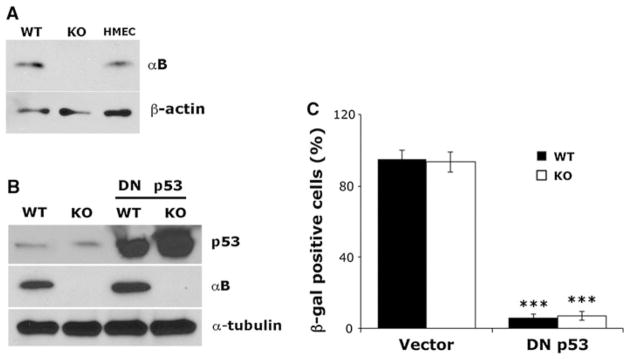
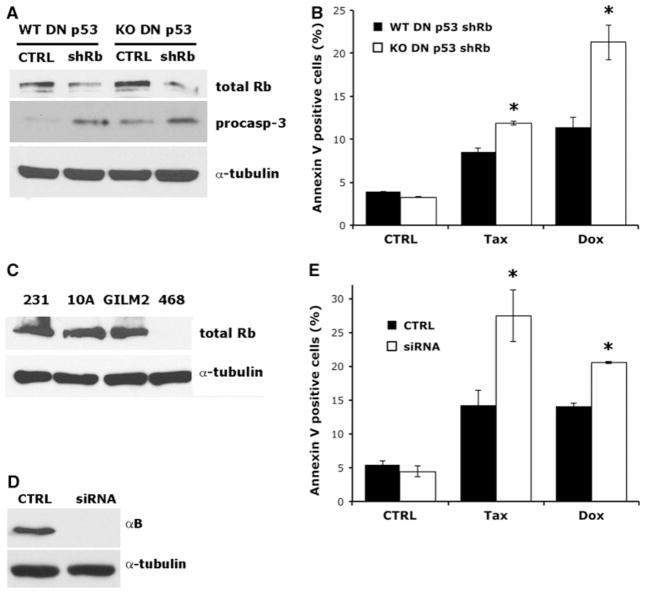
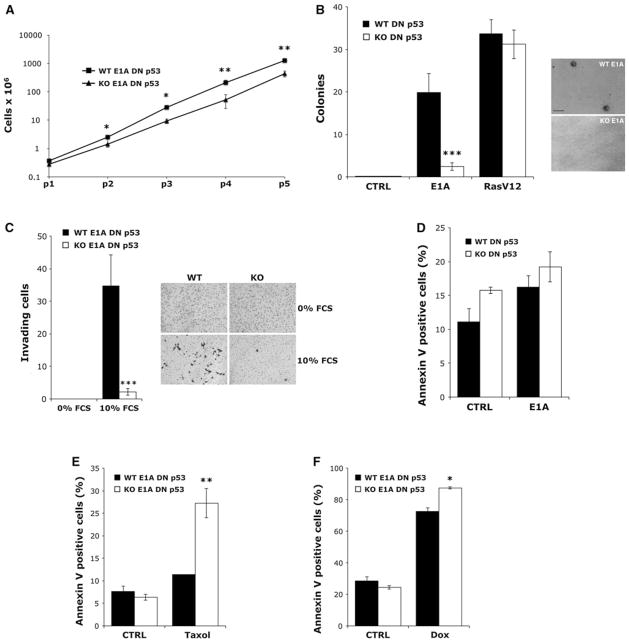
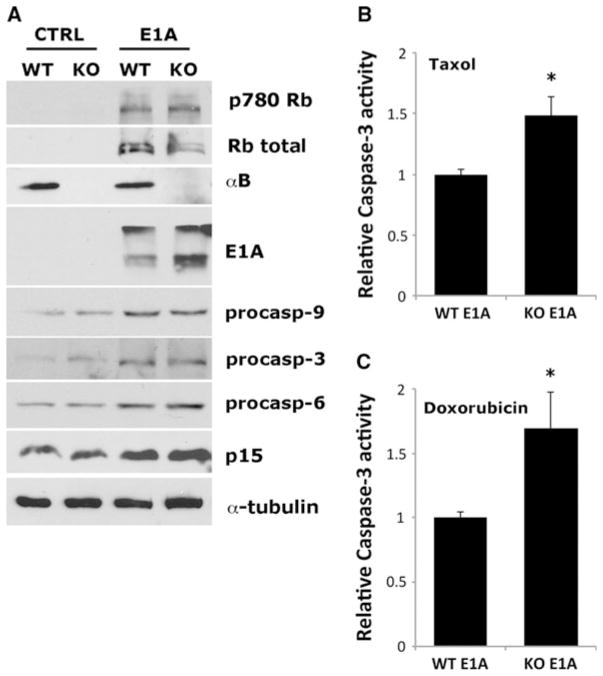
The retinoblastoma (Rb) tumor suppressor gene is frequently inactivated in cancer, resulting in deregulated activation of E2F transcription factors, which promote S-phase entry, p53-dependent and p53-independent apoptosis. Transformed cells evade p53-dependent apoptosis initiated by Rb inactivation by TP53 mutation. However, the mechanisms by which cancer cells circumvent p53-independent apoptosis in this context are poorly understood. Because Rb inactivation primes cells for apoptosis by p53-independent induction of procaspases, we postulated that αB-crystallin, an inhibitor of procaspase-3 activation, would suppress caspase activation in cells with combined Rb and p53 inactivation. Notably, αB-crystallin is commonly expressed in ER/PR/HER2 "triple-negative" breast carcinomas characterized by frequent Rb loss and TP53 mutation. We report that αB-crystallin (-/-) knock out (KO) MEFs immortalized by dominant negative (DN) p53 are resistant to transformation by the adenovirus E1A oncoprotein, which inactivates Rb, while wild-type (WT) MEFs are readily transformed by DN p53 and E1A. αB-crystallin (-/-) KO MEFs stably expressing DN p53 and E1A were more sensitive to chemotherapy-induced caspase-3 activation and apoptosis than the corresponding WT MEFs, despite comparable induction of procaspases by E1A. Similarly, silencing Rb in WT and αB-crystallin (-/-) KO MEFs immortalized by DN p53 increased procaspase levels and sensitized αB-crystallin (-/-) KO MEFs to chemotherapy. Furthermore, silencing αB-crystallin in triple-negative breast cancer cells, which lack Rb and express mutant p53, enhanced chemotherapy sensitivity compared to non-silencing controls. Our results indicate that αB-crystallin inhibits caspase activation in cells primed for apoptosis by Rb inactivation and plays a novel oncogenic role in the context of combined Rb and p53 inactivation.
视网膜母细胞瘤(Rb)肿瘤抑制基因在癌症中经常失活,导致 E2F 转录因子的失调激活,促进 S 期进入、p53 依赖性和 p53 非依赖性细胞凋亡。转化细胞通过 TP53 突变逃避由 Rb 失活引发的 p53 依赖性细胞凋亡。然而,目前尚不清楚癌细胞在这种情况下逃避 p53 非依赖性细胞凋亡的机制。因为 Rb 失活通过 p53 非依赖性诱导前半胱天冬酶,使细胞为细胞凋亡做好准备,所以我们推测αB-晶体蛋白,一种前半胱天冬酶-3 激活的抑制剂,会抑制 Rb 和 p53 同时失活的细胞中的半胱天冬酶激活。值得注意的是,αB-晶体蛋白在 ER/PR/HER2“三阴性”乳腺癌中普遍表达,这些乳腺癌常伴有 Rb 缺失和 TP53 突变。我们报告说,通过显性负(DN)p53 永生化的αB-晶体蛋白(-/-)敲除(KO)MEF 对腺病毒 E1A 癌蛋白的转化具有抗性,E1A 癌蛋白使 Rb 失活,而野生型(WT)MEF 则很容易被 DN p53 和 E1A 转化。稳定表达 DN p53 和 E1A 的αB-晶体蛋白(-/-)KO MEF 对化疗诱导的半胱天冬酶-3 激活和细胞凋亡比相应的 WT MEF 更敏感,尽管 E1A 可比诱导前半胱天冬酶。同样,在 WT 和由 DN p53 永生化的αB-晶体蛋白(-/-)KO MEF 中沉默 Rb 增加了前半胱天冬酶的水平,并使αB-晶体蛋白(-/-)KO MEF 对化疗敏感。此外,在缺乏 Rb 并表达突变型 p53 的三阴性乳腺癌细胞中沉默αB-晶体蛋白增强了化疗敏感性,与非沉默对照相比。我们的结果表明,αB-晶体蛋白抑制由 Rb 失活引发的细胞凋亡的半胱天冬酶激活,并在 Rb 和 p53 同时失活的情况下发挥新的致癌作用。