Department of Hematology, Poznan University of Medical Sciences, Szamarzewskiego 84, 61-569, Poznan, Poland.
Ann Hematol. 2013 Jul;92(7):925-33. doi: 10.1007/s00277-013-1716-2. Epub 2013 Mar 8.
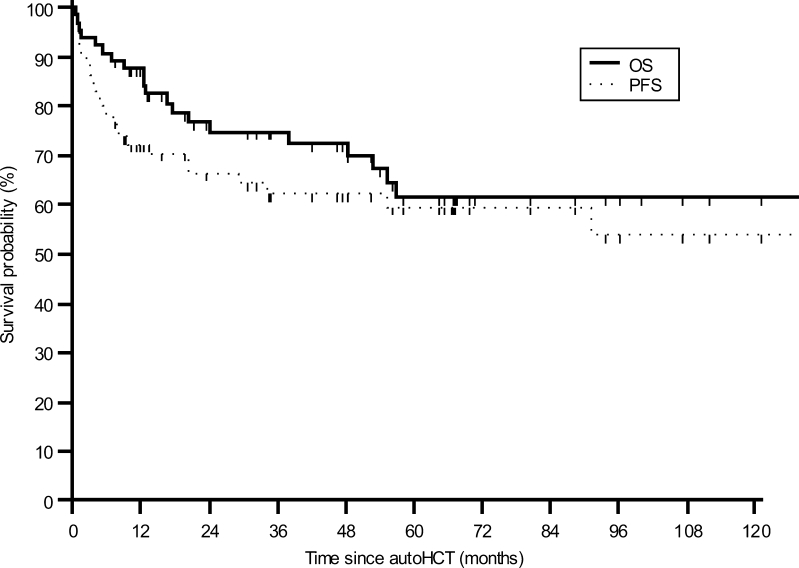
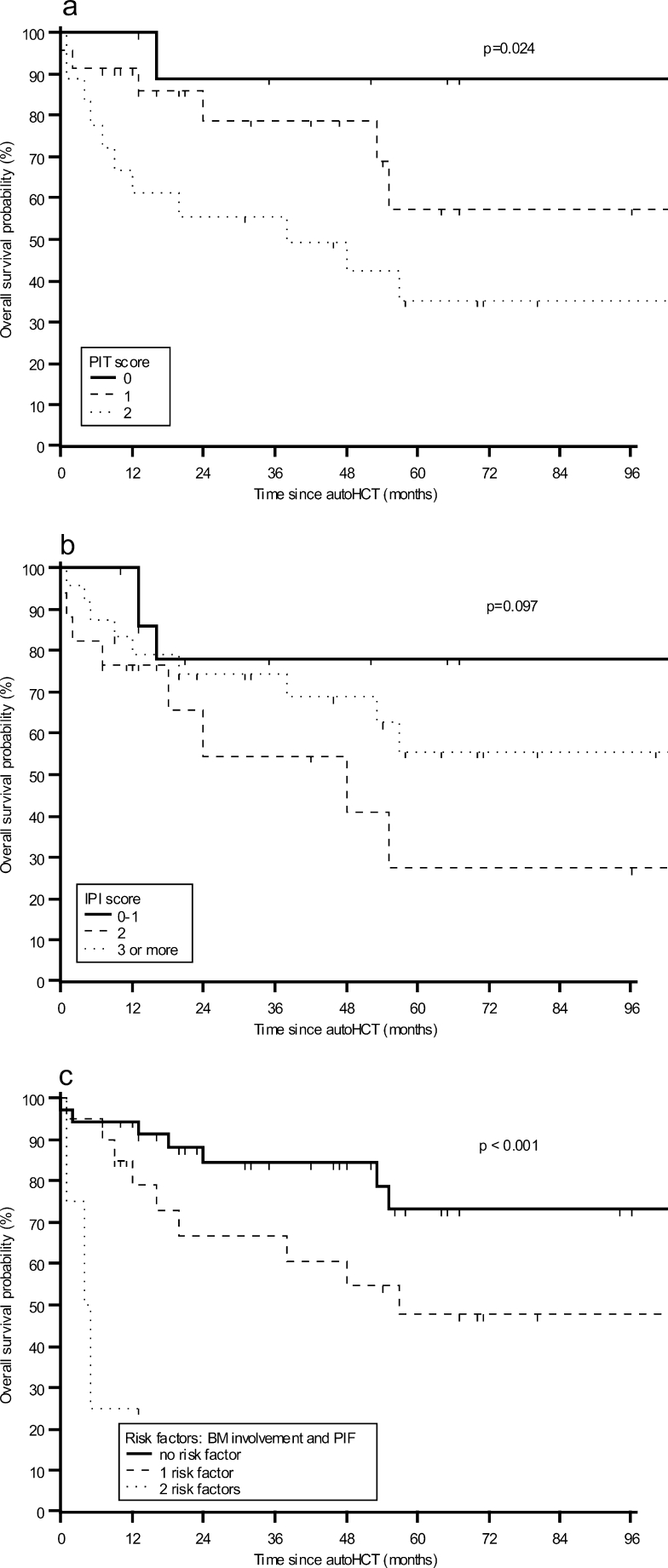
This report is a retrospective analysis of 65 patients with peripheral T cell lymphoma (PTCL), who underwent high-dose therapy and autologous hematopoietic stem cell transplantation (autoHCT) as a consolidation of first response achieved with either induction or salvage chemotherapy. We intended to determine the prognostic factors that influenced outcome after autoHCT and to define the predictive value of the scoring systems most often applied for transplant outcomes. Nineteen patients in either complete or partial remission underwent autoHCT after induction chemotherapy. Forty-six patients received second-line chemotherapy as a consolidation of partial response after induction chemotherapy (n = 34) or as a salvage therapy after primary induction failure (n = 12), and thereafter proceeded to autoHCT. Finally, the 36 patients were in complete remission, and 29 in partial remission at autoHCT. The median follow-up of survivors was 53 months (range 7-157 months). The 5-year overall survival and progression-free survival for all patients were 61.5% (95% CI 47.0-74.2%) and 59.4% (95% CI 46.1-71.5%), respectively. In multivariate analysis, bone marrow involvement at diagnosis and less than partial remission after induction chemotherapy were factors independently predictive for overall survival and progression-free survival. The prognostic index for PTCL could reliably stratify the prognosis of PTCL in this analysis.
本报告对 65 例接受高剂量化疗和自体造血干细胞移植(autoHCT)作为诱导或挽救化疗后首次缓解巩固治疗的外周 T 细胞淋巴瘤(PTCL)患者进行了回顾性分析。我们旨在确定影响 autoHCT 后结局的预后因素,并定义最常用于移植结果的评分系统的预测价值。19 例患者在诱导化疗后达到完全或部分缓解后接受 autoHCT。46 例患者在诱导化疗后部分缓解(n=34)或初次诱导失败后的二线化疗(n=12)后接受巩固治疗,然后进行 autoHCT。最后,36 例患者达到完全缓解,29 例患者在 autoHCT 时处于部分缓解。幸存者的中位随访时间为 53 个月(7-157 个月)。所有患者的 5 年总生存率和无进展生存率分别为 61.5%(95%CI 47.0-74.2%)和 59.4%(95%CI 46.1-71.5%)。多因素分析显示,诊断时骨髓受累和诱导化疗后未达到部分缓解是总生存率和无进展生存率的独立预测因素。PTCL 的预后指数能够可靠地对本分析中的 PTCL 预后进行分层。