Center for Molecular Recognition, Department of Biochemistry, College of Physicians and Surgeons, Columbia University, New York, New York, USA.
PLoS One. 2013;8(3):e58335. doi: 10.1371/journal.pone.0058335. Epub 2013 Mar 5.
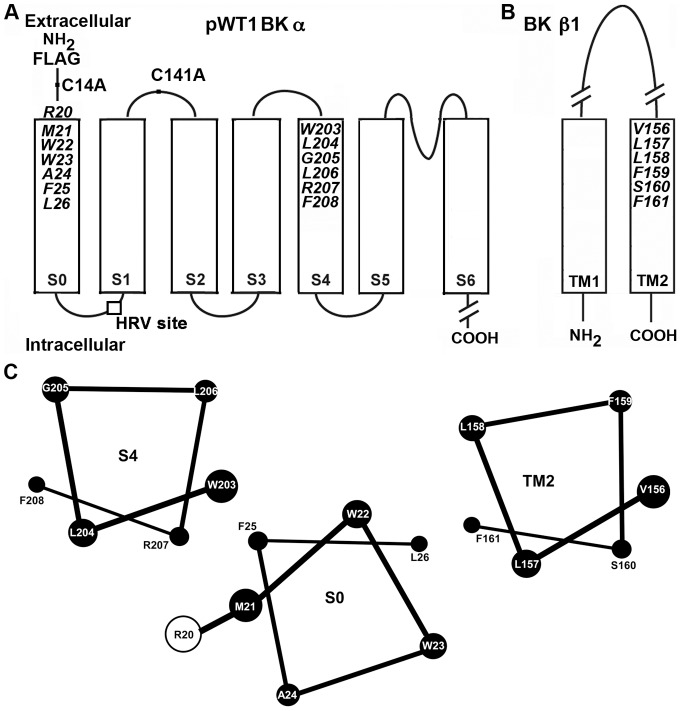
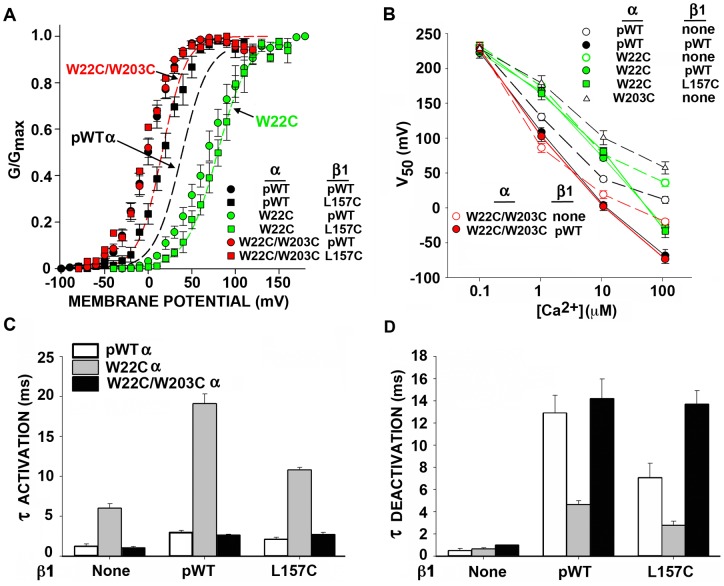
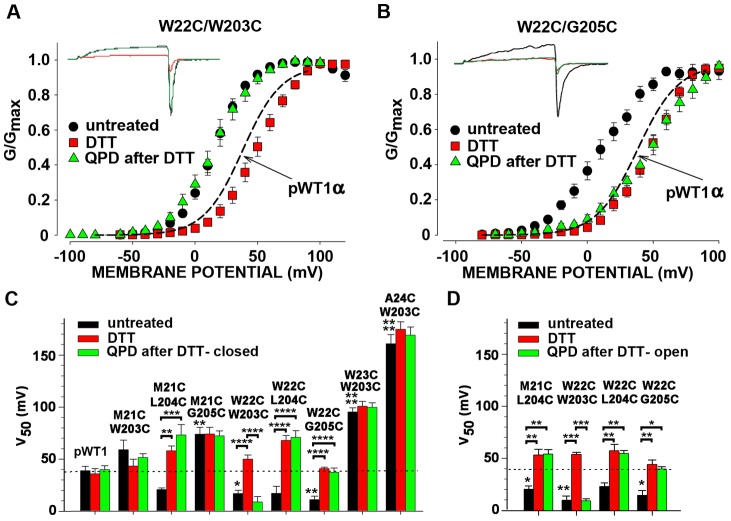
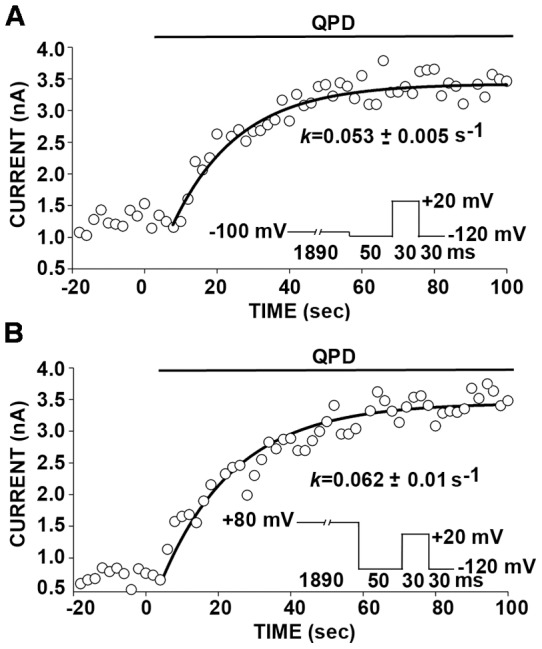
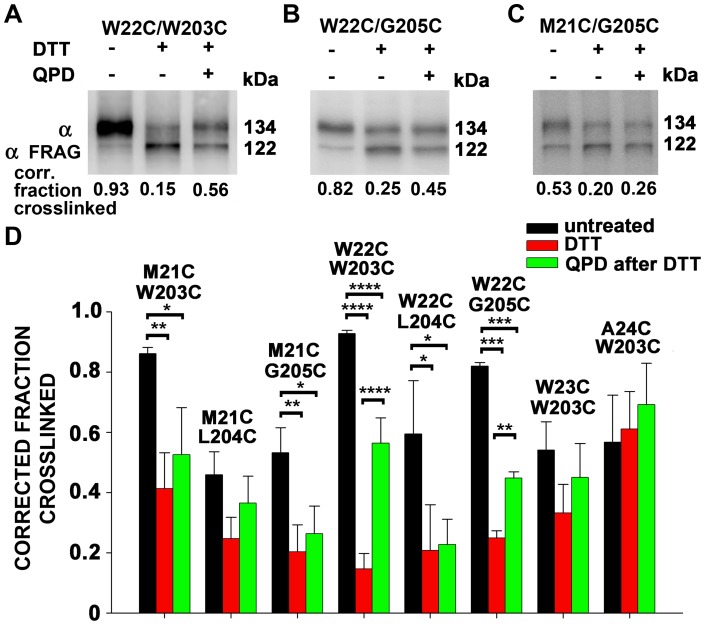
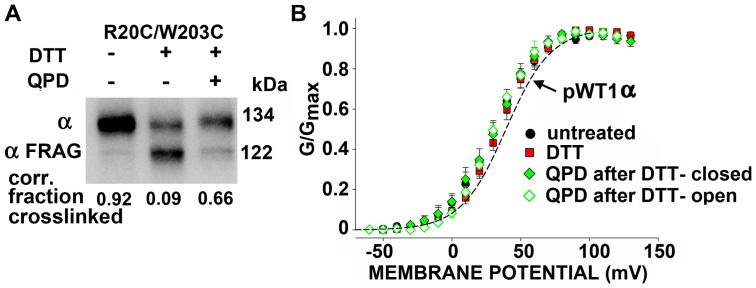
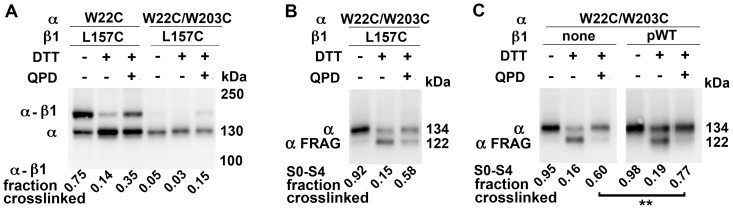
The large-conductance potassium channel (BK) α subunit contains a transmembrane (TM) helix S0 preceding the canonical TM helices S1 through S6. S0 lies between S4 and the TM2 helix of the regulatory β1 subunit. Pairs of Cys were substituted in the first helical turns in the membrane of BK α S0 and S4 and in β1 TM2. One such pair, W22C in S0 and W203C in S4, was 95% crosslinked endogenously. Under voltage-clamp conditions in outside-out patches, this crosslink was reduced by DTT and reoxidized by a membrane-impermeant bis-quaternary ammonium derivative of diamide. The rate constants for this reoxidation were not significantly different in the open and closed states of the channel. Thus, these two residues are approximately equally close in the two states. In addition, 90% crosslinking of a second pair, R20C in S0 and W203C in S4, had no effect on the V50 for opening. Taken together, these findings indicate that separation between residues at the extracellular ends of S0 and S4 is not required for voltage-sensor activation. On the contrary, even though W22C and W203C were equally likely to form a disulfide in the activated and deactivated states, relative immobilization by crosslinking of these two residues favored the activated state. Furthermore, the efficiency of recrosslinking of W22C and W203C on the cell surface was greater in the presence of the β1 subunit than in its absence, consistent with β1 acting through S0 to stabilize its immobilization relative to α S4.
大电导钙激活钾通道(BK)α亚基包含一个跨膜(TM)螺旋 S0,位于经典 TM 螺旋 S1 到 S6 之前。S0 位于 S4 和调节β1 亚基的 TM2 螺旋之间。在 BK α S0 和 S4 的膜中和β1 TM2 的第一螺旋-turn 中,用一对 Cys 取代了一对 Cys。这样的一对,S0 中的 W22C 和 S4 中的 W203C,有 95%的内源性交联。在外侧向外斑中的电压钳条件下,这种交联被 DTT 减少,并通过二酰胺的不可渗透膜的双季铵盐衍生物重新氧化。该再氧化的速率常数在通道的开放和关闭状态下没有显著差异。因此,这两个残基在两种状态下大约同样接近。此外,第二个对,S0 中的 R20C 和 S4 中的 W203C,有 90%的交联对打开的 V50 没有影响。总之,这些发现表明,S0 和 S4 的细胞外末端之间的残基分离对于电压传感器的激活不是必需的。相反,尽管 W22C 和 W203C 在激活和失活状态下同样可能形成二硫键,但这两个残基的交联相对固定有利于激活状态。此外,在β1 亚基存在的情况下,W22C 和 W203C 在细胞表面上重新交联的效率高于不存在β1 亚基的情况下,这与β1 通过 S0 作用以稳定其相对于α S4 的固定相一致。