From the Centre for Integrative Physiology, College of Medicine & Veterinary Medicine, Hugh Robson Building, University of Edinburgh, Edinburgh EH8 9XD, United Kingdom.
From the Centre for Integrative Physiology, College of Medicine & Veterinary Medicine, Hugh Robson Building, University of Edinburgh, Edinburgh EH8 9XD, United Kingdom; Pharmacology and Toxicology, Institute of Pharmacy, University Tuebingen, 72076 Tuebingen, Germany.
J Biol Chem. 2010 Oct 22;285(43):33307-33314. doi: 10.1074/jbc.M110.153940. Epub 2010 Aug 6.
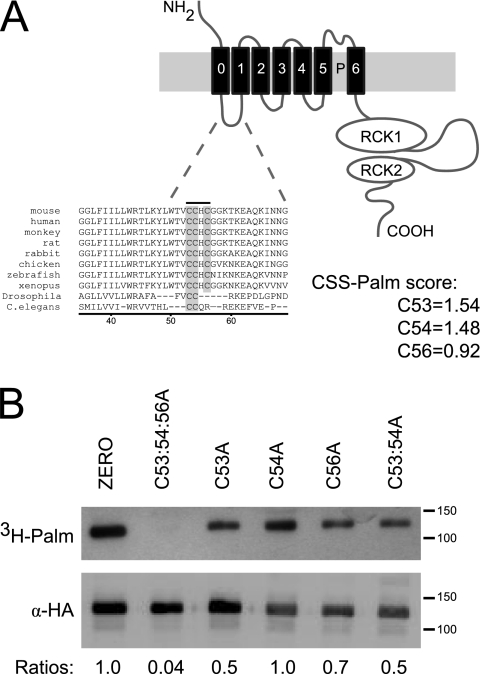
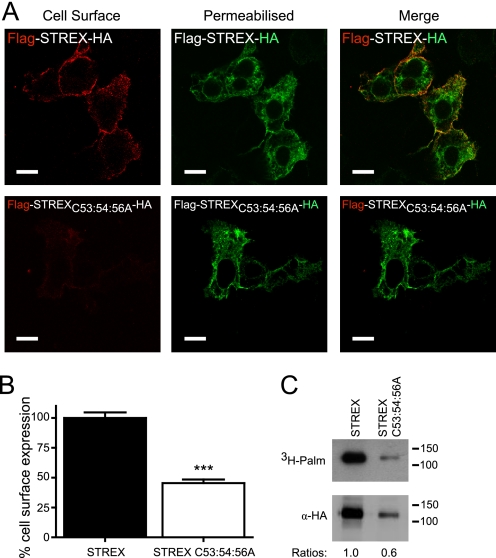
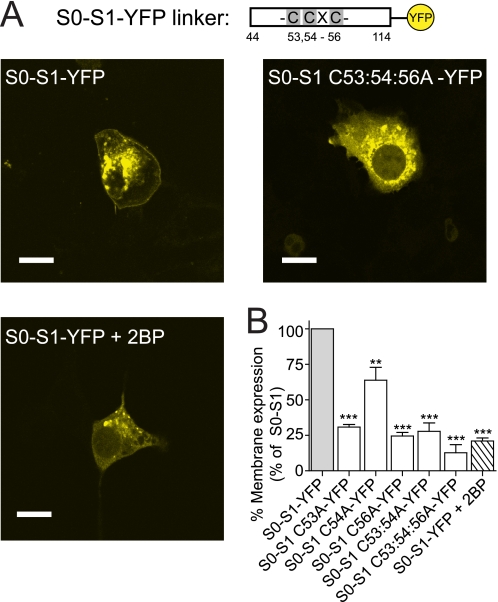
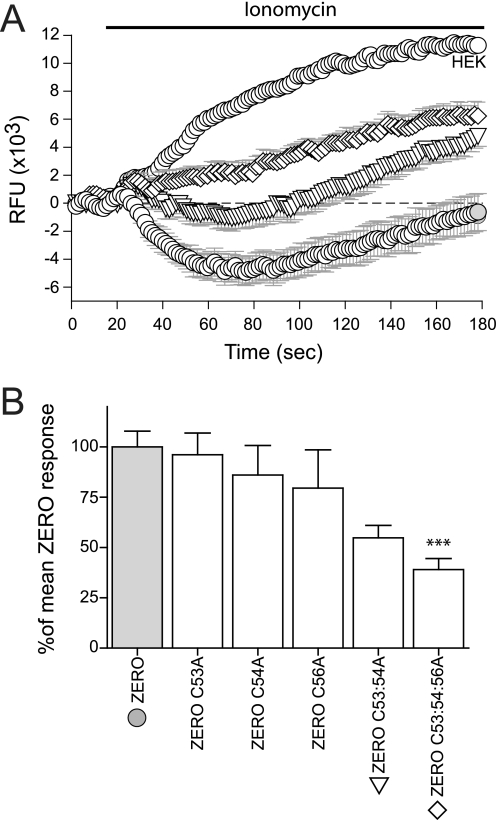
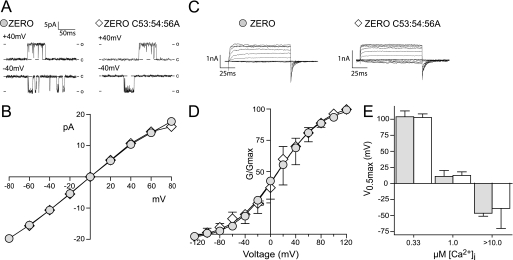
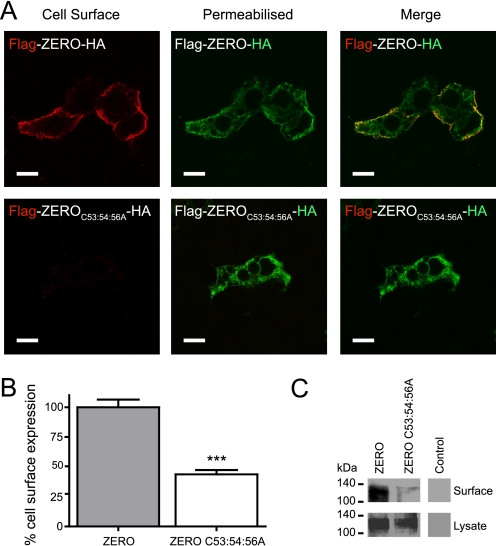
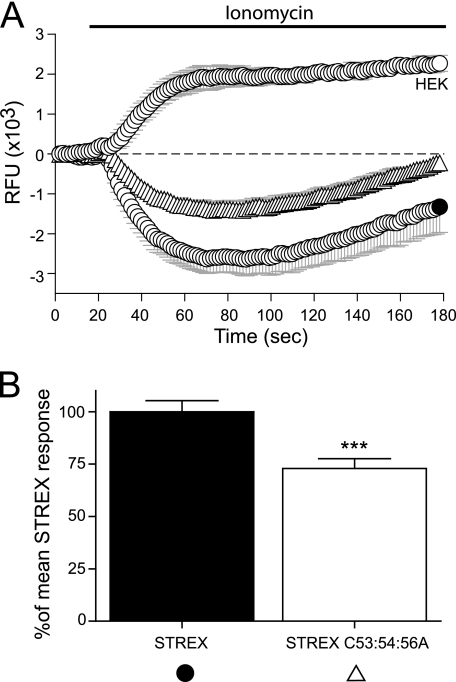
S-palmitoylation is rapidly emerging as an important post-translational mechanism to regulate ion channels. We have previously demonstrated that large conductance calcium- and voltage-activated potassium (BK) channels are palmitoylated within an alternatively spliced (STREX) insert. However, these studies also revealed that additional site(s) for palmitoylation must exist outside of the STREX insert, although the identity or the functional significance of these palmitoylated cysteine residues are unknown. Here, we demonstrate that BK channels are palmitoylated at a cluster of evolutionary conserved cysteine residues (Cys-53, Cys-54, and Cys-56) within the intracellular linker between the S0 and S1 transmembrane domains. Mutation of Cys-53, Cys-54, and Cys-56 completely abolished palmitoylation of BK channels lacking the STREX insert (ZERO variant). Palmitoylation allows the S0-S1 linker to associate with the plasma membrane but has no effect on single channel conductance or the calcium/voltage sensitivity. Rather, S0-S1 linker palmitoylation is a critical determinant of cell surface expression of BK channels, as steady state surface expression levels are reduced by ∼55% in the C53:54:56A mutant. STREX variant channels that could not be palmitoylated in the S0-S1 linker also displayed significantly reduced cell surface expression even though STREX insert palmitoylation was unaffected. Thus our work reveals the functional independence of two distinct palmitoylation-dependent membrane interaction domains within the same channel protein and demonstrates the critical role of S0-S1 linker palmitoylation in the control of BK channel cell surface expression.
S-棕榈酰化作用迅速成为调节离子通道的一种重要的翻译后修饰机制。我们之前已经证明,大电导钙激活电压门控钾(BK)通道在一个替代拼接(STREX)插入片段内发生棕榈酰化。然而,这些研究还表明,在 STREX 插入片段之外,肯定存在另外的棕榈酰化位点,尽管这些被棕榈酰化的半胱氨酸残基的身份或功能意义尚不清楚。在这里,我们证明 BK 通道在 S0 和 S1 跨膜结构域之间的细胞内环中一组进化保守的半胱氨酸残基(Cys-53、Cys-54 和 Cys-56)处发生棕榈酰化。Cys-53、Cys-54 和 Cys-56 的突变完全消除了缺乏 STREX 插入片段的 BK 通道的棕榈酰化(ZERO 变体)。棕榈酰化允许 S0-S1 接头与质膜结合,但对单通道电导或钙/电压敏感性没有影响。相反,S0-S1 接头棕榈酰化是 BK 通道细胞表面表达的关键决定因素,因为 C53:54:56A 突变体的稳态表面表达水平降低了约 55%。不能在 S0-S1 接头中发生棕榈酰化的 STREX 变体通道即使 STREX 插入片段的棕榈酰化不受影响,其细胞表面表达也显著降低。因此,我们的工作揭示了同一通道蛋白中两个不同的棕榈酰化依赖性膜相互作用域的功能独立性,并证明了 S0-S1 接头棕榈酰化在控制 BK 通道细胞表面表达中的关键作用。