Comprehensive Pneumology Center, Institute of Lung Biology and Disease, Helmholtz Zentrum München, Ingolstaedter Landstrasse 1, 85758 Neuherberg, Germany.
Biomed Res Int. 2013;2013:652632. doi: 10.1155/2013/652632. Epub 2013 Jan 2.
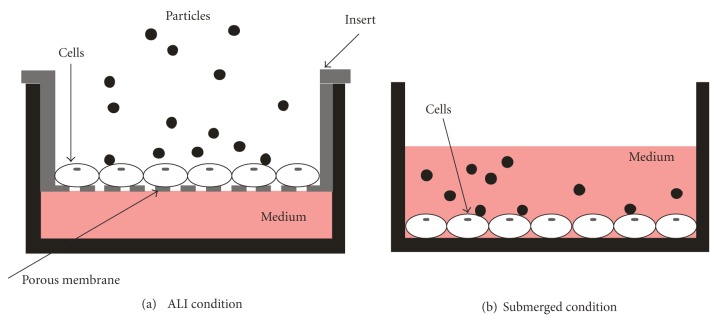
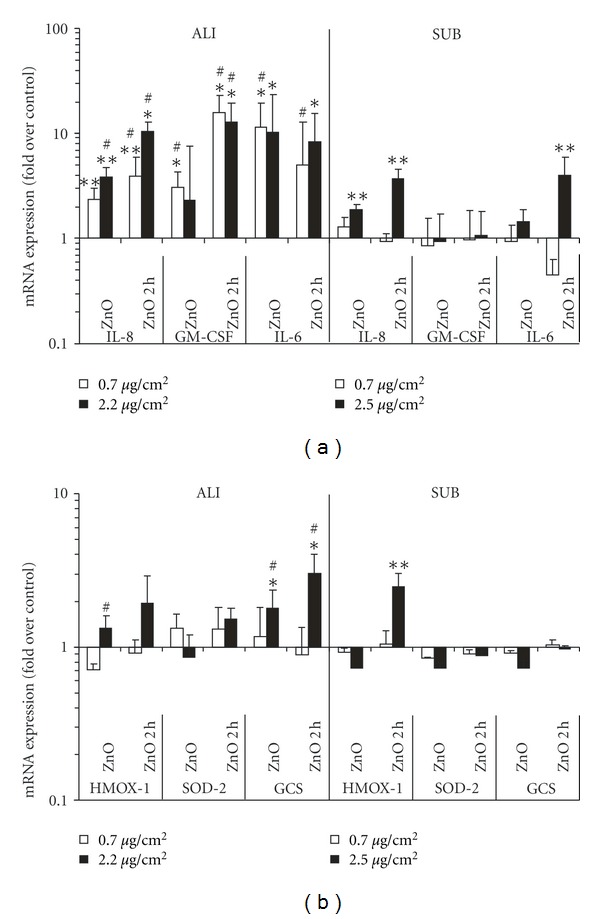
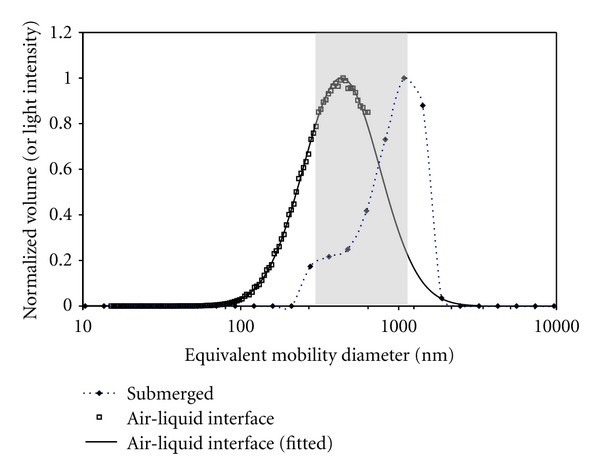
The biological effects of inhalable nanoparticles have been widely studied in vitro with pulmonary cells cultured under submerged and air-liquid interface (ALI) conditions. Submerged exposures are experimentally simpler, but ALI exposures are physiologically more realistic and hence potentially biologically more meaningful. In this study, we investigated the cellular response of human alveolar epithelial-like cells (A549) to airborne agglomerates of zinc oxide (ZnO) nanoparticles at the ALI, compared it to the response under submerged culture conditions, and provided a quantitative comparison with the literature data on different types of particles and cells. For ZnO nanoparticle doses of 0.7 and 2.5 μ g ZnO/cm(2) (or 0.09 and 0.33 cm(2) ZnO/cm(2)), cell viability was not mitigated and no significant effects on the transcript levels of oxidative stress markers (HMOX1, SOD-2 and GCS) were observed. However, the transcript levels of proinflammatory markers (IL-8, IL-6, and GM-CSF) were induced to higher levels under ALI conditions. This is consistent with the literature data and it suggests that in vitro toxicity screening of nanoparticles with ALI cell culture systems may produce less false negative results than screening with submerged cell cultures. However, the database is currently too scarce to draw a definite conclusion on this issue.
在体外,研究人员已经广泛研究了可吸入纳米颗粒对肺细胞的生物学效应,这些肺细胞在浸没和气液界面(ALI)条件下进行培养。浸没暴露在实验上更简单,但 ALI 暴露更符合生理现实,因此在生物学上可能更有意义。在这项研究中,我们研究了人肺泡上皮样细胞(A549)在 ALI 条件下对氧化锌(ZnO)纳米颗粒空气团聚物的细胞反应,将其与浸没培养条件下的反应进行了比较,并与文献中关于不同类型颗粒和细胞的数据进行了定量比较。对于 ZnO 纳米颗粒剂量为 0.7 和 2.5μg ZnO/cm2(或 0.09 和 0.33cm2 ZnO/cm2),细胞活力没有受到抑制,氧化应激标志物(HMOX1、SOD-2 和 GCS)的转录水平也没有显著变化。然而,在 ALI 条件下,促炎标志物(IL-8、IL-6 和 GM-CSF)的转录水平被诱导到更高的水平。这与文献数据一致,表明与浸没细胞培养相比,使用 ALI 细胞培养系统对纳米颗粒进行体外毒性筛选可能会产生更少的假阴性结果。然而,目前的数据库还太匮乏,无法对此问题得出明确的结论。