
在 7T 下获得的扩散加权磁共振光谱的轴突和神经胶质微观结构信息。
Axonal and glial microstructural information obtained with diffusion-weighted magnetic resonance spectroscopy at 7T.
机构信息
C.J. Gorter Center for High Field MRI, Department of Radiology, Leiden University Medical Center Leiden, Netherlands.
出版信息
Front Integr Neurosci. 2013 Mar 13;7:13. doi: 10.3389/fnint.2013.00013. eCollection 2013.
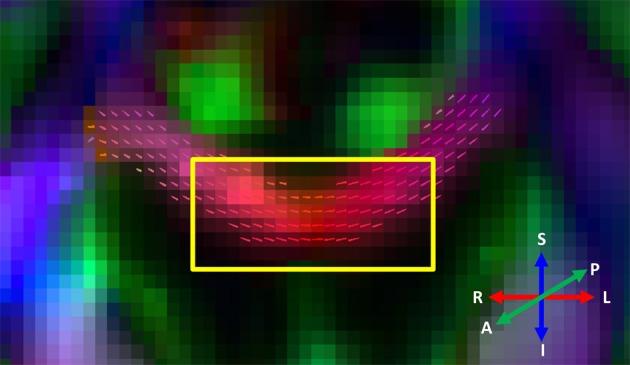
Diffusion-weighted magnetic resonance spectroscopy (DWS) offers unique access to compartment-specific microstructural information on tissue, and potentially sensitive detection of compartment-specific changes in disease. The specificity of DWS is, however, offset by its relative low sensitivity, intrinsic to all MRS-based methods, and further exacerbated by the signal loss due to the diffusion weighting and long echo times. In this work we first provide an experimental example for the type of compartment-specific information that can be obtained with DWS from a small volume of interest (VOI) in brain white matter. We then propose and discuss a strategy for the analysis of DWS data, which includes the use of models of diffusion in compartments with simple geometries. We conclude with a broader discussion of the potential role of DWS in the characterization of tissue microstructure and the complementarity of DWS with less-specific but more sensitive microstructural tools such as diffusion tensor imaging.
扩散加权磁共振波谱(DWS)提供了一种独特的方法,可以获取组织特定隔室的微观结构信息,并有可能敏感地检测到疾病中特定隔室的变化。然而,DWS 的特异性受到其相对较低的灵敏度的限制,这是所有基于 MRS 的方法所固有的,并且由于扩散加权和长回波时间导致的信号损失而进一步加剧。在这项工作中,我们首先提供了一个实验示例,说明了可以从脑白质小体积感兴趣区(VOI)中获得的 DWS 特定隔室信息的类型。然后,我们提出并讨论了一种用于 DWS 数据分析的策略,其中包括使用具有简单几何形状的隔室扩散模型。最后,我们更广泛地讨论了 DWS 在组织微观结构特征化中的潜在作用,以及 DWS 与扩散张量成像等特异性较低但更敏感的微观结构工具的互补性。




 Zotero 插件