Department of Preventive Medicine and Public Health, University of Kansas Medical Center, 3901 Rainbow Boulevard, Kansas City, KS 66160, USA.
Subst Abuse Treat Prev Policy. 2013 Mar 15;8:13. doi: 10.1186/1747-597X-8-13.
Quitting smoking improves health and drug use outcomes among people in treatment for substance abuse. The twofold purpose of this study is to describe tobacco treatment provision across a representative sample of U.S. facilities and to use these data to develop the brief Index of Tobacco Treatment Quality (ITTQ).
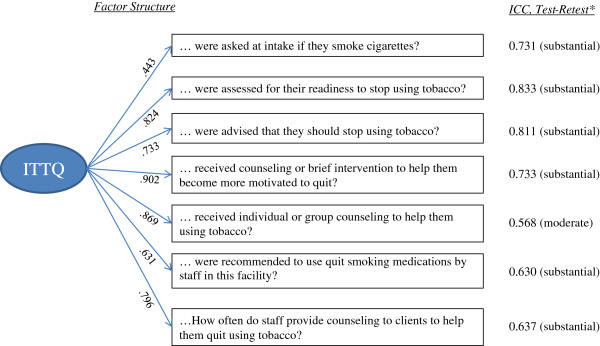
We constructed survey items based on current tobacco treatment guidelines, existing surveys, expert input, and qualitative research. We administered the survey to a stratified sample of 405 facility administrators selected from all 3,800 U.S. adult outpatient facilities listed in the SAMHSA Inventory of Substance Abuse Treatment Services. We constructed the ITTQ with a subset of 7 items that have the strongest clinical evidence for smoking cessation.
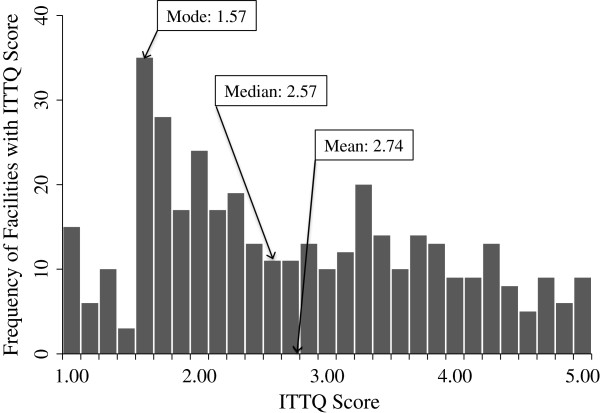
Most facilities (87.7%) reported that a majority of their clients were asked if they smoke cigarettes. Nearly half of facilities (48.6%) reported that a majority of their smoking clients were advised to quit. Fewer (23.3%) reported that a majority of their smoking clients received tobacco treatment counseling and even fewer facilities (18.3%) reported a majority of their smoking clients were advised to use quit smoking medications. The median facility ITTQ score was 2.57 (on a scale of 1-5) and the ITTQ displayed good internal consistency (Cronbach's alpha = .844). Moreover, the ITTQ had substantial test-retest reliability (.856), and ordinal confirmatory factor analysis found that our one-factor model for ITTQ fit the data very well with a CFI of 0.997 and an RMSEA of 0.042.
The ITTQ is a brief and reliable tool for measuring tobacco treatment quality in substance abuse treatment facilities. Given the clear-cut room for improvement in tobacco treatment, the ITTQ could be an important tool for quality improvement by identifying service levels, facilitating goal setting, and measuring change.
戒烟可改善接受药物滥用治疗人群的健康和药物使用效果。本研究有两个目的,一是描述具有代表性的美国治疗机构中的烟草治疗服务提供情况,二是利用这些数据开发简短的烟草治疗质量指数(ITTQ)。
我们根据当前的烟草治疗指南、现有调查、专家意见和定性研究制定了调查项目。我们对从 SAMHSA 物质滥用治疗服务清单中列出的所有 3800 家美国成人门诊治疗机构中抽取的 405 家机构的行政管理人员进行了分层抽样调查。我们用与戒烟最相关的 7 项内容组成 ITTQ 的子集。
大多数机构(87.7%)报告说,他们询问了大多数就诊者是否吸烟。近一半的机构(48.6%)报告说,他们建议大多数吸烟就诊者戒烟。更少的机构(23.3%)报告说,他们为大多数吸烟就诊者提供了烟草治疗咨询,更少的机构(18.3%)报告说,他们建议大多数吸烟就诊者使用戒烟药物。机构的 ITTQ 中位数得分为 2.57(满分 5 分),ITTQ 具有良好的内部一致性(Cronbach's alpha=0.844)。此外,ITTQ 的重测信度较高(0.856),有序验证性因子分析表明,我们的 ITTQ 单因子模型非常适合数据,拟合优度指数为 0.997,折半信度为 0.856。
ITTQ 是测量物质滥用治疗机构中烟草治疗质量的一种简短可靠的工具。鉴于在烟草治疗方面有明显的改进空间,ITTQ 可以通过确定服务水平、促进目标设定和衡量变化来成为质量改进的重要工具。