Department of Haematology, Zhongshan Hospital of Xiamen University, Xiamen, Fujian 361004, China.
Cancer Cell Int. 2013 Mar 13;13(1):25. doi: 10.1186/1475-2867-13-25.
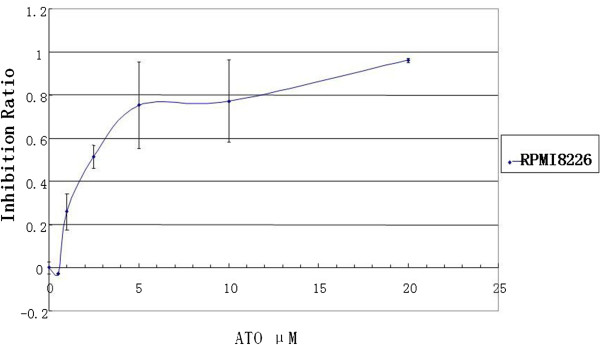
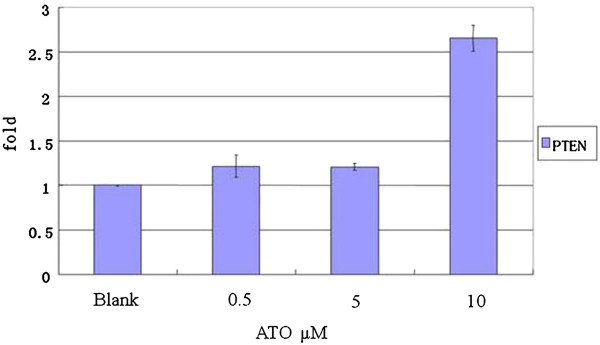
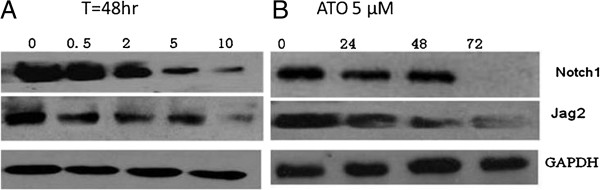
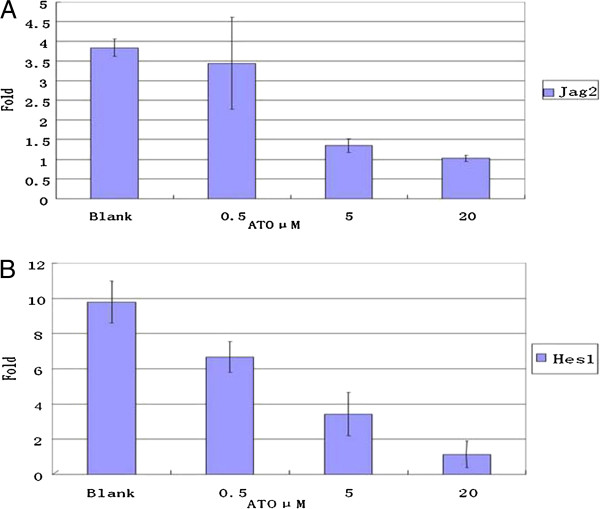
Arsenic Trioxide (ATO) has shown remarkable efficacy for the treatment of multiple myeloma (MM). However, the mechanism by which ATO exerts its inhibitory effect on the proliferation of myeloma cells remains to be clarified. We study the inhibitory effect of ATO at various concentrations on the proliferation of the myeloma cell line RPMI 8226 and discussed the molecular mechanism of ATO on myeloma cell line. Our results proved that ATO had a significant dose-dependent and time-dependent inhibitory effect on the expressions of the Notch receptor (Notch1) and Notch ligand (Jag2). Data from the real-time PCR assay showed that the mRNA expression levels of the Jag2 gene and its downstream gene Hes1 were both significantly down-regulated after the myeloma cells were treated with ATO while the expression of the tumor suppressor gene PTEN was up-regulated. These results elucidated the molecular mechanism underlying the ATO mediated inhibition of myeloma cell proliferation. This is the first report on the anti-myeloma activity in myeloma cells through inhibition of the Notch signaling pathway.
三氧化二砷(ATO)在治疗多发性骨髓瘤(MM)方面显示出显著的疗效。然而,ATO 抑制骨髓瘤细胞增殖的机制仍需阐明。我们研究了 ATO 在不同浓度下对骨髓瘤细胞系 RPMI 8226 增殖的抑制作用,并探讨了 ATO 对骨髓瘤细胞系的分子机制。我们的结果证明,ATO 对 Notch 受体(Notch1)和 Notch 配体(Jag2)的表达具有显著的剂量依赖性和时间依赖性抑制作用。实时 PCR 检测结果显示,ATO 处理骨髓瘤细胞后,Jag2 基因及其下游基因 Hes1 的 mRNA 表达水平均明显下调,而抑癌基因 PTEN 的表达上调。这些结果阐明了 ATO 介导的抑制骨髓瘤细胞增殖的分子机制。这是首例通过抑制 Notch 信号通路报道的 ATO 在骨髓瘤细胞中的抗骨髓瘤活性。