Discipline of Exercise and Sport Science, Faculty of Health Science, The University of Sydney, Sydney, NSW, 2006, Australia.
J Foot Ankle Res. 2013 Mar 5;6(1):8. doi: 10.1186/1757-1146-6-8.
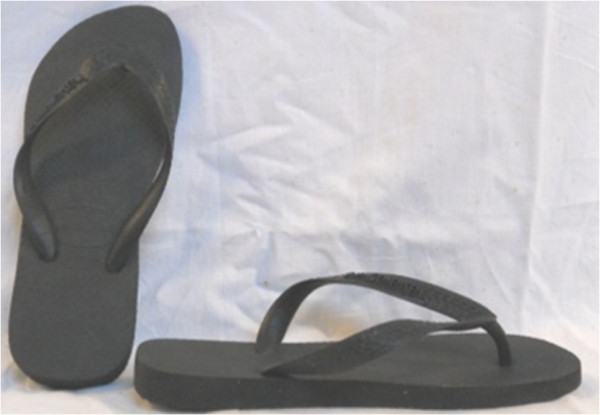
Thong style flip-flops are a popular form of footwear for children. Health professionals relate the wearing of thongs to foot pathology and deformity despite the lack of quantitative evidence to support or refute the benefits or disadvantages of children wearing thongs. The purpose of this study was to compare the effect of thong footwear on children's barefoot three dimensional foot kinematics during walking and jogging.
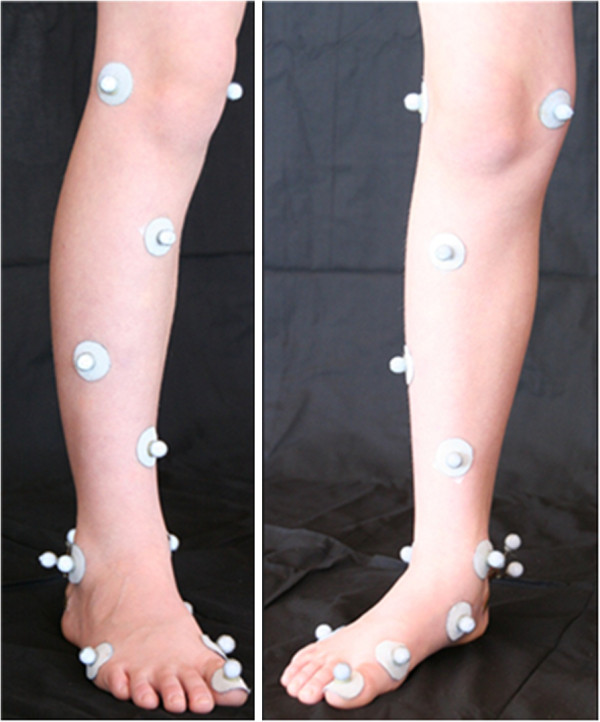
Thirteen healthy children (age 10.3 ± 1.6 SD years) were recruited from the metropolitan area of Sydney Australia following a national press release. Kinematic data were recorded at 200 Hz using a 14 camera motion analysis system (Cortex, Motion Analysis Corporation, Santa Rosa, USA) and simultaneous ground reaction force were measured using a force platform (Model 9281B, Kistler, Winterthur, Switzerland). A three-segment foot model was used to describe three dimensional ankle, midfoot and one dimensional hallux kinematics during the stance sub-phases of contact, midstance and propulsion.
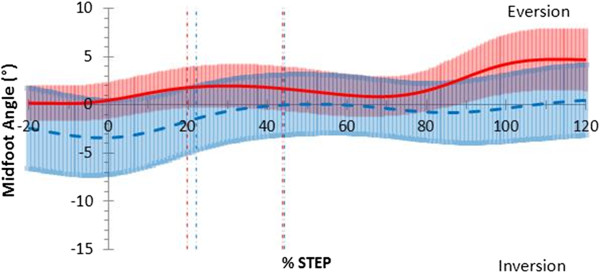
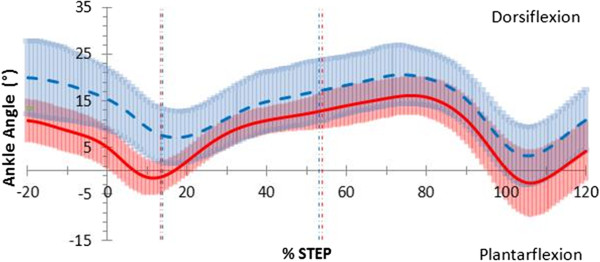
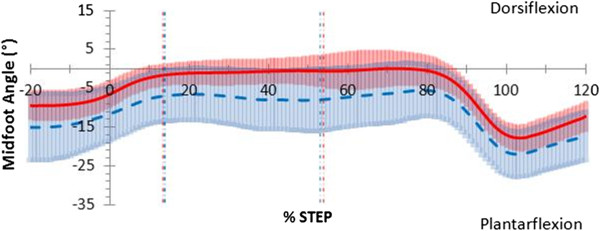
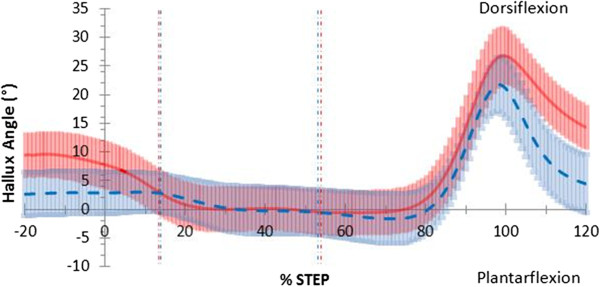
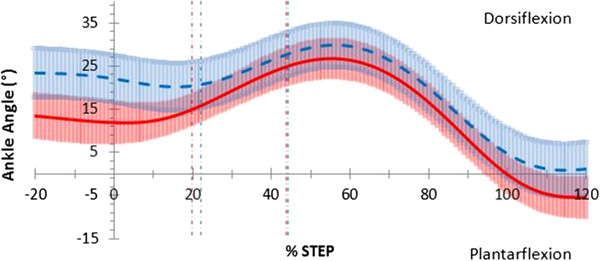
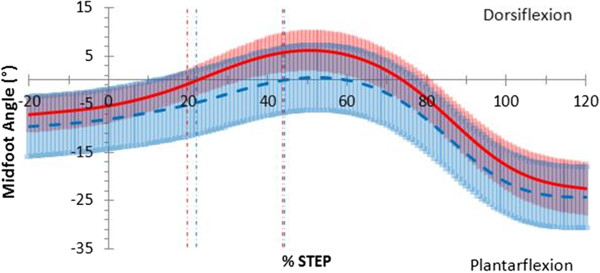
Thongs resulted in increased ankle dorsiflexion during contact (by 10.9°, p; = 0.005 walk and by 8.1°, p; = 0.005 jog); increased midfoot plantarflexion during midstance (by 5.0°, p; = 0.037 jog) and propulsion (by 6.7°, p; = 0.044 walk and by 5.4°, p;= 0.020 jog); increased midfoot inversion during contact (by 3.8°, p;= 0.042 jog) and reduced hallux dorsiflexion during walking 10% prior to heel strike (by 6.5°, p; = 0.005) at heel strike (by 4.9°, p; = 0.031) and 10% post toe-off (by 10.7°, p; = 0.001).
Ankle dorsiflexion during the contact phase of walking and jogging, combined with reduced hallux dorsiflexion during walking, suggests a mechanism to retain the thong during weight acceptance. Greater midfoot plantarflexion throughout midstance while walking and throughout midstance and propulsion while jogging may indicate a gripping action to sustain the thong during stance. While these compensations exist, the overall findings suggest that foot motion whilst wearing thongs may be more replicable of barefoot motion than originally thought.
丁字裤风格的夹趾拖鞋是儿童流行的一种鞋类。尽管没有定量证据支持或反驳儿童穿丁字裤的好处或坏处,但健康专家将穿丁字裤与足部病理和畸形联系起来。本研究的目的是比较丁字鞋对儿童行走和慢跑时赤脚三维足部运动学的影响。
从澳大利亚悉尼大都市区招募了 13 名健康儿童(年龄 10.3 ± 1.6 岁,标准差),这是在全国新闻发布会后进行的。使用 14 个摄像头运动分析系统(Cortex,Motion Analysis Corporation,Santa Rosa,USA)以 200 Hz 的频率记录运动学数据,并使用力台(Model 9281B,Kistler,Winterthur,Switzerland)同时测量地面反作用力。使用三关节足模型描述接触、中间和推进阶段的三个维度的踝关节、中足和一维度的大脚趾运动学。
丁字裤在接触时使踝关节背屈增加(行走时增加 10.9°,p = 0.005,慢跑时增加 8.1°,p = 0.005);在中间阶段(慢跑时增加 5.0°,p = 0.037)和推进阶段(行走时增加 6.7°,p = 0.044,慢跑时增加 5.4°,p = 0.020)使中足跖屈增加;在接触时使中足内翻增加(慢跑时增加 3.8°,p = 0.042),行走时在足跟着地前 10%使大脚趾背屈减少(行走时减少 6.5°,p = 0.005),在足跟着地时(减少 4.9°,p = 0.031)和足尖离地前 10%时(减少 10.7°,p = 0.001)。
行走和慢跑时接触阶段的踝关节背屈,以及行走时大脚趾背屈减少,提示在承重时保持丁字裤的机制。行走时整个中间阶段和慢跑时整个中间阶段和推进阶段中足跖屈增加,可能表明在站立时保持丁字裤的抓地力。虽然存在这些代偿,但总体发现表明,穿丁字裤时的足部运动可能比最初想象的更能复制赤脚运动。