Zhibing Qiu, Xin Chen, Ming Xu, Lele Liu, YingShuo Jiang, LiMing Wang
Department of Cardiothoracic and vascular Surgery, Nanjing First Hospital, Nanjing Heart Institute, Nanjing Medical University, 68 Changle Rd, Nanjing, 210006, China.
J Cardiothorac Surg. 2013 Mar 8;8:42. doi: 10.1186/1749-8090-8-42.
There is controversy regarding the choice of prosthetic valves in patients with cardiac valve disease and dialysis-dependent patients. This review assesses a 12-year experience and outcomes after valve replacement in patients on chronic preoperative renal dialysis, comparing survival and valve-related outcomes following valve replacement with bioprostheses versus mechanical prostheses in this population in china.
From January 1999 and October 2011, 73 consecutive dialysis patients underwent cardiac valve replacement. The patients were divided into two groups: (Group B) bioprosthesis valves were implanted in 38 (52.1%) patients and (Group M) mechanical valves were implanted in 35 (47.9%) patients. Outcome measures included perioperative data, hospital mortality, major postoperative complications, follow-up outcomes, valve related morbidity and late survival.
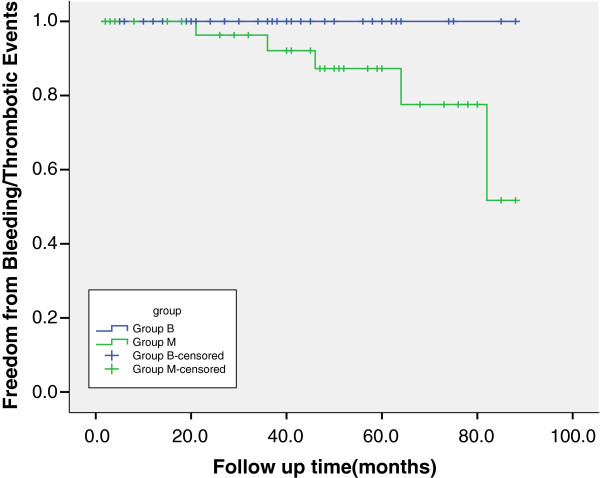
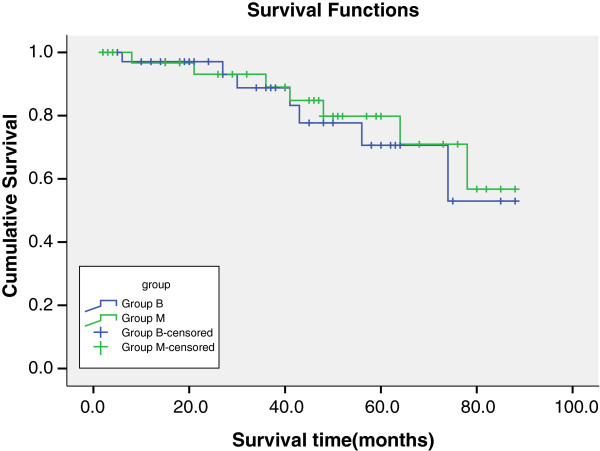
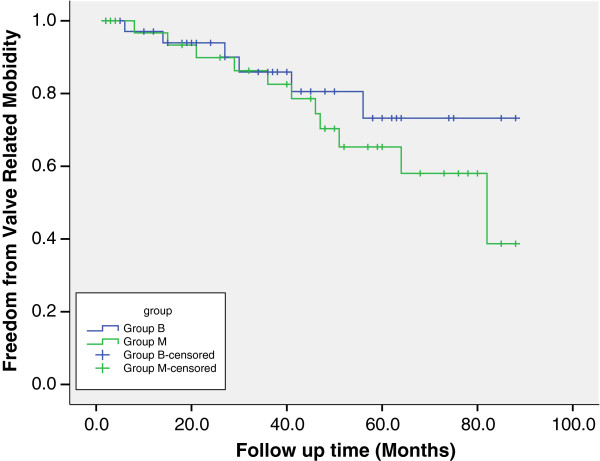
There were no significant differences in terms of patient characteristics in the 2 groups. Thirty-three were isolated aortic valve replacements (45.2%); 28 were isolated mitral valve replacements (38.4%); 10 were combined aortic and mitral replacements (13.7%); 2 were combined tricuspid and mitral replacements (2.7%). The overall hospital mortality was 5.5% (n = 4) and was not different between Group B (5.3%) and Group M (5.7%). Low ejection fraction was the only independent predictors of hospital mortality. There was no significant difference between the groups in the overall rate of complications. The overall mean follow-up was 47 ± 23 months. According to the Kaplan-Meier analysis, late mortality, perivalvular leak and freedom from reoperation were similar in patients with mechanical and bioprosthesis valves. The bioprosthesis valve group had significantly higher freedom from thromboembelism-bleeding events (100% versus 77.6 ± 11.0%, p = 0.012), and valve-related morbidity (73.2 ± 10.1% versus 58.1 ± 10.9%, p = 0.035) in 5 years. Kaplan-Meier survival estimates at 1, 3, and 5 years were 0.971, 0.832, and 0.530 in group B, and 0.967, 0.848, and 0.568 in group M.
There is no significant difference in the perioperative morbidity and mortality, late survival of dialysis patients after cardiac valve replacement with bioprostheses versus mechanical valves. In spite of the limited sample size analyzed, its outcome and consistency to several previous reports supports a conclusion that bioprostheses rather than mechanical ones could be a favorable choice for valve replacement needs of renal failure patients.
对于心脏瓣膜病患者及依赖透析的患者而言,人工瓣膜的选择存在争议。本综述评估了术前长期接受肾透析的患者瓣膜置换术后12年的经验及结果,比较了中国该人群中生物瓣膜与机械瓣膜置换术后的生存率及瓣膜相关结局。
1999年1月至2011年10月,73例连续性透析患者接受了心脏瓣膜置换术。患者被分为两组:(B组)38例(52.1%)患者植入生物瓣膜,(M组)35例(47.9%)患者植入机械瓣膜。观察指标包括围手术期数据、医院死亡率、术后主要并发症、随访结局、瓣膜相关发病率及远期生存率。
两组患者的特征无显著差异。单纯主动脉瓣置换术33例(45.2%);单纯二尖瓣置换术28例(38.4%);主动脉瓣与二尖瓣联合置换术10例(13.7%);三尖瓣与二尖瓣联合置换术2例(2.7%)。总体医院死亡率为5.5%(n = 4),B组(5.3%)与M组(5.7%)之间无差异。低射血分数是医院死亡率的唯一独立预测因素。两组总体并发症发生率无显著差异。总体平均随访时间为47±23个月。根据Kaplan-Meier分析,机械瓣膜与生物瓣膜置换患者的远期死亡率、瓣周漏及再次手术率相似。生物瓣膜组在5年内血栓栓塞-出血事件发生率显著更低(100%对77.6±11.0%,p = 0.012),瓣膜相关发病率也更低(73.2±10.1%对58.1±10.9%,p = 0.035)。B组1年、3年和5年的Kaplan-Meier生存率估计值分别为0.971、0.832和0.530,M组分别为0.967、0.848和0.