Division of Hematology/Oncology, Children's Hospital Los Angeles, Los Angeles, CA 90027, USA.
J Neurooncol. 2013 Jun;113(2):285-91. doi: 10.1007/s11060-013-1111-9. Epub 2013 Mar 19.
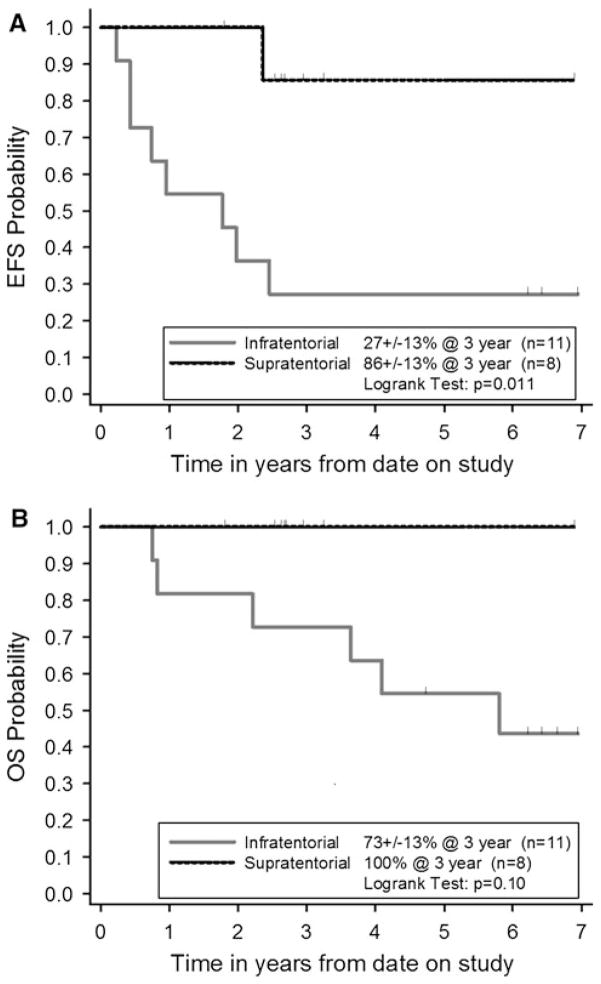
This study investigates the outcome of children <10 years old with newly-diagnosed ependymoma treated on the prospective multinational "Head Start" III clinical trial. Between April 2004 and July 2009, 19 children with newly-diagnosed ependymoma were enrolled. All children were to receive five induction chemotherapy cycles followed by one consolidation cycle of myelo-ablative chemotherapy and autologous hematopoietic cell rescue. Children between 6 and 10 years of age or with residual tumor prior to consolidation were to receive irradiation thereafter. Median age of 19 children (8 female) was 20 months at diagnosis. Median follow up was 44 months. The primary site was infratentorial in 11 and supratentorial in 8 patients. Gross total resection was achieved in 10 patients. After induction chemotherapy, all three supratentorial ependymoma patients with residual disease achieved a complete response (CR), while only one of six infratentorial patients with residual disease achieved CR. Three infratentorial patients developed progressive disease during induction chemotherapy. All four infratentorial patients with residual disease who underwent autologous hematopoietic cell transplant, failed to achieve CR. Four patients received focal irradiation following chemotherapy. The 3-year event free survival (EFS) and overall survival (OS) for supratentorial ependymoma were 86 ± 13 % and 100 % respectively. The 3-year EFS and OS for infratentorial ependymoma were 27 ± 13 % and 73 ± 13 % respectively. The role of intensive induction and consolidation chemotherapy in deferring irradiation should be investigated further in children with supratentorial ependymoma with residual disease following surgery. This approach appears ineffective in children with infratentorial ependymoma in the absence of irradiation.
本研究调查了在 prospective 多国“Head Start”III 临床试验中接受治疗的新诊断为室管膜瘤的<10 岁儿童的结果。在 2004 年 4 月至 2009 年 7 月期间,共纳入 19 名新诊断为室管膜瘤的儿童。所有儿童均接受五个诱导化疗周期,然后进行一个巩固周期的骨髓清除化疗和自体造血细胞挽救。6 至 10 岁的儿童或巩固前有残留肿瘤的儿童此后接受放疗。19 名儿童(8 名女性)的中位年龄为诊断时 20 个月。中位随访时间为 44 个月。原发部位位于幕下 11 例,幕上 8 例。10 例患者实现了大体全切除。在诱导化疗后,所有 3 例幕上室管膜瘤伴残留疾病的患者均达到完全缓解(CR),而 6 例幕下患者中仅 1 例达到 CR。3 例幕下患者在诱导化疗期间发生疾病进展。所有 4 例接受自体造血细胞移植的幕下残留疾病患者均未达到 CR。4 例患者在化疗后接受了局部放疗。幕上室管膜瘤的 3 年无事件生存(EFS)和总生存(OS)分别为 86±13%和 100%。幕下室管膜瘤的 3 年 EFS 和 OS 分别为 27±13%和 73±13%。对于手术后残留疾病的幕上室管膜瘤儿童,应进一步研究强化诱导和巩固化疗在延迟放疗中的作用。在没有放疗的情况下,这种方法对幕下室管膜瘤患儿无效。