1. Fatemeh Zahra Infertility and Health Reproductive Research Center, Babol University of Medical Sciences, Babol, Iran.
Cell J. 2011 Summer;13(2):73-8. Epub 2011 Aug 24.
This study evaluated in vitro maturation (IVM) of oocytes in the germinal vesicle (GV) stage in stimulated intracytoplasmic sperm injection (ICSI) cycles.
A total of 26 women, aged 18 -37 years, who were candidates for ICSI at the Fatemeh Zahra Infertility and Health Reproductive Research Center in 2007 were recruited for this study. We used the standard long protocol for ovarian stimulation. Follicles >11 mm were punctured 36-38 hours after administration of 10000 IU human chorionic gonadotrophin (hCG). Immature oocytes were cultured for 24-30 hours. Oocytes that liberated polar bodies were injected by sperm prepared within the previous day. IVM fertilized oocytes were cultured an additional 24-30 hours for cleavage. The rates of maturation, fertilization and cleavage in IVM oocytes were recorded and statistically compared to in vivo matured sibling oocytes.
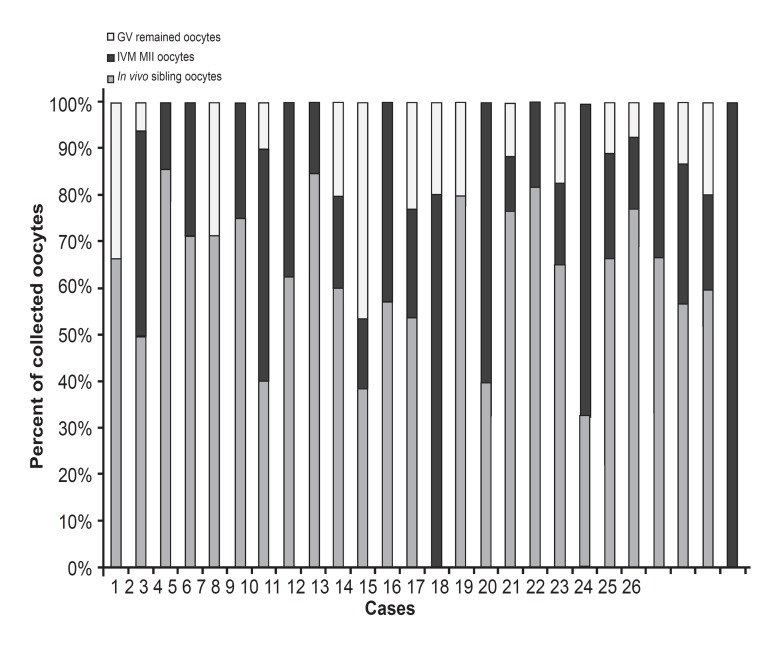
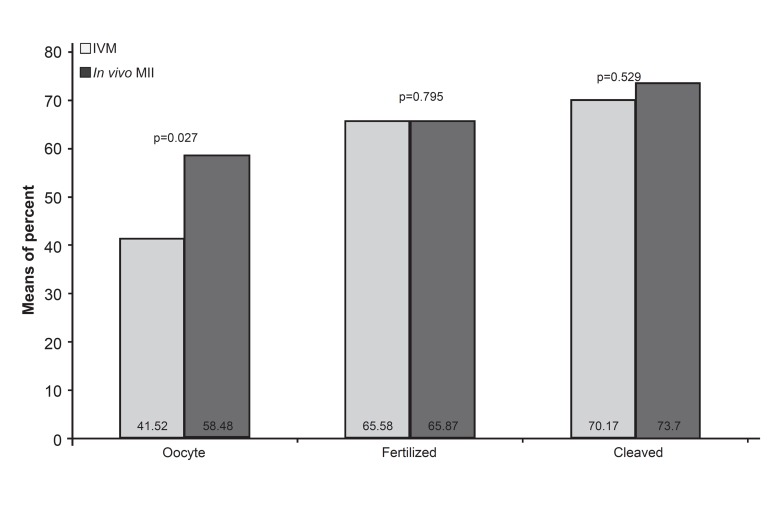
There were 279 collected oocytes (mean±SD: 10.73 ± 6.2), of which 4.08±2.79 were subjected to IVM. An average of 2.73 ± 2.15 GV oocytes (70%) developed to metaphase II (MII). Although the maturation rate significantly differed between the IVM and in vivo MII sibling oocyte groups (p=0.027), the numbers of fertilized oocytes (p=0.795) and cleaved embryos (p=0.529) were not significantly high in the in vivo group. Transfer of IVM embryos occurred in only three cases with one pregnancy that resulted in the delivery of a healthy baby.
This study shows that culturing GV oocytes can produce acceptable numbers of four-cell embryos on the transfer day. The developmental competence of oocytes is not significantly different between early stage IVM and in vivo sibling embryos.
本研究评估了在刺激胞质内精子注射(ICSI)周期中处于生发泡(GV)阶段的卵母细胞的体外成熟(IVM)。
2007 年,我们招募了 26 名年龄在 18-37 岁之间的因 ICSI 而候选的女性,她们在 Fatemeh Zahra 不孕与健康生殖研究中心接受治疗。我们使用标准的长方案进行卵巢刺激。在给予 10000IU 人绒毛膜促性腺激素(hCG)后 36-38 小时,穿刺大于 11mm 的卵泡。不成熟的卵母细胞培养 24-30 小时。在前一天准备好的精子使释放极体的卵母细胞受精。IVM 受精的卵母细胞再培养 24-30 小时进行分裂。记录 IVM 卵母细胞的成熟、受精和分裂率,并与体内成熟的同源卵母细胞进行统计学比较。
共采集 279 个卵母细胞(均值±标准差:10.73±6.2),其中 4.08±2.79 个进行 IVM。平均有 2.73±2.15 个 GV 卵母细胞(70%)发育至中期 II(MII)。尽管 IVM 和体内 MII 同源卵母细胞组的成熟率有显著差异(p=0.027),但体内组的受精卵母细胞数量(p=0.795)和分裂胚胎数量(p=0.529)并没有显著增加。仅在 3 例中进行了 IVM 胚胎移植,其中 1 例妊娠并分娩了一个健康婴儿。
本研究表明,培养 GV 卵母细胞可以在移植日产生可接受数量的四细胞胚胎。早期 IVM 和体内同源胚胎卵母细胞的发育能力没有显著差异。