Department of Physical Therapy, University of Florida, Gainesville, FL, USA.
J Orthop Sports Phys Ther. 2013;43(7):457-65. doi: 10.2519/jospt.2013.4492. Epub 2013 Mar 18.
Retrospective cohort.
The objectives of this study were (1) to examine patients' general expectations for treatment by physical therapists and specific expectations for common interventions in patients with neck pain, and (2) to assess the extent to which the patients' general and specific expectations for treatment, particularly spinal manipulation, affect clinical outcomes.
Patient expectations can have a profound influence on the magnitude of treatment outcome across a broad variety of patient conditions.
We performed a secondary analysis of data from a clinical trial of interventions for neck pain. Prior to beginning treatment for neck pain, 140 patients were asked about their general expectations of benefit as well as their specific expectations for individual interventions. Next, we examined how these expectations related to the patients' ratings of the success of treatment at 1 and 6 months after treatment.
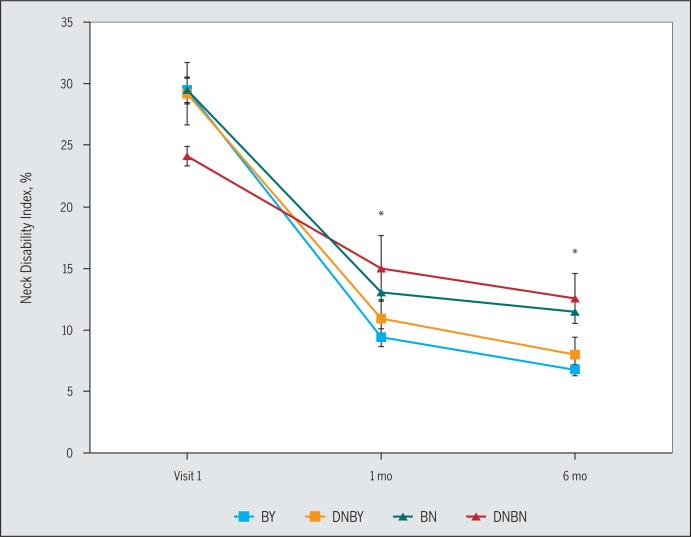
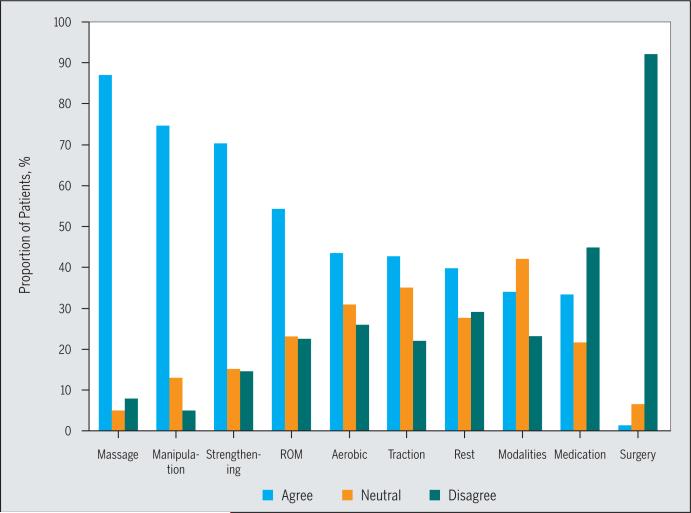
Patients had positive expectations for treatment by a physical therapist, with more than 80% of patients expecting moderate relief of symptoms, prevention of disability, the ability to do more activity, and to sleep better. The manual therapy interventions of massage (87%) and manipulation (75%) had the highest proportion of patients who expected these interventions to significantly improve neck pain. These were followed by strengthening (70%) and range-of-motion (54%) exercises. Very few patients thought surgery would improve their neck pain (less than 1%). At 1 month, patients who were unsure of experiencing complete pain relief had lower odds of reporting a successful outcome than patients expecting complete relief (odds ratio [OR] = 0.33; 95% confidence interval [CI]: 0.11, 0.99). Believing that manipulation would help and not receiving manipulation lowered the odds of success (OR = 0.16; 95% CI: 0.04, 0.72) compared to believing manipulation would help and receiving manipulation. Six months after treatment, having unsure expectations for complete pain relief lowered the odds of success (OR = 0.19; 95% CI: 0.05, 0.7), whereas definitely expecting to do more exercise increased the odds of success (OR = 11.4; 95% CI: 1.7, 74.7). Regarding self-reported disability assessed with the Neck Disability Index, patients who believed manipulation would help and received manipulation reported less disability than those who did not believe manipulation would help and both received manipulation (mean difference, -3.8; 95% CI: -5.9, -1.5; P = .006) and did not receive manipulation (mean difference, -5.7; 95% CI: -9.3, -2.1; P = .014). There was also an interaction between time and the expectation for complete relief.
General expectations of benefit have a strong influence on clinical outcomes for patients with neck pain.
Prognosis, level 2b-.

回顾性队列研究。
本研究的目的是:(1)检查患者对物理治疗师治疗的一般期望以及对颈部疼痛患者常见干预措施的具体期望;(2)评估患者对治疗的一般和具体期望,特别是对脊柱手法治疗的期望,对临床结果的影响程度。
患者的期望会对广泛的患者病情的治疗效果产生深远影响。
我们对颈部疼痛干预临床试验的数据进行了二次分析。在开始治疗颈部疼痛之前,140 名患者被问及他们对治疗获益的一般期望以及对个别干预措施的具体期望。接下来,我们研究了这些期望如何与患者在治疗后 1 个月和 6 个月时对治疗成功的评价相关。
患者对物理治疗师的治疗有积极的期望,超过 80%的患者期望症状中度缓解、预防残疾、能够进行更多活动和改善睡眠。按摩(87%)和手法治疗(75%)这两种手动疗法干预措施的患者比例最高,他们期望这些干预措施能显著改善颈部疼痛。接下来是强化锻炼(70%)和关节活动度(54%)锻炼。很少有患者认为手术会改善他们的颈部疼痛(不到 1%)。在 1 个月时,对完全缓解疼痛不确定的患者比期望完全缓解的患者报告治疗成功的可能性要低(比值比[OR] = 0.33;95%置信区间[CI]:0.11,0.99)。相信手法治疗会有帮助而未接受手法治疗会降低治疗成功率(OR = 0.16;95%CI:0.04,0.72),而相信手法治疗会有帮助并接受手法治疗则会提高治疗成功率(OR = 0.19;95%CI:0.05,0.7)。治疗 6 个月后,对完全缓解疼痛的不确定期望会降低治疗成功率(OR = 0.19;95%CI:0.05,0.7),而明确期望进行更多运动则会增加治疗成功率(OR = 11.4;95%CI:1.7,74.7)。关于用颈部残疾指数(NDI)评估的自我报告残疾,相信手法治疗会有帮助并接受了手法治疗的患者比不相信手法治疗会有帮助且都接受了手法治疗(平均差异,-3.8;95%CI:-5.9,-1.5;P =.006)和都没有接受手法治疗(平均差异,-5.7;95%CI:-9.3,-2.1;P =.014)的患者报告的残疾程度更低。对完全缓解的期望与时间之间也存在交互作用。
对颈部疼痛患者的一般获益期望对临床结果有很强的影响。
预后,2b 级。