Department of Multifunctional Materials and Structures Laboratory, National Institute of Materials Physics, 105 Bis Atomistilor, P.O. Box MG 07, 077125 Magurele, Romania.
Biomed Res Int. 2013;2013:916218. doi: 10.1155/2013/916218. Epub 2012 Dec 30.
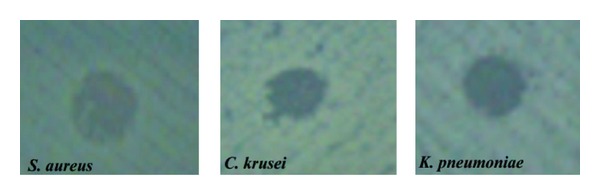
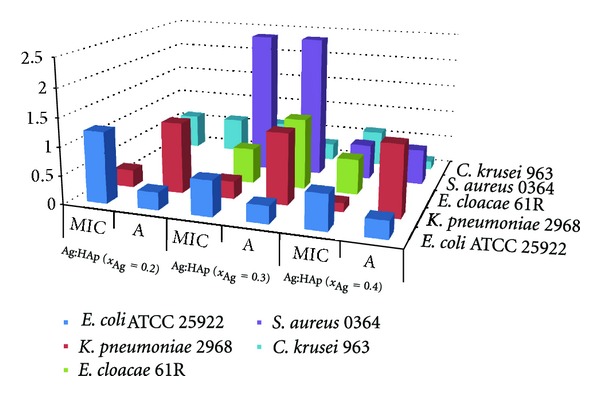
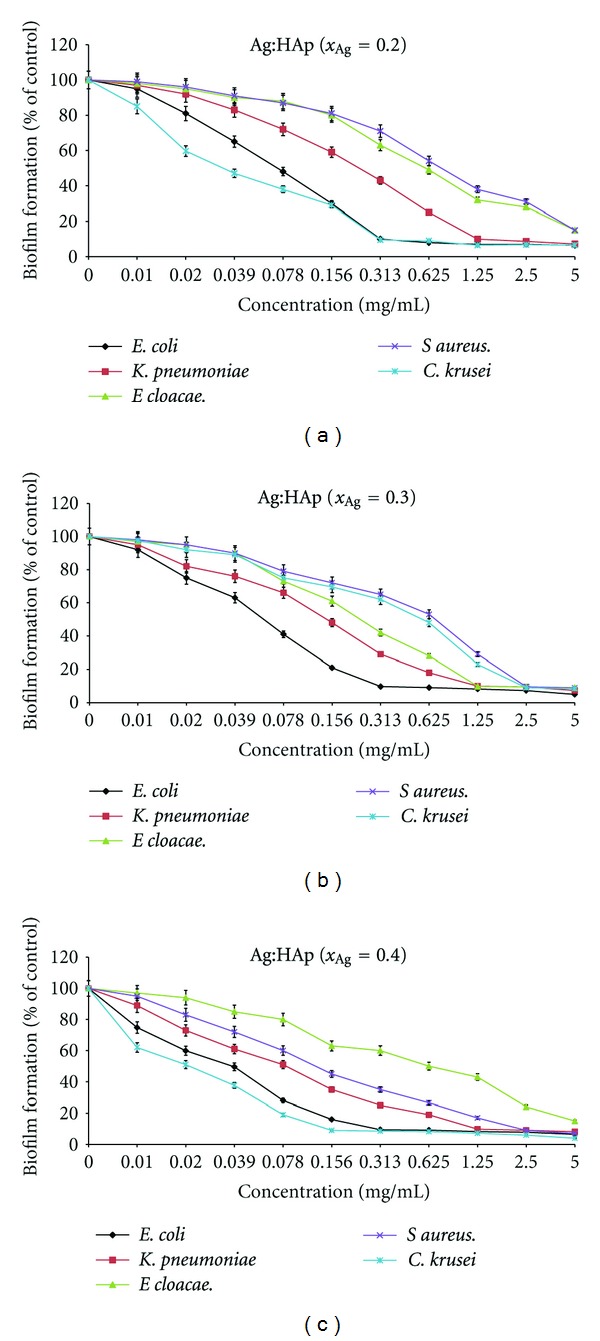
The synthesis of nanosized particles of Ag-doped hydroxyapatite with antibacterial properties is of great interest for the development of new biomedical applications. The aim of this study was the evaluation of Ca(10-x)Ag(x)(PO4)6(OH)2 nanoparticles (Ag:HAp-NPs) for their antibacterial and antifungal activity. Resistance to antimicrobial agents by pathogenic bacteria has emerged in the recent years and became a major health problem. Here, we report a method for synthesizing Ag doped nanocrystalline hydroxyapatite. A silver-doped nanocrystalline hydroxyapatite was synthesized at 100°C in deionised water. Also, in this paper Ag:HAp-NPs are evaluated for their antimicrobial activity against gram-positive and gram-negative bacteria and fungal strains. The specific antimicrobial activity revealed by the qualitative assay is demonstrating that our compounds are interacting differently with the microbial targets, probably due to the differences in the microbial wall structures.
具有抗菌性能的掺银羟基磷灰石纳米粒子的合成对于开发新的生物医学应用具有重要意义。本研究的目的是评估 Ca(10-x)Ag(x)(PO4)6(OH)2 纳米粒子(Ag:HAp-NPs)的抗菌和抗真菌活性。近年来,致病菌对抗菌药物的耐药性已经出现,成为一个主要的健康问题。在这里,我们报告了一种合成掺银纳米晶羟基磷灰石的方法。在去离子水中于 100°C 下合成掺银纳米晶羟基磷灰石。此外,本文还评估了 Ag:HAp-NPs 对革兰氏阳性和革兰氏阴性细菌和真菌菌株的抗菌活性。定性分析显示的特定抗菌活性表明,我们的化合物与微生物靶标相互作用的方式不同,这可能是由于微生物细胞壁结构的差异。