Division of General Internal Medicine, Department of Medicine, Johns Hopkins University School of Medicine, Baltimore, Maryland, USA.
Obesity (Silver Spring). 2013 Oct;21(10):2146-52. doi: 10.1002/oby.20384. Epub 2013 Jun 6.
Physicians' negative attitudes toward patients with obesity are well documented. Whether or how these beliefs may affect patient-physician communication is unknown. To describe the relationship between patient body mass index (BMI) and physician communication behaviors (biomedical, psychosocial/lifestyle, and rapport building) during typical outpatient primary care visits was aimed.
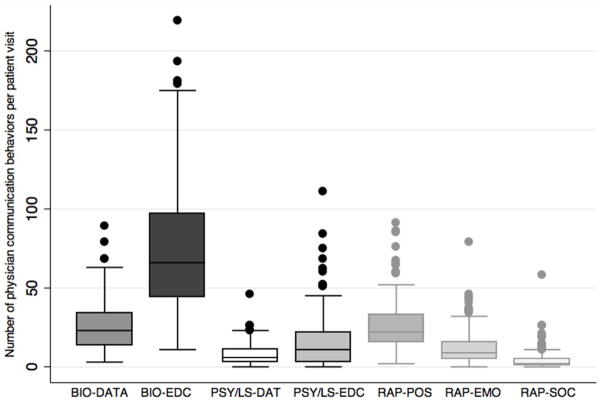
Using audio-recorded outpatient encounters from 39 urban primary care physicians (PCPs) and 208 of their patients, the frequency of communication behaviors using the Roter Interaction Analysis System was examined. The independent variable was measured; patient BMI and dependent variables were communication behaviors by the PCP within the biomedical, psychosocial/lifestyle, and rapport building domains. A cross-sectional analysis using multilevel Poisson regression models to evaluate the association between BMI and physician communication was performed.
PCPs demonstrated less emotional rapport with overweight and obese patients (incidence rate ratio, IRR, 0.65, 95%CI 0.48-0.88, P = 0.01; IRR 0.69, 95%CI 0.58-0.82, P < 0.01, respectively) than for normal weight patients. No differences in PCPs' biomedical or psychosocial/lifestyle communication by patient BMI were found.
Our findings raise the concern that low levels of emotional rapport in primary care visits with overweight and obese patients may weaken the patient-physician relationship, diminish patients' adherence to recommendations, and decrease the effectiveness of behavior change counseling.
医生对肥胖患者的负面态度已有充分记录。这些信念是否以及如何影响医患沟通尚不清楚。本研究旨在描述门诊初级保健就诊过程中患者体重指数(BMI)与医生沟通行为(生物医学、心理社会/生活方式和建立融洽关系)之间的关系。
使用 39 名城市初级保健医生(PCP)和 208 名患者的门诊录音记录,使用 Roter 互动分析系统检查沟通行为的频率。测量自变量(患者 BMI),PCP 的生物医学、心理社会/生活方式和建立融洽关系领域的沟通行为为因变量。使用多级泊松回归模型进行横截面分析,以评估 BMI 与医生沟通之间的关联。
与体重正常的患者相比,PCP 与超重和肥胖患者的情感融洽程度较低(发病率比,IRR,0.65,95%CI 0.48-0.88,P = 0.01;IRR 0.69,95%CI 0.58-0.82,P < 0.01)。未发现患者 BMI 对 PCP 生物医学或心理社会/生活方式沟通的差异。
我们的研究结果表明,超重和肥胖患者在初级保健就诊中情感融洽程度较低可能会削弱医患关系,降低患者对建议的依从性,并降低行为改变咨询的效果。