
重组腺病毒人p53基因治疗恶性胸腔或腹腔积液的疗效
Efficacy of recombinant adenoviral human p53 gene in treatment of malignant pleural or peritoneal effusions.
作者信息
Zhang Xin, Hu Yi, Wang Jinliang, Zhang Sujie, Tao Haitao, Jing Sun, Wu Baishou
机构信息
Department of Oncology, the General Hospital of Chinese PLA, Beijing 100853, China.
出版信息
Zhongguo Fei Ai Za Zhi. 2013 Mar;16(3):153-6. doi: 10.3779/j.issn.1009-3419.2013.03.07.
BACKGROUND AND OBJECTIVE
Once the malignant pleural or peritoneal effusion is developed it is difficult to control. This report presents a new method for controlling the malignant effusions.
METHODS
Forty-eight patients, 29 males and 19 females with an average age of 61.2 years old, who were satisfied with the study inclusion criteria, were recruited in this study. Twenty-seven and 21 patients had a malignant pleural and peritoneal effusion, respectively. After draining most of fluids, these patients received intra-cavity infusion of rAd-p53 once per week for 4 weeks, at dose of 2×10¹² viral particles (VP) diluted into 200 mL of saline solution for pleural effusions, and 4×10¹² VP diluted into 500 mL of saline solution for peritoneal effusions.
RESULTS
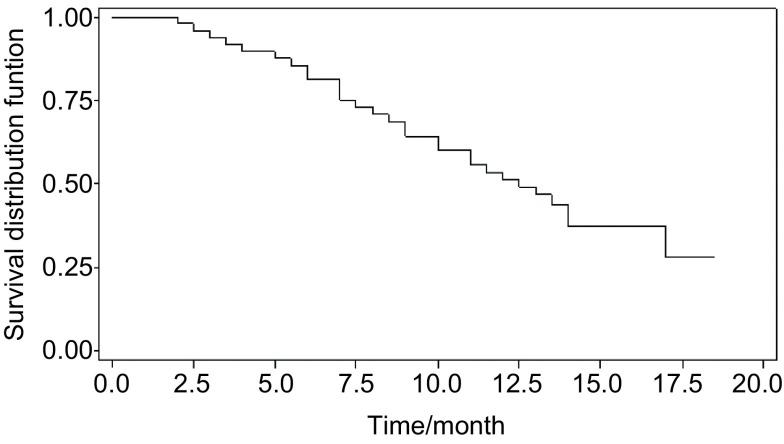
Participants were followed up for a median time of 13.6 month. A total of 11 cases, 7 with pleural effusions and 4 with peritoneal effusions achieved a complete response (CR), and 20 cases (12 pleural effusions and 8 peritoneal effusions) had a partial response (PR). The overall response rate is 64.6%. Patients' quality of life, assessed by using Karnofsky performance scale (KPS) scores, was improved by an average of 26.4. The one-year of overall survival rate was 54.2% with a median survival time of 12.5 months. There were no serious side effects observed except for self-limited fever found in 79.8% of the cases.
CONCLUSIONS
Intra-cavity infusion of rAd-p53 is an effective and safe treatment for the patients with malignant pleural or peritoneal effusions, especially for those patients who can't tolerate the standard treatments.
背景与目的
一旦发生恶性胸腔或腹腔积液,就难以控制。本报告介绍一种控制恶性积液的新方法。
方法
本研究招募了48例患者,其中男性29例,女性19例,平均年龄61.2岁,这些患者均符合研究纳入标准。分别有27例和21例患者患有恶性胸腔积液和腹腔积液。在排出大部分液体后,这些患者每周接受一次瘤内注射重组腺病毒-p53(rAd-p53),共4周,胸腔积液的剂量为2×10¹²病毒颗粒(VP)稀释于200 mL盐溶液中,腹腔积液的剂量为4×10¹² VP稀释于500 mL盐溶液中。
结果
参与者的中位随访时间为13.6个月。共有11例患者,7例胸腔积液和4例腹腔积液达到完全缓解(CR),20例(12例胸腔积液和8例腹腔积液)有部分缓解(PR)。总缓解率为64.6%。使用卡诺夫斯基功能状态量表(KPS)评分评估患者的生活质量,平均提高了26.4。一年总生存率为54.2%,中位生存时间为12.5个月。除79.8%的病例出现自限性发热外,未观察到严重副作用。
结论
瘤内注射rAd-p53是治疗恶性胸腔或腹腔积液患者的一种有效且安全的方法,尤其适用于那些无法耐受标准治疗的患者。
 Zotero 插件