Department of Microbiology, Institute for Water and Wetland Research, Radboud University Nijmegen Nijmegen, Netherlands.
Front Microbiol. 2013 Mar 18;4:60. doi: 10.3389/fmicb.2013.00060. eCollection 2013.
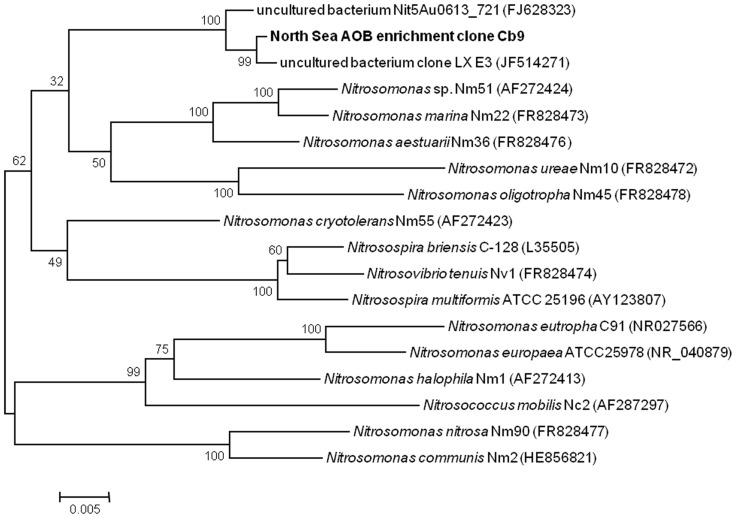
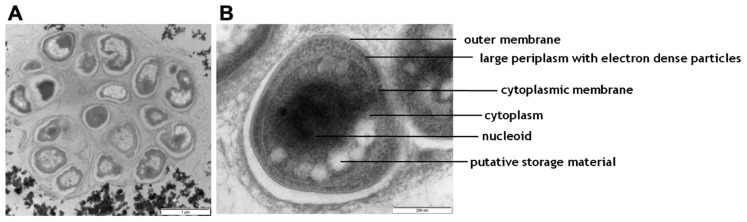
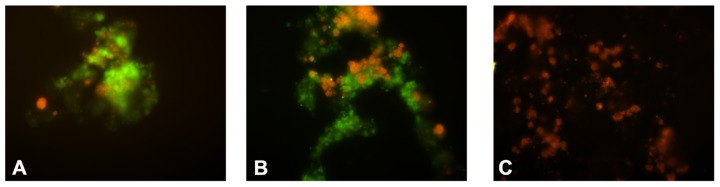
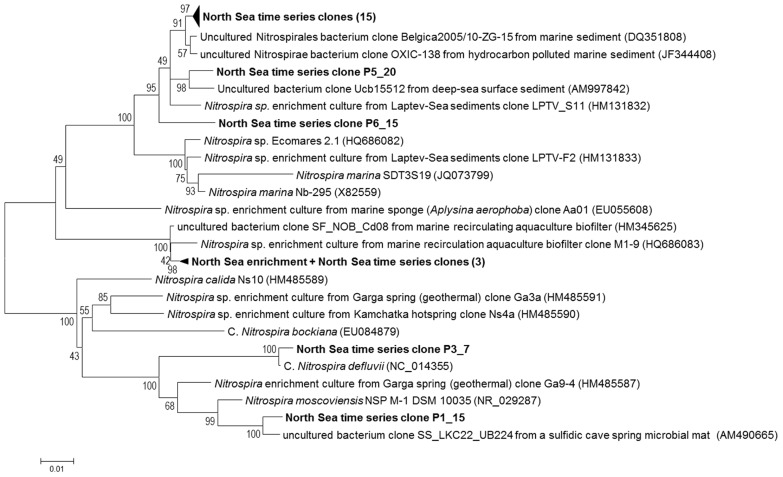
Marine microorganisms are important for the global nitrogen cycle, but marine nitrifiers, especially aerobic nitrite oxidizers, remain largely unexplored. To increase the number of cultured representatives of marine nitrite-oxidizing bacteria (NOB), a bioreactor cultivation approach was adopted to first enrich nitrifiers and ultimately nitrite oxidizers from Dutch coastal North Sea water. With solely ammonia as the substrate an active nitrifying community consisting of novel marine Nitrosomonas aerobic ammonia oxidizers (ammonia-oxidizing bacteria) and Nitrospina and Nitrospira NOB was obtained which converted a maximum of 2 mmol of ammonia per liter per day. Switching the feed of the culture to nitrite as a sole substrate resulted in a Nitrospira NOB dominated community (approximately 80% of the total microbial community based on fluorescence in situ hybridization and metagenomic data) converting a maximum of 3 mmol of nitrite per liter per day. Phylogenetic analyses based on the 16S rRNA gene indicated that the Nitrospira enriched from the North Sea is a novel Nitrospira species with Nitrospira marina as the next taxonomically described relative (94% 16S rRNA sequence identity). Transmission electron microscopy analysis revealed a cell plan typical for Nitrospira species. The cytoplasm contained electron light particles that might represent glycogen storage. A large periplasmic space was present which was filled with electron dense particles. Nitrospira-targeted polymerase chain reaction analyses demonstrated the presence of the enriched Nitrospira species in a time series of North Sea genomic DNA samples. The availability of this new Nitrospira species enrichment culture facilitates further in-depth studies such as determination of physiological constraints, and comparison to other NOB species.
海洋微生物对全球氮循环至关重要,但海洋硝化菌,尤其是需氧亚硝酸盐氧化菌,仍在很大程度上未被探索。为了增加海洋亚硝酸盐氧化菌(NOB)的培养代表数量,采用生物反应器培养方法从荷兰北海沿海海水开始,首先富集硝化菌,最终富集亚硝酸盐氧化菌。仅以氨作为底物,可获得由新型海洋硝化菌(氨氧化菌)和 Nitrospina 和 Nitrospira NOB 组成的活性硝化菌群,该菌群每天每升可转化高达 2mmol 的氨。将培养物的饲料切换为亚硝酸盐作为唯一底物,导致 Nitrospira NOB 占主导地位的群落(基于荧光原位杂交和宏基因组数据,约占总微生物群落的 80%),每天每升可转化高达 3mmol 的亚硝酸盐。基于 16S rRNA 基因的系统发育分析表明,从北海中富集的 Nitrospira 是一种新型的 Nitrospira 物种,其下一个分类描述的相对物是 Nitrospira marina(94%的 16S rRNA 序列同一性)。透射电子显微镜分析显示了 Nitrospira 物种典型的细胞计划。细胞质中含有可能代表糖原储存的电子轻颗粒。存在一个大的周质空间,其中充满了电子致密颗粒。针对 Nitrospira 的聚合酶链反应分析表明,在北海基因组 DNA 样本的时间序列中存在富集的 Nitrospira 物种。这种新型 Nitrospira 物种富集培养物的可用性便于进一步进行深入研究,例如确定生理限制,并与其他 NOB 物种进行比较。